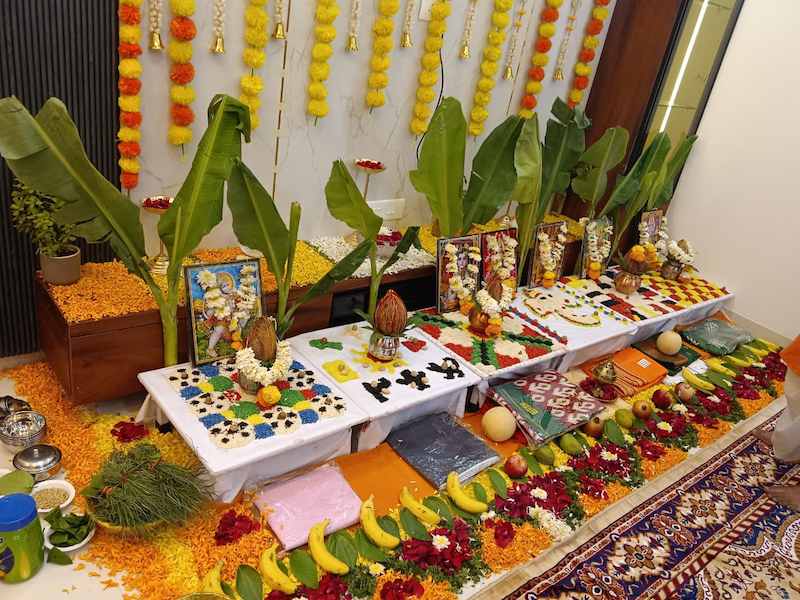
Vastu Shanti Puja in Pune | 6 Mandals, 2 Pandits | ₹15000
TL;DR: Pitradev arranges the complete Vastu Shanti Puja at your home in Pune with 2 experienced pandit ji, 6 puja mandals, and 4 to 5 hours of detailed vidhi at ₹15,000. The ceremony includes Shodashmatrika Mandal, Ganesh Pujan Mandal, Navgrah Mandal, Vastu Mandal, Sarvatobhadra Mandal, and Kalash/Vishnu Mandal — each prepared on the floor with coloured rice powder and worshipped with specific mantras. Both Marathi Guruji and North Indian pandit ji available. All samagri included. No hidden charges.
Your New Home Deserves More Than a Basic Puja
Buying a home in Pune — whether it is a 2 BHK in Hinjewadi or a 3 BHK in Baner — is the single biggest investment most families make in their lifetime. Years of savings, months of loan paperwork, and countless decisions go into that one moment when you finally get the keys.
The Vastu Shanti Puja before entering this home is not a formality. It is the ceremony that removes every Vastu Dosh from the construction, purifies the space of any negative energy accumulated during the building process, invites the blessings of Vastu Purush (the deity of directions) and the Pancha Bhootas (five elements of nature), and prepares the home for a life of peace, prosperity, and harmony.
A basic puja with 1 pandit and 2 mandals takes 1 to 2 hours and covers the minimum. The ₹15,000 Vastu Shanti Puja that Pitradev offers is fundamentally different — it is a comprehensive, premium ceremony with 2 pandit ji, 6 mandals, and 4 to 5 hours of detailed vidhi that leaves nothing undone.
For families who believe that the beginning defines the journey, this is the beginning your home deserves.
What Makes the 6-Mandal Vastu Shanti Puja Premium
The heart of any Vastu Shanti Puja is the mandals — sacred geometric diagrams drawn on the floor with coloured rice powder, each representing a specific divine force. While a basic puja uses 2 mandals, the complete Vastu Shanti Puja uses 6 mandals, each worshipped with its own set of mantras, offerings, and invocations.
Here is what each mandal represents and why it matters:
1. Shodashmatrika Mandal
This mandal invokes the 16 divine mothers (Shodash Matrikas) who are the protective feminine forces of the universe. These include Gauri, Padma, Shachi, Medha, Savitri, Vijaya, Jaya, Devasena, Swadha, Swaha, Mataro, Lokamataro, Dhrithi, Pushti, Tushti, and Kuladevi. Worshipping them at the time of Grihapravesh ensures that the home receives the protective energy of all 16 divine mothers, safeguarding the family from every direction.
2. Ganesh Pujan Mandal
Lord Ganesha is the Vighnaharta — the remover of obstacles. No auspicious ceremony in the Hindu tradition begins without his invocation. The Ganesh Pujan Mandal is drawn and worshipped first, seeking his blessings for the successful completion of the entire Vastu Shanti Puja and for the obstacle-free entry into the new home.
3. Navgrah Mandal
The Navgrah (nine planets) mandal invokes the blessings of Surya, Chandra, Mangal, Budh, Brihaspati, Shukra, Shani, Rahu, and Ketu. Each planet governs specific aspects of life — health, wealth, relationships, career, and stability. Worshipping the Navgrah at the time of Grihapravesh harmonises their influence on the home and its inhabitants, ensuring that no planetary affliction causes disturbance in the new space.
4. Vastu Mandal
This is the central mandal of the entire ceremony. Vastu Purush — the deity who resides in every structure — is invoked and worshipped through this mandal. The mandal maps the 45 energy zones of the home (as per Vastu Shastra), and the worship ensures that Vastu Purush is pleased and the energy flow in the home is aligned for prosperity and well-being. Any Vastu Dosh arising from the construction, the direction of rooms, or the placement of the kitchen and bathrooms is addressed through this mandal.
5. Sarvatobhadra Mandal
The Sarvatobhadra Mandal is one of the most auspicious mandals in Vedic tradition. The word “Sarvatobhadra” means “auspicious in every direction.” This mandal invokes blessings from all directions, all elements, and all deities simultaneously, creating a 360-degree protective shield around the home. It is the mandal that ensures the home is blessed not just from one angle but from every possible direction.
6. Kalash / Vishnu Mandal
The Kalash Mandal represents Lord Vishnu, the preserver of the universe. The sacred Kalash (pot) filled with water, adorned with mango leaves and a coconut, is established on this mandal. Worshipping Lord Vishnu through this mandal invites his preserving energy into the home — ensuring that the prosperity, health, and harmony that enter the home on the day of Grihapravesh are preserved and sustained for years to come.
These 6 mandals together create a complete spiritual foundation for the new home. Each mandal takes 20 to 30 minutes of dedicated worship, which is why the complete ceremony requires 4 to 5 hours and 2 pandit ji working together.
The Complete Puja Sequence — 4 to 5 Hours
Here is the step-by-step sequence that the 2 pandit ji follow during the ceremony:
Preparation (30 minutes): The pandit ji arrive and prepare the puja area. 6 mandals are drawn on the floor using coloured rice powder (rangoli). The Kalash is established. All samagri is arranged.
Gauri Ganesh Pujan: The ceremony opens with the invocation of Lord Ganesha and Goddess Gauri at the Ganesh Pujan Mandal.
Kalash Pujan: The sacred Kalash is worshipped on the Kalash/Vishnu Mandal.
Shodashmatrika Pujan: The 16 divine mothers are invoked and worshipped at the Shodashmatrika Mandal.
Navgrah Pujan: All 9 planets are worshipped at the Navgrah Mandal with the prescribed mantras and offerings.
Vastu Pujan: Vastu Purush is invoked and worshipped at the Vastu Mandal — the central and most important part of the ceremony.
Sarvatobhadra Pujan: The all-directional blessings are sought at the Sarvatobhadra Mandal.
Dwar Pujan: The main door of the home is worshipped — this is the point through which all energy enters the home.
Kitchen Pujan: The kitchen is purified and blessed — this is where the family’s nourishment will come from, and its sanctity is essential.
Vastu Shanti Havan: The sacred fire is lit in the havan kund, and offerings of ghee, samagri, and herbs are made with Vedic mantras specific to Vastu Shanti. The havan purifies the atmosphere of the entire home.
Maha Sankalp: The formal intention of the Grihapravesh is declared, with the names of all family members who will reside in the home.
Maha Aarti: The family performs the concluding Aarti together.
Grihapravesham: The family enters the home formally after the completion of the puja, stepping over the threshold with the right foot first.
Vastu Shanti Puja Package — ₹15,000
Pitradev offers the complete 6-mandal Vastu Shanti Puja at your home in Pune at a fixed, all-inclusive cost of ₹15,000.
What is included:
- 2 experienced pandit ji
- All 6 mandals prepared and worshipped
- Complete Vastu Shanti Havan with havan kund and all havan materials
- All puja samagri — flowers, coconuts, rice, kumkum, haldi, Ganga jal, sacred thread, incense, and every other ritual item
- Pandit ji dakshina
- Duration: 4 to 5 hours
- No hidden charges
What you need to arrange:
- 6 chowkis (small wooden tables) for the mandals
- Fruits — 5 types
- Sweets — 1 kg
- Milk — 2 litres
- Curd — 500 grams
- Ghee — 250 grams
- Sugar — 250 grams
- Tulsi plant
- Rice — 500 grams
- Gas stove (for boiling milk during Grihapravesh)
- Asan/mat — 2 numbers
- Basic utensils (plates, bowls, spoons)
The complete list is shared at the time of booking. Pandit ji brings all havan materials, mandal preparation items, and puja samagri — you arrange only the household items.
You can directly book this package from our Vastu Shanti Puja booking page.
Both Marathi Guruji and North Indian Pandit Available
Pune is a city where both Marathi and North Indian families live side by side. The Vastu Shanti Puja vidhi differs between traditions, and using a pandit from your own tradition matters.
For Marathi families:
A Marathi Guruji performs the ceremony as per Maharashtrian tradition — with the specific sankalp form, mantras, and customs that Marathi families recognise. For families looking for a pandit in Pune from the local tradition, Pitradev has verified Marathi purohits available.
For North Indian families:
A North Indian pandit in Pune from Prayagraj, Banaras, Gaya, or Mithila performs the ceremony in the Hindi-speaking tradition. The mantras, the havan, the sankalp, and the overall flow are exactly what UP, Bihar, Delhi, Rajasthan, and Jharkhand families have grown up with.
For Telugu, Tamil, and Kannada families:
South Indian purohits are also available for families who wish to have the Vastu Shanti performed in their regional tradition.
The language and tradition preference is confirmed at the time of booking.
Why the ₹15,000 Package Is the Right Choice for a New Flat
Pune’s real estate market offers flats ranging from ₹50 lakhs to ₹3 crores. Whether you are buying your first 2 BHK in Wagholi or upgrading to a 3 BHK in Baner, the flat is the biggest financial commitment of your life.
The ₹15,000 Vastu Shanti Puja represents less than 0.03% of the cost of even a ₹50 lakh flat. For this investment, you get a 4 to 5 hour ceremony with 2 pandit ji, 6 mandals, a complete havan, and the assurance that every Vastu Dosh in the home has been addressed before your family sleeps in it for the first time.
Compare this with the basic ₹7,500 option (1 pandit, 2 mandals, 2 to 3 hours) — it covers the essentials but does not include the Shodashmatrika, Sarvatobhadra, or the full Kalash/Vishnu Mandal worship. For a home you plan to live in for decades, the complete ceremony is the one that gives you lasting peace of mind.
Where We Serve in Pune — Areas and Societies
Pitradev arranges Vastu Shanti Puja across every residential area in Pune. Here are the areas where we receive the highest demand:
Hinjewadi — Blue Ridge, Megapolis, Kolte Patil Life Republic, Krisala Hinjewadi, and all Phase 1, 2, and 3 societies. The highest concentration of new flat buyers in Pune.
Wakad — My Home Wakad, Godrej Infinity, Tata Aria, Kolte Patil Western Avenue. Wakad has the second highest demand for Grihapravesh services.
Baner and Balewadi — Premium residential societies with large 3 BHK and 4 BHK flats. Families upgrading from smaller flats often choose the ₹15,000 or ₹21,000 package for their dream home.
Kharadi — Gera’s Planet of Joy, Gera’s Island of Joy, Kolte Patil Downtown, Kolte Patil Signature Meadows. The eastern IT corridor with rapidly growing North Indian and South Indian populations.
Viman Nagar — Close to the airport, popular with senior professionals and frequently travelling families.
Pimpri-Chinchwad — The industrial twin city with a large migrant population from UP, Bihar, Rajasthan, and Madhya Pradesh working in automobile and manufacturing sectors.
Hadapsar and Magarpatta — Magarpatta City township, Amanora Park Town, and surrounding areas. A mix of IT professionals and established families.
Aundh and Pimple Saudagar — Established residential areas with strong demand for both Marathi and North Indian pandits.
Wagholi — One of Pune’s most affordable residential areas, popular with young families buying their first home. High demand for the ₹7,500 basic and ₹15,000 Vastu Shanti packages.
Kalyani Nagar and Koregaon Park — Premium East Pune localities with luxury apartments and independent houses.
NIBM Road and Kondhwa — Growing residential corridors in South Pune.
Bavdhan and Pashan — Popular with families who work in Hinjewadi but prefer a more established neighbourhood.
No matter which area of Pune you are in, 2 verified pandit ji can be arranged at your doorstep with all puja samagri for the complete 6-mandal Vastu Shanti Puja.
Vastu Shanti Puja in Pune Apartments — Practical Considerations
Most families in Pune live in apartments, and performing a premium puja with 6 mandals and havan requires specific planning:
Space requirement. The 6 mandals need approximately 8 feet by 10 feet of clear floor space. Most living rooms in 2 BHK and 3 BHK Pune apartments can accommodate this. If the living room is compact, mandals can be arranged in the drawing-cum-dining area.
Havan smoke. Our pandit ji are experienced in performing havan in apartments. A controlled amount of samagri is used to minimise smoke while maintaining the completeness of the havan. Keep windows and balcony doors open for ventilation.
Society rules. Some gated societies have rules about fire inside flats. If your society has such rules, inform us at booking and the pandit ji will adjust — sometimes performing the havan on the balcony or in the society’s common area is the practical solution.
6 chowkis. You need 6 small wooden tables or chowkis for the mandals. If you do not have these, small stools or flat boards can also be used. The pandit ji guides you on the arrangement when they arrive.
Timing. The puja starts between 7 and 9 AM and finishes by noon or early afternoon. Morning start is recommended so the family can complete the Grihapravesh and settle into the home by evening.
Other Vastu Shanti Puja Packages Available
While the ₹15,000 package is the most recommended, Pitradev also offers:
Basic Grihapravesh Puja — ₹7,500
1 pandit ji, 2 mandals, approximately 3 hours. Covers the essential pujas — Ganesh Pujan, Navgrah Pujan, Vastu Pujan, Dwar Pujan, Kitchen Pujan, and Shanti Havan. Suited for families who want a complete but compact ceremony.
Grand Vastu Shanti Puja with Satyanarayan Katha and Durga Saptshati Path — ₹21,000
3 pandit ji, all 6 mandals, approximately 4 to 5 hours. Everything in the ₹15,000 package plus Satyanarayan Katha and Durga Saptshati Path. The most elaborate Grihapravesh ceremony available.
All packages include pandit dakshina and puja samagri. No hidden charges.
How to Book
- Contact Pitradev on WhatsApp or phone
- Share your preferred date, address, and language preference (Marathi, Hindi, Telugu, Tamil, or Kannada)
- Choose your package — ₹7,500, ₹15,000, or ₹21,000
- Confirm the booking — pandit ji names, timing, and the complete list of household items you need to arrange are shared
- Pandit ji arrive at your home on the confirmed date with all samagri
Book at least 7 to 10 days in advance. During the November-December Grihapravesh season (after Devuthani Ekadashi), booking 2 to 3 weeks in advance is strongly recommended as pandit availability fills up fast.
Conclusion
A new home is not just a property. It is the place where your family will build its future — where your children will grow up, where your festivals will be celebrated, where your happiest and hardest moments will unfold. The Vastu Shanti Puja is the ceremony that prepares this space to receive all of it with grace.
The 6-mandal Vastu Shanti Puja at ₹15,000 with 2 pandit ji is the most complete way to begin this chapter. Every mandal has a purpose. Every mantra has a direction. And every minute of the 4 to 5 hour ceremony contributes to the spiritual foundation of your home.
With Pitradev, Marathi Guruji and North Indian pandit ji are both available across every area of Pune — from Megapolis in Hinjewadi to Gera’s Planet of Joy in Kharadi. The price is fixed, the samagri is included, and the vidhi is complete. Book your Vastu Shanti Puja and enter your home the right way.
Frequently Asked Questions
1. What is the cost of Vastu Shanti Puja in Pune?
Pitradev offers 3 packages: Basic Grihapravesh at ₹7,500 (1 pandit, 2 mandals, 3 hours), Vastu Shanti Puja at ₹15,000 (2 pandits, 6 mandals, 4 to 5 hours — most recommended), and Grand Puja at ₹21,000 (3 pandits, 6 mandals, with Satyanarayan Katha and Durga Saptshati Path). All packages include pandit dakshina and samagri.
2. How many mandals are prepared in the Vastu Shanti Puja?
The ₹15,000 and ₹21,000 packages include 6 mandals: Shodashmatrika Mandal, Ganesh Pujan Mandal, Navgrah Mandal, Vastu Mandal, Sarvatobhadra Mandal, and Kalash/Vishnu Mandal. Each mandal is drawn on the floor with coloured rice powder and worshipped with specific mantras.
3. Is a Marathi Guruji available for Vastu Shanti Puja in Pune?
Yes. Pitradev provides both Marathi Guruji and North Indian pandit ji for Vastu Shanti Puja in Pune. Telugu, Tamil, and Kannada purohits are also available. The ceremony is performed in your language and as per your community’s tradition.
4. Can Vastu Shanti Puja be performed in a Pune apartment?
Yes. Our pandit ji are experienced in performing the 6-mandal ceremony and havan in apartments. The mandals require approximately 8 by 10 feet of floor space. If your society has rules about fire or smoke, the havan can be adjusted for the balcony or common area.
5. Which areas of Pune do you serve?
Pitradev serves all areas of Pune including Hinjewadi, Wakad, Baner, Kharadi, Viman Nagar, Pimpri-Chinchwad, Hadapsar, Magarpatta, Aundh, Pimple Saudagar, Wagholi, Kalyani Nagar, NIBM Road, and all surrounding localities.
6. How far in advance should I book?
Book at least 7 to 10 days in advance. During the November-December Grihapravesh season after Devuthani Ekadashi, booking 2 to 3 weeks in advance is strongly recommended as pandit availability fills up fast.
Shashank Mishra
Manager, Pitradev.com
Shashank Mishra comes with over 15 years of experience in religious tourism and organising Vedic rituals and ancestral ceremonies. At Pitradev, he oversees the coordination of Asthi Visarjan, Pind Daan, Shraadh, Grihapravesh, Vastu Shanti Puja, Satyanarayan Katha, Rudrabhishek, and other sacred rites across Varanasi, Prayagraj, Gaya, Bangalore, Hyderabad, Pune, and Mumbai.
Latest Blog
- Pind Daan in Gaya by Odia Pandit | Odia Shraddha Paddhati
- Vastu Shanti Puja in Pune | 6 Mandals, 2 Pandits | ₹15000
- Gaya Pind Daan vs Varanasi Pind Daan
- Satyanarayan Katha in Pune by North Indian Pandit
- Odia Pandit Prayagraj | Asthi Bisarjan & Pind Daan Same Day
- How to Book Asthi Visarjan in Kashi Online
- Book Pandit Services Online A Complete Step by Step Guide
- Book Verified Pandit Ji in Bangalore for Any Puja Easy Guide
- How to Book a Vastu Pujan Griha Pravesh Puja for Your New Home
- How to Book Pind Daan in Gaya Online Complete Guide
- Pind Daan in Varanasi After Pitru Paksha
- Pind Daan for Dogs in Varanasi: Complete Rituals at Kashi
- Things To Know Before Booking A Pandit for Satyanarayan Puja
- How To Choose Right Muhurat for Griha Pravesh for Your New Home
- 7 Key Rituals and Stages of Pind Daan in Gaya
- Gand Mool Nakshatra Shanti Puja: Complete Process
- Grihapravesh Muhurat in November and December 2026
- Asthi Visarjan in Varanasi for Pets: Dogs And Cats
- Pind Daan in Varanasi: Guide to Ritual, Process, Cost, Booking
- Mistakes to Avoid During Asthi Visarjan in Varanasi
- How to book satyanarayn puja
- Verified South Indian Purohits in Gaya
- Samvatsarikam in Varanasi: Cost and Vidhi
- Best South Indian Purohits in Kashi Varanasi
- Pind Daan in Varanasi by Telugu Purohit
- Telugu Purohit in Gaya: Pind Daan Packages
- Tripindi Shraadh in Gaya
- Pitradev- Hindi, Tamil, Telugu & Bengali Pandit in Bangalore
- Narayan Bali Puja in Gaya
- Can I Do Pind Daan Within One Year of Death?
- One Day Narayan Bali Puja at Trimbakeshwar
- Asthi Visarjan at Manikarnika Ghat in Kashi Varanasi
- Cost of Asthi Visarjan in Varanasi: Packages and Precautions
- Pandit for Tripindi Shradh in Varanasi: 2026 Dates & Cost
- Pind Daan in Gaya in Pitru Paksha 2026: Dates and Packages
- Vastu Shanti Puja Cost in Pune by North Indian Pandit
- Pitra Dosh: Causes, Symptoms and Remedies — A Complete Guide
- How to Find Genuine Tamil Vadhyars in Kashi Varanasi
- How to Carry Asthi in Flight in India?
- Pind Daan in Gaya by Tamil Iyer: Cost, Packages and Process
- Asthi Visarjan in Srirangapatna from Bangalore — Full Guide
- Send Ashes from Coimbatore to Kashi — Asthi Visarjan Service
- Cost of Asthi Visarjan in Prayagraj by Telugu Pandit
- Asthi Visarjan and Pind Daan in Prayagraj for Odia Families
- North Indian Pandit Bangalore for Annaprashan Puja
- Telugu Grihapravesham Bangalore: 4 Packages Cost & Inclusion
- Cost of Tripindi Shraadh in Varanasi -Pishachmochan Kund
- North Indian Pandit in Pune for Grihapravesh: Package Guide
- Pind Daan in Prayagraj: Cost, Vidhi & Booking Guide-2026
- Narayan Bali Puja in Varanasi — Complete Cost Breakdown for 2026
- Book a Verified North Indian Pandit in Pune: Cost & Packages
- How to Send Asthi to Kashi: A Step-by-Step Guide
- Book Tamil Iyer in Bangalore for Grihapravesham – Complete Guide
- How to Plan 10th 11th and 12th Day Rituals in Varanasi
- Pitru Paksha 2026 – Pind Daan in Prayagraj, Kashi and Gaya
- Pitru Paksha 2026 – Book Online Pind Daan in Varanasi
- Asthi Visarjan in Varanasi for Tamil Families – Complete Guide
- How to Send Asthi (Ashes) from USA to India – Complete Guide
- Narayan Bali Puja in Varanasi – Complete Guide 2026
- Pind Daan in Gaya from Malaysia – Complete Guide
- Pind Pradanam in Varanasi from Malaysia – Complete Guide
- Grihapravesh Puja in Bangalore by Kannada Purohit
- Online Pind Daan in Varanasi for NRIs
- Book Verified Telugu Purohits in Bangalore for Grihapravesham
- Best Ghat for Asthi Visarjan in Varanasi: A Practical Comparison
- Asthi Visarjan in Prayagraj – Complete Guide 2026
- Tripindi Shradh in Varanasi – Complete Guide
- Asthi Visarjan in Varanasi –Best Ghat & Package 2026
- Grihapravesh Puja in Prestige City Sarjapur
- Gaya Ji Pind Daan 2026 – Quick Guide for Planning Your Trip
- Online Puja Booking for Griha Pravesh, Shradh & Satyanarayan
- Pitru Paksha 2026 Dates, Rituals and Pind Daan Guide
- Akshaya Tritiya 2026 (19 April): Best Muhurat for Griha Pravesh
- How to Do Asthi Visarjan When You Cannot Travel: Complete Guide
- Asthi Visarjan in Kashi: Complete Guide with Cost & Time
- Griha Pravesh Muhurat 2026: Auspicious Dates & Timings
- Complete Guide to Gaya Pind Daan Ritual, Samagri & Best Time
- Asthi Visarjan By Post in Kashi Varanasi – Complete Guide
- How to Book a Bengali Pandit for Puja: Step-by-Step Process
- Book Verified Pandit for Puja in Bangalore
- Book Verified North Indian Pandit in Hyderabad Online
- Book North Indian Pandit in Bangalore for Satyanarayan Puja
- How to Book a Pandit in Bangalore Online for Puja:Complete Guide
- Find and Book Pandits in Hyderabad for Griha Pravesh Puja Online
- How to Find and Book Experienced Pandit Online for Puja?
- Exploring the History and Origins of Griha Pravesh Puja Rituals
- Top 5 Ancient Places for Gayaji Pind Daan - 2024 Guide
- Significance of Performing Griha Pravesh Puja in Hindu Culture
- How to Choose the Right Pandit for Pind Daan in Gaya
- Why is Pind Daan in Gaya so Famous?
- Where to Find Experienced Pandit for Griha Pravesh Puja Online?
- Cost of Pind Daan in Gaya: Packages, Procedure and How to Book
- Griha Pravesh Puja and Housewarming Ceremony 2024
- How Gaya Pind Daan Brings Closure and Peace to Your Ancestors
- Gayaji Pind Daan: Achieve Eternal Peace for Your Ancestors
- Online Pind daan: Importance, Cost, and Procedure
- Gaya Pind Daan Puja is Performed by an Experienced Pandit ji
- The Sacred Ritual of Brahma Kapal Pind Daan
- A Complete Guide About Pind Daan in India: Update 2023
- Unveiling the Significance of Pind Daan in Gaya
- The Ultimate Guide to Pind Daan Tour Packages
- Where to do Asthi Visarjan in Haridwar?
- Rudrabhishek Pooja Why Hindus Perform Rudrabhishek pooja At home
- Varanasi's Asthi Visarjan: Embracing Life's Eternal Journey
- Unveiling the Sacred Ritual:
- Significance of Asthi Visarjan in Haridwar
- Exploring the Profound Significance of Asthi Visarjan in Kashi
- The Science of Pind Daan:
- What are the rituals of Pind Daan?
- Varanasi Ayodhya Tour Package with Prayagraj
- Pind Daan Puja in Varanasi | Book Your Puja Online
- Prayagraj: The Enchanting Journey of Asthi Visarjan
- Pind Daan Gaya : When and Where to Do Pind Daan in Gayaji
- Exploring the Mystical Rituals of Asthi Visarjan Poojan
- Which are the Best Places to do Pind Daan in Gaya?
- Everything You Need to Know About Rudrabhishek Puja
- Why Is Pind Daan At Gaya Important To Hindus?
- Asthi Visarjan: When to Perform It, Where to Go, and Cost
- Rudra Abhishek Puja's Purpose:
- Ganga Pushkaralu 2023
- Pind daan for people having unnatural deaths
- Is doing pind daan beneficial without self presence of related?