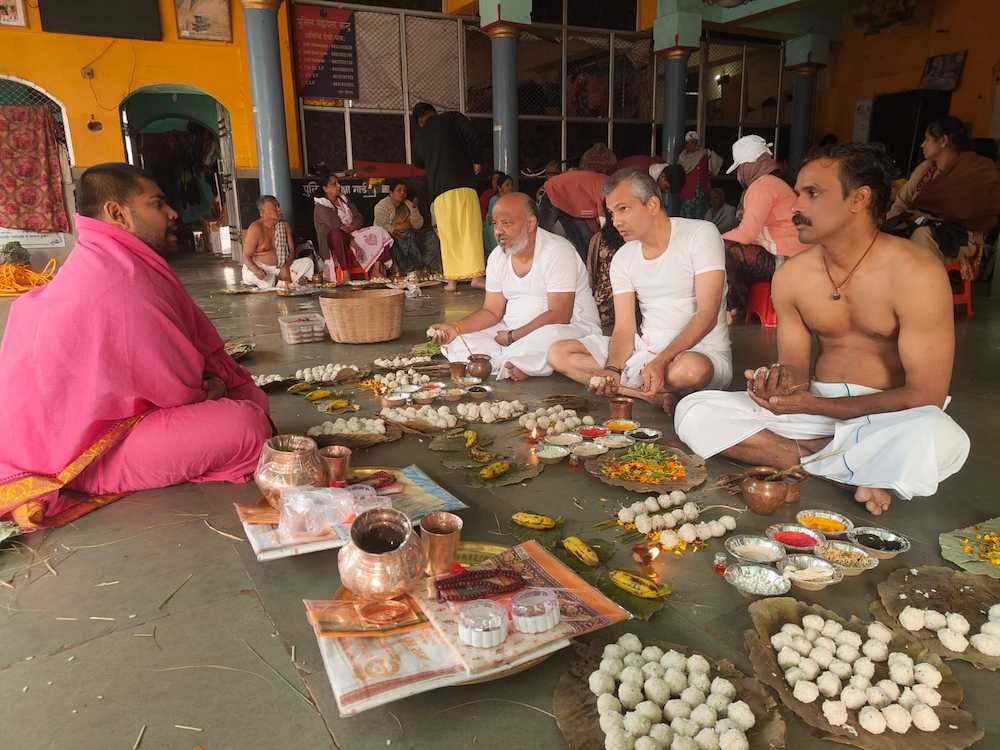
Pind Daan in Gaya in Pitru Paksha 2026: Dates and Packages
Pitru Paksha 2026 runs from 26 September to 10 October. The first half of the fortnight (26 September to around 1 October) sees relatively less crowd at Gaya, while the second half, especially Matri Navami and Sarva Pitri Amavasya, draws the heaviest rush. Pitradev offers one day Pind Daan packages in Gaya from ₹5,000 to ₹11,000, with the priest, material, and all ritual requirements included. Pre-booking your puja and accommodation well in advance is strongly advised to avoid last-minute difficulty.
Why Pitru Paksha Is the Most Important Time for Pind Daan in Gaya
Pitru Paksha is the 15-day period in the Hindu calendar that is dedicated entirely to honouring departed ancestors. It is believed that during these days the souls of the ancestors descend from Pitru Loka to the earth to receive offerings from their descendants. Performing Pind Daan in Gaya during this period is considered to carry the highest spiritual merit, because Gaya is the foremost tirtha for ancestral rites and the potency of the rituals performed here is believed to multiply manifold during Pitru Paksha.
For this reason, lakhs of families from across India and abroad travel to Gaya during this short window every year. The Vishnupad Mandir, the Falgu River, and the Akshayvat tree see an unbroken stream of devotees throughout the fortnight. As a result, planning your visit carefully, choosing the right dates, and pre-booking the puja and stay well in advance can make the difference between a peaceful experience and a stressful one.
Pitru Paksha 2026 Dates: The Complete Tithi Calendar
Pitru Paksha 2026 begins on 26 September 2026 (Saturday) and ends on 10 October 2026 (Saturday). Shradh is traditionally performed on the tithi on which the ancestor passed away. The day-wise calendar is as follows:
- 26 September (Saturday) — Purnima Shradh (first day of Pitru Paksha)
- 27 September (Sunday) — Pratipada Shradh
- 28 September (Monday) — Dwitiya Shradh
- 29 September (Tuesday) — Tritiya Shradh
- 30 September (Wednesday) — Chaturthi Shradh
- 1 October (Thursday) — Panchami Shradh
- 2 October (Friday) — Shashthi Shradh
- 3 October (Saturday) — Saptami Shradh
- 4 October (Sunday) — Ashtami Shradh
- 5 October (Monday) — Navami Shradh (Matri Navami)
- 6 October (Tuesday) — Dashami Shradh
- 7 October (Wednesday) — Ekadashi Shradh
- 8 October (Thursday) — Dwadashi Shradh
- 9 October (Friday) — Trayodashi Shradh
- 10 October (Saturday) — Sarva Pitri Amavasya (Mahalaya Amavasya, last day)
If the exact tithi of the ancestor's passing is not known, the Shradh is generally performed on Sarva Pitri Amavasya, which is considered a universal day for all ancestors. For the complete tithi-wise details, you may also refer to the Pitru Paksha 2026 Shradh calendar on our website.
Which Days Are Most Crowded and Which Are Relatively Calm
This is perhaps the most practical piece of information for families planning their travel. Not all days of Pitru Paksha carry the same crowd, and choosing wisely can make your experience significantly more comfortable.
First half (26 September to approximately 1 October): The opening days of Pitru Paksha, from Purnima Shradh through Panchami Shradh, see relatively less crowd at Gaya compared to the second half. Many families have not yet arrived, the hotels and dharamshalas still have availability, and the queues at Vishnupad Mandir and the ghats are more manageable. If your ancestor's tithi falls in this window, or if you have flexibility in choosing your date, planning your visit during the first half is strongly recommended.
Second half (2 October onwards): From Shashthi Shradh onwards, the crowd at Gaya begins to build steadily. The rush intensifies significantly around Navami Shradh (5 October), which is also observed as Matri Navami, the day specifically dedicated to performing Shradh for the departed mother. This is one of the most crowded days of the entire fortnight.
Peak days to avoid if possible: Two days in particular see the heaviest rush at Gaya — Matri Navami (5 October 2026) and Sarva Pitri Amavasya (10 October 2026). On Sarva Pitri Amavasya, which is the last and most universally observed day, the number of devotees at the Vishnupad Mandir and the Falgu River ghats reaches its highest point. If your family has flexibility, performing the Pind Daan a few days before these peak dates will give you a calmer and more focused experience.
Why You Should Pre-Book Puja and Accommodation in Advance
Many a time families travel to Gaya during Pitru Paksha without any prior arrangement, assuming that a priest and a hotel room will be available on arrival. This approach works during the rest of the year, but during Pitru Paksha it almost always leads to difficulty. Considering the scale of the Pitru Paksha Mela at Gaya, the following realities should be kept in mind.
Priest availability becomes extremely limited during the fortnight. Experienced and reliable pandits are booked days or weeks in advance by families who have planned ahead. Arriving without a booking means you are left to find a priest at the temple gate, where the pricing is unclear and the quality of the vidhi is uncertain.
Hotels and dharamshalas in Gaya fill up quickly, especially from Saptami Shradh onwards. Room rates during Pitru Paksha are significantly higher than the rest of the year, and last-minute availability is often restricted to the most expensive or the most basic options. Families with elderly members or children face particular discomfort when accommodation is not secured in advance.
For these reasons, we strongly advise booking your Pind Daan puja and your accommodation at least 3 to 4 weeks before your intended date. Pitradev arranges the priest, the ritual, and can also assist with stay and local travel, so that everything is confirmed before you begin your journey.
Pind Daan Packages in Gaya for Pitru Paksha 2026
Pitradev offers three one day Pind Daan packages in Gaya, each with a fixed, all-inclusive cost. The priest charges and all ritual material are included, and no additional money is asked for during the puja.
Package 1: Pind Daan at Vishnupad Mandir — ₹5,000
This package covers the Pind Daan at the Vishnupad Mandir, the most sacred and central place for Gaya Shradh. The ritual includes the sankalp (taking name and gotra of the ancestors), offering of pinds (rice balls), and Vedic prayers performed by the priest. This is suited to families who wish to perform the rite at the single most important location in Gaya.
Book Package 1 — Pind Daan at Vishnupad Mandir
Package 2: Pind Daan at Three Places — ₹7,500
In this package the ritual is performed at three sacred locations: Vishnupad Mandir, Akshayvat Tree, and Falgu River. This is the package most commonly chosen by families visiting Gaya, as it covers the three most important sites of the traditional Gaya Shradh in a single day.
Book Package 2 — Pind Daan at Three Places
Package 3: Pind Daan at Four Places — ₹11,000
This is the most comprehensive one day package, covering Vishnupad Mandir, Akshayvat Tree, Falgu River, and Pret Shila. Adding Pret Shila completes the traditional Gaya Shradh process in its fullest form, as this is the sacred hillock where departed souls are believed to be released from the state of being a pret.
Book Package 3 — Pind Daan at Four Places
Other Ancestral Ceremonies You Can Combine During Pitru Paksha
Many families who travel to Gaya during Pitru Paksha also wish to perform additional ancestral ceremonies alongside the Pind Daan. Pitradev arranges the following rites in Gaya, each performed by an experienced priest with the complete vidhi. These can be booked independently or combined with your Pind Daan visit.
Tripindi Shraadh — ₹15,000. This is performed when the annual Shraadh has not been conducted for 3 or more consecutive years, or when the exact tithi of the departed is not known. The rite pacifies unsettled ancestral souls and brings them peace.
Narayan Bali — ₹15,000. This specialised ritual is performed to release the soul of a person who died an unnatural or untimely death, such as an accident or other unfortunate circumstance. Narayan Bali conducted at Gaya during Pitru Paksha is believed to carry exceptional spiritual merit.
Navkesh, Daswa, Ekadasha, Dwadasha and Terahvi — ₹15,000. This covers the complete post-death rites traditionally performed on the 9th through 13th day after passing. Families who wish to perform these at a tirtha kshetra rather than at home choose to have them conducted at Gaya.
All three ceremonies are priced at a fixed ₹15,000 each, with the priest and material included.
What to Expect on the Day: The Pind Daan Procedure
The Pind Daan process at Gaya follows a set sequence, regardless of which package you choose. The ritual begins from 7 am in the morning and can be performed until sunset. You will need to carry a clean white dhoti (for gentlemen) and come to the ghat or temple. The pandit ji provides all the ritual materials.
The ceremony starts with the sankalp, in which the priest formally invokes the name, gotra, and tithi of the departed ancestors. You then prepare 16 rice balls (pinds), picking each one and taking the name and gotra of your ancestors as guided by the priest. Following the pind offering, tarpan is performed by offering water mixed with black sesame seeds to the ancestors. The pinds are then collected and immersed in the sacred river. The complete ceremony takes approximately 2 to 3 hours for a one-place package, and 3 to 4 hours if multiple sacred locations are included.
Practical Tips for Families Visiting Gaya During Pitru Paksha
A few practical points that will make your visit smoother. Arrive in Gaya a day before your scheduled puja date, so that you are rested and ready to begin early in the morning. Carry a written note with the names and gotras of all the ancestors for whom you wish to perform the rite, as the priest will ask for these during the sankalp. Start the ritual early in the morning to avoid the afternoon crowd. Raj Ghat is the most easily accessible ghat in Gaya, as cars and cabs can reach it directly and it has dedicated parking, which is helpful for families with elderly members. Pitradev also provides pick-up and drop from the Gaya airport and railway station, so local transport need not be a worry.
Combine Gaya with Varanasi and Prayagraj
Many families who travel to Gaya for Pind Daan during Pitru Paksha also wish to perform Asthi Visarjan at Varanasi and visit the Triveni Sangam at Prayagraj, completing the full ancestral pilgrimage in one journey. For such families, Pitradev offers a dedicated Varanasi – Prayagraj – Gaya – Varanasi 4 Night 5 Day package that covers all 3 sacred cities with travel, stay, priest, and ritual arrangements handled end to end.
Conclusion
Performing Pind Daan in Gaya during Pitru Paksha is the most auspicious way to honour your departed ancestors and to help their souls attain moksha. Pitru Paksha 2026 runs from 26 September to 10 October, and the first half of the fortnight offers a relatively calmer window for families who have flexibility in their dates. The single most important step you can take is to pre-book your puja and accommodation well in advance, so that the experience is peaceful rather than rushed. With Pitradev, the cost is clearly set out across 3 one day packages from ₹5,000 to ₹11,000, with additional ancestral ceremonies available at ₹15,000 each, and every arrangement is taken care of so that your family can focus entirely on the rite itself. To book your Pind Daan in Gaya for Pitru Paksha 2026, contact Pitradev on WhatsApp or call today, and secure your date before the rush begins.
Frequently Asked Questions
1. What are the Pitru Paksha 2026 dates for Pind Daan in Gaya?
2. Which days during Pitru Paksha are the most crowded in Gaya?
3. How much does Pind Daan in Gaya cost during Pitru Paksha?
4. Should I book the puja and accommodation in advance for Pitru Paksha?
5. Can Tripindi Shraadh or Narayan Bali also be performed during Pitru Paksha in Gaya?
Shashank Mishra
Manager, Pitradev.com
Shashank Mishra comes with over 15 years of experience in religious tourism and organising Vedic rituals and ancestral ceremonies. At Pitradev, he oversees the coordination of Asthi Visarjan, Pind Daan, Shraadh, Grihapravesh, Vastu Shanti Puja, Satyanarayan Katha, Rudrabhishek, and other sacred rites across Varanasi, Prayagraj, Gaya, Bangalore, Hyderabad, Pune, and Mumbai. His deep understanding of Hindu customs across regional traditions — North Indian, Tamil, Telugu, Odia, and Kannada — allows him to guide families through the correct vidhi with care and clarity, whether it is an ancestral ceremony at a tirtha kshetra or a housewarming puja in a metro city.
Latest Blog
- Pind Daan for Dogs in Varanasi: Complete Rituals at Kashi
- Things To Know Before Booking A Pandit for Satyanarayan Puja
- How To Choose Right Muhurat for Griha Pravesh for Your New Home
- 7 Key Rituals and Stages of Pind Daan in Gaya
- Gand Mool Nakshatra Shanti Puja: Complete Process
- Grihapravesh Muhurat in November and December 2026
- Asthi Visarjan in Varanasi for Pets: Dogs And Cats
- Pind Daan in Varanasi: Guide to Ritual, Process, Cost, Booking
- Mistakes to Avoid During Asthi Visarjan in Varanasi
- How to book satyanarayn puja
- Verified South Indian Purohits in Gaya
- Samvatsarikam in Varanasi: Cost and Vidhi
- Best South Indian Purohits in Kashi Varanasi
- Pind Daan in Varanasi by Telugu Purohit
- Telugu Purohit in Gaya: Pind Daan Packages
- Tripindi Shraadh in Gaya
- Pitradev- Hindi, Tamil, Telugu & Bengali Pandit in Bangalore
- Narayan Bali Puja in Gaya
- Can I Do Pind Daan Within One Year of Death?
- One Day Narayan Bali Puja at Trimbakeshwar
- Asthi Visarjan at Manikarnika Ghat in Kashi Varanasi
- Cost of Asthi Visarjan in Varanasi: Packages and Precautions
- Pandit for Tripindi Shradh in Varanasi: 2026 Dates & Cost
- Pind Daan in Gaya in Pitru Paksha 2026: Dates and Packages
- Vastu Shanti Puja Cost in Pune by North Indian Pandit
- Pitra Dosh: Causes, Symptoms and Remedies — A Complete Guide
- How to Find Genuine Tamil Vadhyars in Kashi Varanasi
- How to Carry Asthi in Flight in India?
- Pind Daan in Gaya by Tamil Iyer: Cost, Packages and Process
- Asthi Visarjan in Srirangapatna from Bangalore — Full Guide
- Send Ashes from Coimbatore to Kashi — Asthi Visarjan Service
- Cost of Asthi Visarjan in Prayagraj by Telugu Pandit
- Asthi Visarjan and Pind Daan in Prayagraj for Odia Families
- North Indian Pandit Bangalore for Annaprashan Puja
- Telugu Grihapravesham Bangalore: 4 Packages Cost & Inclusion
- Cost of Tripindi Shraadh in Varanasi -Pishachmochan Kund
- North Indian Pandit in Pune for Grihapravesh: Package Guide
- Pind Daan in Prayagraj: Cost, Vidhi & Booking Guide-2026
- Narayan Bali Puja in Varanasi — Complete Cost Breakdown for 2026
- Book a Verified North Indian Pandit in Pune: Cost & Packages
- How to Send Asthi to Kashi: A Step-by-Step Guide
- Book Tamil Iyer in Bangalore for Grihapravesham – Complete Guide
- How to Plan 10th 11th and 12th Day Rituals in Varanasi
- Pitru Paksha 2026 – Pind Daan in Prayagraj, Kashi and Gaya
- Pitru Paksha 2026 – Book Online Pind Daan in Varanasi
- Asthi Visarjan in Varanasi for Tamil Families – Complete Guide
- How to Send Asthi (Ashes) from USA to India – Complete Guide
- Narayan Bali Puja in Varanasi – Complete Guide 2026
- Pind Daan in Gaya from Malaysia – Complete Guide
- Pind Pradanam in Varanasi from Malaysia – Complete Guide
- Grihapravesh Puja in Bangalore by Kannada Purohit
- Online Pind Daan in Varanasi for NRIs
- Book Verified Telugu Purohits in Bangalore for Grihapravesham
- Best Ghat for Asthi Visarjan in Varanasi: A Practical Comparison
- Asthi Visarjan in Prayagraj – Complete Guide 2026
- Tripindi Shradh in Varanasi – Complete Guide
- Asthi Visarjan in Varanasi –Best Ghat & Package 2026
- Grihapravesh Puja in Prestige City Sarjapur
- Gaya Ji Pind Daan 2026 – Quick Guide for Planning Your Trip
- Online Puja Booking for Griha Pravesh, Shradh & Satyanarayan
- Pitru Paksha 2026 Dates, Rituals and Pind Daan Guide
- Akshaya Tritiya 2026 (19 April): Best Muhurat for Griha Pravesh
- North Indian Pandit in Bangalore for All Hindu Pujas
- How to Do Asthi Visarjan When You Cannot Travel: Complete Guide
- Asthi Visarjan in Kashi: Complete Guide with Cost & Time
- Griha Pravesh Muhurat 2026: Auspicious Dates & Timings
- Complete Guide to Gaya Pind Daan Ritual, Samagri & Best Time
- Asthi Visarjan By Post in Kashi Varanasi – Complete Guide
- How to Book a Bengali Pandit for Puja: Step-by-Step Process
- Book Verified Pandit for Puja in Bangalore
- Book Verified North Indian Pandit in Hyderabad Online
- Book North Indian Pandit in Bangalore for Satyanarayan Puja
- How to Book a Pandit in Bangalore Online for Puja:Complete Guide
- Find and Book Pandits in Hyderabad for Griha Pravesh Puja Online
- How to Find and Book Experienced Pandit Online for Puja?
- Exploring the History and Origins of Griha Pravesh Puja Rituals
- Top 5 Ancient Places for Gayaji Pind Daan - 2024 Guide
- Significance of Performing Griha Pravesh Puja in Hindu Culture
- How to Choose the Right Pandit for Pind Daan in Gaya
- Why is Pind Daan in Gaya so Famous?
- Where to Find Experienced Pandit for Griha Pravesh Puja Online?
- Cost of Pind Daan in Gaya: Packages, Procedure and How to Book
- Griha Pravesh Puja and Housewarming Ceremony 2024
- How Gaya Pind Daan Brings Closure and Peace to Your Ancestors
- Gayaji Pind Daan: Achieve Eternal Peace for Your Ancestors
- Online Pind daan: Importance, Cost, and Procedure
- Gaya Pind Daan Puja is Performed by an Experienced Pandit ji
- The Sacred Ritual of Brahma Kapal Pind Daan
- A Complete Guide About Pind Daan in India: Update 2023
- Unveiling the Significance of Pind Daan in Gaya
- The Ultimate Guide to Pind Daan Tour Packages
- Where to do Asthi Visarjan in Haridwar?
- Rudrabhishek Pooja Why Hindus Perform Rudrabhishek pooja At home
- Varanasi's Asthi Visarjan: Embracing Life's Eternal Journey
- Unveiling the Sacred Ritual:
- Significance of Asthi Visarjan in Haridwar
- Exploring the Profound Significance of Asthi Visarjan in Kashi
- The Science of Pind Daan:
- What are the rituals of Pind Daan?
- Varanasi Ayodhya Tour Package with Prayagraj
- Pind Daan Puja in Varanasi | Book Your Puja Online
- Prayagraj: The Enchanting Journey of Asthi Visarjan
- Pind Daan Gaya : When and Where to Do Pind Daan in Gayaji
- Exploring the Mystical Rituals of Asthi Visarjan Poojan
- Which are the Best Places to do Pind Daan in Gaya?
- Everything You Need to Know About Rudrabhishek Puja
- Why Is Pind Daan At Gaya Important To Hindus?
- Asthi Visarjan: When to Perform It, Where to Go, and Cost
- Rudra Abhishek Puja's Purpose:
- Ganga Pushkaralu 2023
- Pind daan for people having unnatural deaths
- Is doing pind daan beneficial without self presence of related?