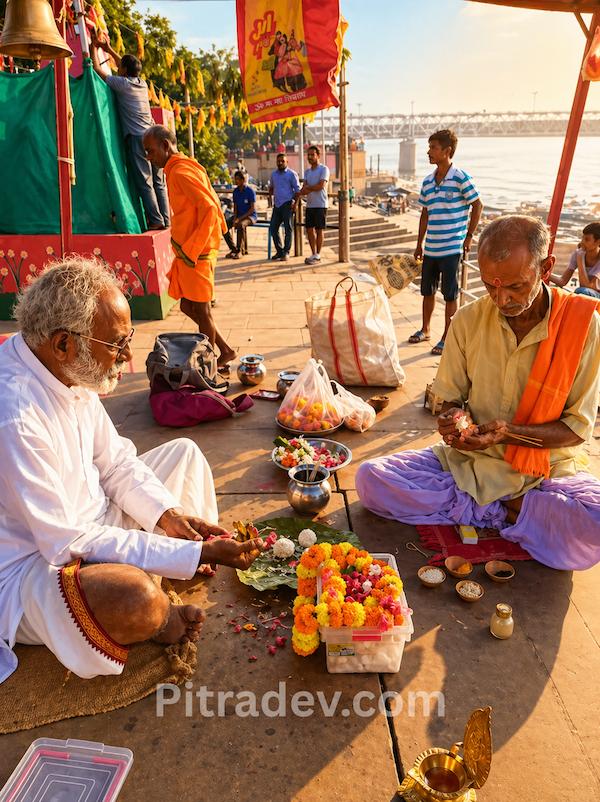
Asthi Visarjan in Varanasi for Tamil Families – Complete Guide
For many Tamil families, performing asthi visarjan is not just a ritual but a deeply emotional responsibility towards their ancestors. Even if families are settled in cities across Tamil Nadu or abroad, the desire to complete this final rite in the holy Ganga remains strong. Among all places in India, Varanasi holds a special spiritual importance for asthi visarjan. It is believed that immersing ashes in the Ganga at Varanasi helps the departed soul attain peace and move towards liberation.
At the same time, many Tamil families have practical questions before planning the ritual. They want to understand the process, the right ghats, whether Tamil priests are available, and how the rituals may differ from what they are familiar with in the South. This guide explains everything in a simple and practical way so that you can plan the ritual with clarity and confidence.
Also read: Asthi Visarjan In Varanasi
Why Tamil Families Prefer Varanasi for Asthi Visarjan
For generations, Tamil families have traveled to Varanasi to perform ancestral rituals. The reason is not just tradition but belief. The Ganga is considered sacred across all regions of India, and Varanasi is known as a place where spiritual rituals are performed continuously with proper procedure. Even families who traditionally perform rituals in places like Rameswaram still consider Varanasi for asthi visarjan because of its association with moksha. The belief is that completing the final rites here helps bring closure and peace.
For families coming from Tamil Nadu, Andhra Pradesh, Karnataka, or Telangana, the main concern is not the location but whether the ritual will be performed correctly and respectfully.
Asthivisarjan in Varanasi with complete material, priest dakshina and boat charges in Rs2000/- Book Now
Where to Perform Asthi Visarjan in Varanasi (Ghats with Tamil Priest Availability)
Asthi visarjan in Varanasi can be performed at multiple ghats along the Ganga. However, some ghats are more commonly preferred by South Indian families due to familiarity and priest availability.
The main ghats where Tamil-speaking priests are usually available include Hanuman Ghat, Kedar Ghat, Manikarnika Ghat, and Raj Ghat.
Hanuman Ghat and Kedar Ghat are traditionally associated with South Indian communities in Varanasi, and many Tamil families feel more comfortable performing rituals here. Manikarnika Ghat is one of the oldest and most significant ghats, though it is usually crowded and more intense due to cremation activities. Raj Ghat, on the other hand, is relatively less crowded and easier to access, making it a practical option for families who prefer a calmer environment.
While these ghats are known for Tamil priest availability, it is important to understand that asthi visarjan can be performed at any ghat in Varanasi, and the effectiveness of the ritual does not depend on the specific ghat.
Step-by-Step Process of Asthi Visarjan in Kashi Varanasi
The process of asthi visarjan is structured and guided by the priest so that families do not face confusion.
The ritual usually begins with asthi pujan at the ghat. The ashes are transferred into a traditional vessel, and the priest performs the initial puja with mantras. Person who is performing asthivisarjan, needs to take the name and gotra of deceased person along with his name and gotra while performing asthivisarjan. After this, the family is taken by boat into the middle of the Ganga, where the actual immersion takes place.
Immersing the ashes in the flowing river is considered important, as it symbolizes the final release of the physical remains. After immersion, tarpan is performed by offering water to the ancestors. The entire process is simple when guided properly and usually takes around one to two hours depending on the arrangement.
How the Ritual May Feel Different from South Indian Customs
One of the biggest concerns Tamil families have is whether the ritual in Varanasi will match their traditional customs.The important thing to understand is that the core of the ritual remains exactly the same. The mantras are in Sanskrit, and the purpose and structure of the ritual do not change.
What may feel slightly different are minor aspects such as the style of conducting the ritual, certain procedural variations, or the language used for communication. These differences are natural because rituals across India follow the same foundation but vary slightly in regional practice.
However, these variations do not affect the correctness or spiritual value of the ritual. The most important elements—sankalp, asthi pujan, immersion, and tarpan—remain consistent.
Understanding the Reality of “Tamil Priests” in Kashi
Another important point that families should be aware of is related to the availability of Tamil priests in Varanasi.Varanasi is a major pilgrimage and tourist destination where priests interact with families from across India. Because of this, many priests have learned basic Tamil, Telugu, or other South Indian languages to communicate better.
In some cases, you may come across priests who claim to be Tamil priests, but when you sit for the puja, you may realize that they are actually North Indian priests who have learned the language. This is quite common in Varanasi and should not be seen negatively. What matters more is whether the priest is experienced and follows the correct ritual procedure.
In fact, many experienced priests in Varanasi have been performing these rituals for decades and are well-versed in handling families from different regions. Their familiarity with the process often ensures a smoother and more guided experience.
Choosing the Right Priest – What Really Matters
For Tamil families visiting Varanasi, the focus should not be only on language or regional identity of the priest. Instead, the key factors should be:
- Proper understanding of the ritual
- Experience in conducting asthi visarjan
- Clear guidance during the process
- Smooth coordination
When these aspects are handled well, the ritual becomes simple and meaningful regardless of language differences.
Cost of Asthi Visarjan in Varanasi
The cost of asthi visarjan in Varanasi depends on the type of ritual and additional inclusions. In case you want to book Tamil priest, we have only one package of Rs5000/ which includes asthivisarjan along with boat, material and priest charges. In case you want to go with north indian priest, we have three packages of asthi visarjan.
Basic asthi visarjan generally starts at around ₹2000, which includes priest guidance and ritual completion. If pind daan is included along with asthi visarjan, the cost is typically around ₹3500. For a more complete ritual including gau daan, the cost may go up to ₹5000. In
These are standard ranges, and the exact cost may vary depending on arrangement and inclusions.
Practical Tips for Tamil Families Visiting Varanasi
Planning the visit properly can make the experience smooth and stress-free.
It is advisable to choose ghats that are easily accessible, especially if elderly family members are traveling. Early morning is generally the best time for the ritual, as the ghats are relatively less crowded and the environment is calmer.
It is also important to carry only a small portion of ashes, as that is sufficient for the ritual. Most arrangements, including materials and priest coordination, are usually handled locally.
Can Asthi Visarjan Be Done Without Traveling?
For families who are unable to travel from Tamil Nadu or abroad, asthi visarjan can also be arranged through a representative.
In such cases, the ashes are sent to Varanasi, and the ritual is performed on behalf of the family with proper sankalp. Photos and videos are shared as confirmation. This option has become increasingly common for families facing travel constraints. Book Online Asthivisarjan in Varanasi Now.
Final Thoughts
Asthi visarjan in Varanasi is a deeply meaningful ritual, and for Tamil families, it is often a once-in-a-lifetime responsibility. While there may be minor differences in language or style compared to South Indian customs, the essence of the ritual remains the same. What matters most is that the ritual is performed correctly, with proper guidance and intention.
With the right planning and understanding, families can complete this important ritual smoothly and with peace of mind.
FAQs
Is it necessary to have a Tamil priest for asthi visarjan in Varanasi?
No, the ritual is performed in Sanskrit and remains the same. Language is only for communication.
Which ghat is best for Tamil families in Varanasi?
Tamil pandits are available at Hanuman Ghat, Kedar Ghat, Manikarnika Ghat, and Raj Ghat.
How long does the asthivisarjan ritual take?
Asthi Visarjan ritual usually takes 1–2 hours including asthi pujan and visarjan in the middle of the river through boat.
Can women do asthi visarjan in Kashi?
Yes, women can perform asthi visarjan and pind daan rituals.
Can I do asthi visarjan without traveling?
Yes, it can be arranged through a priest on your behalf. You can send asthi through post and here in Kashi asthi visarjan will be done on your behalf.
Shashank Mishra
Manager, Pitradev.com
Shashank Mishra comes with over 15 years of experience in religious tourism and organising Vedic rituals and ancestral ceremonies. At Pitradev, he oversees the coordination of Asthi Visarjan, Pind Daan, Shraadh, Grihapravesh, Vastu Shanti Puja, Satyanarayan Katha, Rudrabhishek, and other sacred rites across Varanasi, Prayagraj, Gaya, Bangalore, Hyderabad, Pune, and Mumbai. His deep understanding of Hindu customs across regional traditions — North Indian, Tamil, Telugu, Odia, and Kannada — allows him to guide families through the correct vidhi with care and clarity, whether it is an ancestral ceremony at a tirtha kshetra or a housewarming puja in a metro city.
Latest Blog
- North Indian Pandit in Pimpri-Chinchwad
- Pind Daan in Gaya by Odia Pandit | Odia Shraddha Paddhati
- Vastu Shanti Puja in Pune | 6 Mandals, 2 Pandits | ₹15000
- Gaya Pind Daan vs Varanasi Pind Daan
- Satyanarayan Katha in Pune by North Indian Pandit
- Odia Pandit Prayagraj | Asthi Bisarjan & Pind Daan Same Day
- How to Book Asthi Visarjan in Kashi Online
- Book Pandit Services Online A Complete Step by Step Guide
- Book Verified Pandit Ji in Bangalore for Any Puja Easy Guide
- How to Book a Vastu Pujan Griha Pravesh Puja for Your New Home
- How to Book Pind Daan in Gaya Online Complete Guide
- Pind Daan in Varanasi After Pitru Paksha
- Pind Daan for Dogs in Varanasi: Complete Rituals at Kashi
- Things To Know Before Booking A Pandit for Satyanarayan Puja
- How To Choose Right Muhurat for Griha Pravesh for Your New Home
- 7 Key Rituals and Stages of Pind Daan in Gaya
- Gand Mool Nakshatra Shanti Puja: Complete Process
- Grihapravesh Muhurat in November and December 2026
- Asthi Visarjan in Varanasi for Pets: Dogs And Cats
- Pind Daan in Varanasi: Guide to Ritual, Process, Cost, Booking
- Mistakes to Avoid During Asthi Visarjan in Varanasi
- How to book satyanarayn puja
- Verified South Indian Purohits in Gaya
- Samvatsarikam in Varanasi: Cost and Vidhi
- Best South Indian Purohits in Kashi Varanasi
- Pind Daan in Varanasi by Telugu Purohit
- Telugu Purohit in Gaya: Pind Daan Packages
- Tripindi Shraadh in Gaya
- Pitradev- Hindi, Tamil, Telugu & Bengali Pandit in Bangalore
- Narayan Bali Puja in Gaya
- Can I Do Pind Daan Within One Year of Death?
- One Day Narayan Bali Puja at Trimbakeshwar
- Asthi Visarjan at Manikarnika Ghat in Kashi Varanasi
- Cost of Asthi Visarjan in Varanasi: Packages and Precautions
- Pandit for Tripindi Shradh in Varanasi: 2026 Dates & Cost
- Pind Daan in Gaya in Pitru Paksha 2026: Dates and Packages
- Vastu Shanti Puja Cost in Pune by North Indian Pandit
- Pitra Dosh: Causes, Symptoms and Remedies — A Complete Guide
- How to Find Genuine Tamil Vadhyars in Kashi Varanasi
- How to Carry Asthi in Flight in India?
- Pind Daan in Gaya by Tamil Iyer: Cost, Packages and Process
- Asthi Visarjan in Srirangapatna from Bangalore — Full Guide
- Send Ashes from Coimbatore to Kashi — Asthi Visarjan Service
- Cost of Asthi Visarjan in Prayagraj by Telugu Pandit
- Asthi Visarjan and Pind Daan in Prayagraj for Odia Families
- North Indian Pandit Bangalore for Annaprashan Puja
- Telugu Grihapravesham Bangalore: 4 Packages Cost & Inclusion
- Cost of Tripindi Shraadh in Varanasi -Pishachmochan Kund
- North Indian Pandit in Pune for Grihapravesh: Package Guide
- Pind Daan in Prayagraj: Cost, Vidhi & Booking Guide-2026
- Narayan Bali Puja in Varanasi — Complete Cost Breakdown for 2026
- Book a Verified North Indian Pandit in Pune: Cost & Packages
- How to Send Asthi to Kashi: A Step-by-Step Guide
- Book Tamil Iyer in Bangalore for Grihapravesham – Complete Guide
- How to Plan 10th 11th and 12th Day Rituals in Varanasi
- Pitru Paksha 2026 – Pind Daan in Prayagraj, Kashi and Gaya
- Pitru Paksha 2026 – Book Online Pind Daan in Varanasi
- Asthi Visarjan in Varanasi for Tamil Families – Complete Guide
- How to Send Asthi (Ashes) from USA to India – Complete Guide
- Narayan Bali Puja in Varanasi – Complete Guide 2026
- Pind Daan in Gaya from Malaysia – Complete Guide
- Pind Pradanam in Varanasi from Malaysia – Complete Guide
- Grihapravesh Puja in Bangalore by Kannada Purohit
- Online Pind Daan in Varanasi for NRIs
- Book Verified Telugu Purohits in Bangalore for Grihapravesham
- Best Ghat for Asthi Visarjan in Varanasi: A Practical Comparison
- Asthi Visarjan in Prayagraj – Complete Guide 2026
- Tripindi Shradh in Varanasi – Complete Guide
- Asthi Visarjan in Varanasi –Best Ghat & Package 2026
- Grihapravesh Puja in Prestige City Sarjapur
- Gaya Ji Pind Daan 2026 – Quick Guide for Planning Your Trip
- Online Puja Booking for Griha Pravesh, Shradh & Satyanarayan
- Pitru Paksha 2026 Dates, Rituals and Pind Daan Guide
- Akshaya Tritiya 2026 (19 April): Best Muhurat for Griha Pravesh
- How to Do Asthi Visarjan When You Cannot Travel: Complete Guide
- Asthi Visarjan in Kashi: Complete Guide with Cost & Time
- Griha Pravesh Muhurat 2026: Auspicious Dates & Timings
- Complete Guide to Gaya Pind Daan Ritual, Samagri & Best Time
- Asthi Visarjan By Post in Kashi Varanasi – Complete Guide
- How to Book a Bengali Pandit for Puja: Step-by-Step Process
- Book Verified Pandit for Puja in Bangalore
- Book Verified North Indian Pandit in Hyderabad Online
- Book North Indian Pandit in Bangalore for Satyanarayan Puja
- How to Book a Pandit in Bangalore Online for Puja:Complete Guide
- Find and Book Pandits in Hyderabad for Griha Pravesh Puja Online
- How to Find and Book Experienced Pandit Online for Puja?
- Exploring the History and Origins of Griha Pravesh Puja Rituals
- Top 5 Ancient Places for Gayaji Pind Daan - 2024 Guide
- Significance of Performing Griha Pravesh Puja in Hindu Culture
- How to Choose the Right Pandit for Pind Daan in Gaya
- Why is Pind Daan in Gaya so Famous?
- Where to Find Experienced Pandit for Griha Pravesh Puja Online?
- Cost of Pind Daan in Gaya: Packages, Procedure and How to Book
- Griha Pravesh Puja and Housewarming Ceremony 2024
- How Gaya Pind Daan Brings Closure and Peace to Your Ancestors
- Gayaji Pind Daan: Achieve Eternal Peace for Your Ancestors
- Online Pind daan: Importance, Cost, and Procedure
- Gaya Pind Daan Puja is Performed by an Experienced Pandit ji
- The Sacred Ritual of Brahma Kapal Pind Daan
- A Complete Guide About Pind Daan in India: Update 2023
- Unveiling the Significance of Pind Daan in Gaya
- The Ultimate Guide to Pind Daan Tour Packages
- Where to do Asthi Visarjan in Haridwar?
- Rudrabhishek Pooja Why Hindus Perform Rudrabhishek pooja At home
- Varanasi's Asthi Visarjan: Embracing Life's Eternal Journey
- Unveiling the Sacred Ritual:
- Significance of Asthi Visarjan in Haridwar
- Exploring the Profound Significance of Asthi Visarjan in Kashi
- The Science of Pind Daan:
- What are the rituals of Pind Daan?
- Varanasi Ayodhya Tour Package with Prayagraj
- Pind Daan Puja in Varanasi | Book Your Puja Online
- Prayagraj: The Enchanting Journey of Asthi Visarjan
- Pind Daan Gaya : When and Where to Do Pind Daan in Gayaji
- Exploring the Mystical Rituals of Asthi Visarjan Poojan
- Which are the Best Places to do Pind Daan in Gaya?
- Everything You Need to Know About Rudrabhishek Puja
- Why Is Pind Daan At Gaya Important To Hindus?
- Asthi Visarjan: When to Perform It, Where to Go, and Cost
- Rudra Abhishek Puja's Purpose:
- Ganga Pushkaralu 2023
- Pind daan for people having unnatural deaths
- Is doing pind daan beneficial without self presence of related?