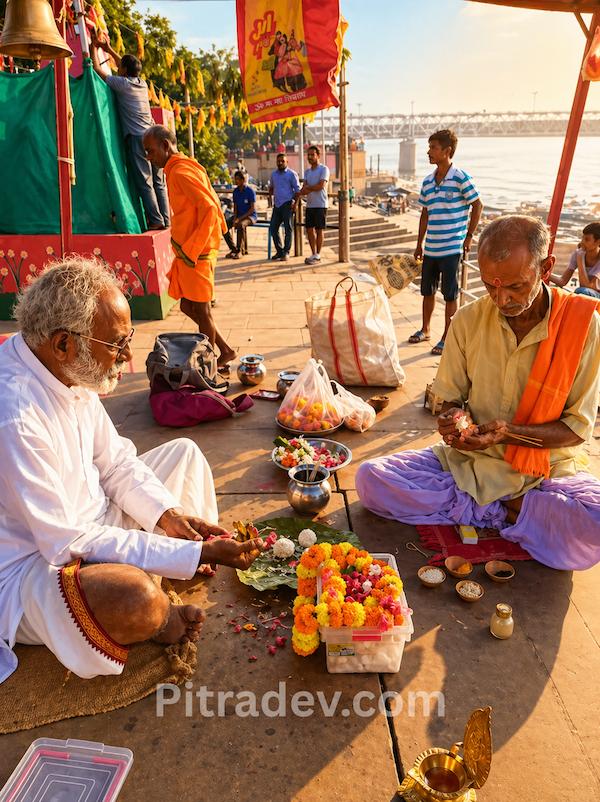
How to Find Genuine Tamil Vadhyars in Kashi Varanasi
Finding a genuine Tamil Vadhyar in Kashi requires knowing exactly what to look for — and what to avoid. Many North Indian pandits in Varanasi know basic Tamil phrases and claim to be Tamil priests but perform the puja entirely in the North Indian tradition. Pitradev provides verified Tamil Iyer pandits settled in Kashi for 3 to 4 generations, performing Pind Daan and Asthi Visarjan at Hanuman Ghat or Shivala Ghat at ₹5,000 per ritual. Booking requires a 20% advance payment through the Pitradev website, with the balance payable after the puja is complete.
For Tamil families travelling to Kashi for Pind Daan or Asthi Visarjan, the single most important decision after choosing Varanasi as the location is finding a genuine Tamil Vadhyar — a priest who performs the ritual in the Tamil Brahmin tradition, who takes the Sankalp correctly, and who communicates with the family in Tamil throughout the ceremony. This sounds straightforward until you arrive at the ghats of Varanasi and encounter the reality: a city full of North Indian pandits who have learned just enough Tamil to introduce themselves, quote a price, and create the impression of being a Tamil Vadhyar — before performing the puja entirely in the North Indian tradition. This guide explains exactly how to identify a genuine Tamil Vadhyar in Kashi, what red flags to watch for, and how Pitradev's verified Tamil Iyer pandits ensure your family's ritual is performed in the correct tradition from the first mantra to the last offering.
Why Tamil families specifically need a Tamil Vadhyar in Varanasi
The Pind Daan and Asthi Visarjan performed in the Tamil Brahmin — Tamil Iyer — tradition follow a specific sequence, use specific mantras, and observe specific customs that are distinct from the North Indian form of the same rituals. The Sankalp in the Tamil tradition is taken differently, the mantras recited during the pind offering and Tarpan are from a different Vedic tradition, and the overall sequence of the ceremony — from the opening prayers to the final Tarpan at the Ganga — follows a form that Tamil families recognise from home, from the ceremonies their parents and grandparents observed.
For a family that has travelled from Chennai, Coimbatore, Madurai, Tirunelveli, or any other Tamil city to perform Pind Daan or Asthi Visarjan for a departed family member, having the ritual performed in a tradition they do not recognise is deeply unsatisfying — and in the case of the Sankalp, which binds the merit of the entire ritual to the specific departed soul, performing it in an incorrect or unfamiliar form raises genuine questions about whether the ritual has been correctly fulfilled. The journey to Kashi is not a casual one for Tamil families — it is a sacred obligation — and the Vadhyar who performs the ritual is central to that obligation being met properly.
The problem with North Indian pandits claiming to be Tamil Vadhyars
Varanasi is one of the most visited pilgrimage cities in India, and the ghat economy has evolved over decades to serve pilgrims from every state and community. Many local North Indian pandits have learned basic Tamil and Telugu phrases — enough to greet a family, discuss the puja, quote a price, and give the strong impression that they are Tamil or Telugu priests. They know the right words, they know the right names for the rituals, and they are confident enough in their limited knowledge to convince a grieving family that they are in the right hands.
The reality becomes apparent the moment the puja begins. The mantras are recited in the North Indian style — the Sanskrit pronunciation, the sequence, and the specific hymns used are all from the North Indian Vedic tradition. The Sankalp is taken in a form that North Indian pandits use, not the Tamil Brahmin form. The offerings are arranged in a sequence Tamil families do not recognise from ceremonies at home. For families who are not deeply familiar with the ritual themselves, this difference may not be immediately obvious — but for Tamil Brahmin families who have grown up attending these ceremonies, it is unmistakable from the very first mantra.
The second and more troubling problem is the bait and switch. In many cases, the pandit who approaches the family at the ghat, confirms the booking in Tamil, negotiates the price, and gives the family full confidence — is not the pandit who actually performs the puja. A substitute pandit — often a junior assistant or a local North Indian priest — is sent to conduct the ritual. The original pandit appears only at the time of the Sankalp, when the family's name and gotra are stated, or at the time of collecting the dakshina after the puja is complete. The family, in a state of grief and unfamiliarity with the city, often does not realise the switch has occurred until the puja is well underway. By then, little can be done.
For Pind Daan specifically, this matters enormously. The Sankalp is the act that directs the merit of the entire ritual to the specific departed soul — the name, gotra, and native place of the departed must be stated correctly by the performing Vadhyar, not just acknowledged at the start by a booking agent who then disappears.
Red flags to watch for when approaching pandits at Varanasi ghats
Knowing what to avoid is as important as knowing what to look for. The following are the clearest warning signs that the pandit approaching you at the ghat is not a genuine Tamil Vadhyar:
The pandit approaches you proactively and immediately speaks in Tamil. Genuine Tamil Vadhyars who are settled in Kashi and serve Tamil families regularly do not need to solicit customers at the ghat — their work comes through referrals, established relationships, and advance bookings. A pandit who spots a Tamil-looking family and immediately opens with Tamil phrases is almost certainly a local North Indian pandit who has learned enough to make the approach.
The pandit cannot answer specific questions about Tamil Brahmin customs when asked directly. Ask him which specific mantras are used during Tarpan in the Tamil tradition, or which specific sequence the Sankalp follows for a Tamil Iyer family. A genuine Tamil Vadhyar will answer these questions without hesitation. A North Indian pandit who has learned conversational Tamil will struggle or deflect.
The puja is completed in 10 to 15 minutes. A properly performed Pind Daan or Asthi Visarjan with complete Sankalp, full pind offering or immersion, and Tarpan takes a minimum of 1 to 1.5 hours. A puja completed in under 20 minutes is a bulk operation — the ritual has been abbreviated to the point where its scriptural completeness is genuinely questionable.
A different pandit arrives to perform the puja than the one who confirmed the booking. If the pandit who negotiated with your family is not the one who sits down to begin the ritual, ask directly why the substitute has been sent. If the original pandit cannot give a clear answer, the booking should be reconsidered.
The price quoted is unusually low — below ₹2,000 for a complete Pind Daan including samagri, pandit dakshina, and boat charges. Genuine Tamil Vadhyars with experience and knowledge charge appropriately for their services. An unusually low price almost always signals a cut-rate operation where multiple families are served simultaneously in a bulk sankalp, with no individual family receiving a dedicated ritual.
What makes a genuine Tamil Vadhyar different
A genuine Tamil Vadhyar in Kashi performs Pind Daan or Asthi Visarjan in the Tamil Brahmin tradition — with the Sankalp taken in Tamil and Sanskrit as Tamil Iyer families observe it, the correct mantras from the Tamil Shaiva or Vaishnava tradition as applicable to the family's lineage, and the full sequence of offerings that Tamil families would recognise from ceremonies performed at home in Tamil Nadu.
The Sankalp in the Tamil tradition differs from the North Indian form in the specific sequence of statements, the regional and gotric identifiers used, and the invocation of the appropriate deities for the Tamil Brahmin lineage. For Pind Daan, the pind preparation follows the Tamil Brahmin method, the specific sesame and water offerings in the Tarpan are performed in the Tamil sequence, and the closing prayers are in the form Tamil families know. These are not minor differences — they constitute the complete form of the ritual as the Tamil Brahmin tradition prescribes it.
Duration is another clear marker. A properly performed Tamil Pind Daan at the Ganga takes approximately 1 to 1.5 hours, covering the complete sequence from Sankalp to Tarpan. A genuine Tamil Vadhyar does not rush this — the time given to each stage of the ritual reflects the seriousness with which the puja is being conducted.
Pitradev's verified Tamil Vadhyars in Kashi
Pitradev's Tamil Vadhyar network in Kashi consists of verified Tamil Iyer priests who are originally from Tamil Nadu and have been settled in Varanasi for 3 to 4 generations. These are not North Indian pandits who have learned Tamil — these are Tamil Brahmin families whose forebears came to Kashi specifically to serve Tamil pilgrims and who have maintained the Tamil ritual tradition in an unbroken line across generations. Their knowledge of both the Tamil vidhi and the Varanasi ghat system is deep, specific, and earned through decades of practice.
Swamy Prabhakaran is originally from Coimbatore and brings more than 15 years of direct experience performing Pind Daan and Asthi Visarjan for Tamil families at the ghats of Kashi. His familiarity with the Tamil Iyer tradition — both Shaiva and Vaishnava lineages — ensures that the Sankalp and the complete vidhi are performed in the correct form regardless of the specific family tradition. Families from Coimbatore, Erode, Salem, and the western Tamil Nadu region who have specific regional customs within the Tamil Iyer tradition will find Swamy Prabhakaran's knowledge of those nuances particularly reassuring.
Venu Shastry is originally from Tiruppur and has been performing Pind Daan and Asthi Visarjan rituals at Hanuman Ghat and Shivala Ghat for Tamil families visiting Kashi. His experience with families from across Tamil Nadu — from Chennai and the Kaveri delta region to Madurai and the deep south — means he is comfortable with the full range of Tamil Iyer customs and gotra traditions that Tamil families bring with them to Varanasi.
Both Vadhyars are available through advance booking via Pitradev, and both perform the complete ritual personally — there is no substitute pandit arrangement in Pitradev's service. The Vadhyar who is assigned to your family's puja is the Vadhyar who performs it from Sankalp to Tarpan.
Cost of Pind Daan in Varanasi by Tamil Vadhyar — Rs5000/
Pind Daan at Hanuman Ghat or Shivala Ghat in Varanasi by a Tamil Vadhyar through Pitradev costs ₹5,000. This is an all-inclusive charge covering all puja samagri, the Tamil Vadhyar's dakshina, and boat charges. The complete vidhi takes approximately 1 to 1.5 hours and is performed entirely in the Tamil Iyer tradition.
The ritual begins with the Sankalp at the ghat — the formal declaration in which the departed person's name, gotra, and native place are stated in the Tamil tradition and offered to the divine. Following the Sankalp, the pind — balls prepared from rice flour, sesame, barley, and other prescribed ingredients — are prepared and offered to the departed ancestor with the appropriate Tamil mantras. Tarpan — the offering of water and sesame at the Ganga — completes the ritual. All puja samagri required for the complete vidhi is arranged and brought by the Vadhyar. The family does not need to source or carry any materials to the ghat.
For Tamil families who are also considering performing Pind Daan at Gaya — which is the other major prescribed location for this ritual — the Pind Daan in Gaya by Tamil Iyer service is also available through Pitradev with a verified Tamil Vadhyar at the Vishnupad Temple.
Cost Of Asthi Visarjan in Varanasi by Tamil Vadhyar - Rs5000/
Asthi Visarjan at Hanuman Ghat or Shivala Ghat in Varanasi by a Tamil Vadhyar through Pitradev costs ₹5,000. This is an all-inclusive charge covering all puja samagri, the Tamil Vadhyar's dakshina, and boat charges. The complete Asthi Visarjan vidhi takes approximately 1 to 1.5 hours and is performed in the Tamil tradition from Sankalp to Tarpan.
The ritual begins with the Sankalp at the ghat, after which the family boards the boat and is taken to the immersion point on the Ganga. The ashi is immersed in the sacred river with the prescribed Tamil mantras recited by the Vadhyar, and Tarpan is performed at the river to complete the vidhi. All puja samagri is arranged and brought by the Vadhyar — the family needs to carry only the ashi of the departed in a container. Nothing else needs to be sourced or carried from Tamil Nadu.
For a complete guide to the process and what to expect, visit the Asthi Visarjan in Varanasi for Tamil families page on Pitradev. For families also considering Asthi Visarjan in Varanasi with additional service options, the complete guide is available on the same platform.
How to book a Tamil Vadhyar in Kashi through Pitradev
Booking a Tamil Vadhyar for Pind Daan or Asthi Visarjan in Varanasi through Pitradev requires visiting the Pitradev website and selecting the relevant service. A 20% advance payment is required at the time of booking to confirm the Vadhyar and the date. The remaining balance is payable after the puja is complete.
At the time of booking, the family should share the preferred date, the departed person's name and gotra, the specific ritual required — Pind Daan or Asthi Visarjan — and the number of family members who will be present at the ghat. The assigned Vadhyar will contact the family before the ritual date to confirm all Sankalp details and to answer any questions about the preparation.
It is advisable to book at least 5 to 7 days in advance of the preferred date. During Pitru Paksha — the 16-day period in September and October dedicated to ancestor rites — and on Amavasya dates, demand for Tamil Vadhyars at Kashi is significantly higher, and booking 2 to 3 weeks in advance is recommended during these periods.
Conclusion
The journey to Kashi for Pind Daan or Asthi Visarjan is one of the most significant acts a Tamil family can perform for a departed family member. Performing it with a genuine Tamil Vadhyar — one who conducts the ritual in the correct tradition, takes the Sankalp properly, and does not send a substitute — is what makes the difference between a ritual that is technically performed and one that is correctly fulfilled. The ghats of Varanasi have no shortage of pandits who will approach your family and offer their services. Knowing what to look for and where to find a verified Tamil Vadhyar is the single most important preparation a Tamil family can make before arriving in Kashi.
To book a verified Tamil Vadhyar for Pind Daan in Varanasi or Asthi Visarjan in Varanasi for Tamil families, visit the Pitradev website, select the service, and confirm with a 20% advance payment. The Vadhyar will handle everything from that point forward.
Frequently Asked Questions
How do I identify a genuine Tamil Vadhyar in Varanasi?
A genuine Tamil Vadhyar in Varanasi will perform the ritual in the Tamil Brahmin tradition — with the Sankalp taken in the Tamil Iyer form, the correct mantras from the Tamil tradition, and the full sequence of pind offering and Tarpan as Tamil families would recognise from home. He will be able to answer specific questions about Tamil Brahmin customs without hesitation, will personally perform the complete ritual from start to finish without sending a substitute, and the puja will take a minimum of 1 to 1.5 hours. A puja completed in 10 to 15 minutes, or a situation where the confirming pandit is different from the performing pandit, are the 2 clearest warning signs.
What is the cost of Pind Daan in Varanasi by a Tamil Vadhyar?
Pind Daan in Varanasi by a Tamil Vadhyar through Pitradev costs ₹5,000, all-inclusive — covering all puja samagri, the Vadhyar's dakshina, and boat charges. There are no additional or hidden charges. The 20% advance payment required at the time of booking is deducted from the total, with the remaining balance payable after the puja is complete.
Which ghats in Varanasi are used for Tamil Pind Daan and Asthi Visarjan?
Pitradev's Tamil Vadhyars perform Pind Daan and Asthi Visarjan at Hanuman Ghat or Shivala Ghat, Raj Ghat, in Varanasi. Both are well-established ghats on the Ganga with the appropriate ritual infrastructure for these ceremonies. The specific ghat used for a given booking is confirmed by the Vadhyar at the time of the pre-puja contact with the family.
Do I need to carry any puja materials for Pind Daan or Asthi Visarjan in Varanasi?
No. All puja samagri required for both Pind Daan and Asthi Visarjan — including pind ingredients, sesame, flowers, sacred thread, and all other ritual materials — is arranged and brought by Pitradev's Tamil Vadhyar. For Asthi Visarjan, the family carries only the ashi of the departed in a container. For Pind Daan, the family carries nothing — all materials are covered in the ₹5,000 package.
How far in advance should I book a Tamil Vadhyar in Kashi?
A booking at least 5 to 7 days in advance is recommended. During Pitru Paksha in September and October, and on Amavasya dates throughout the year, demand for Tamil Vadhyars in Kashi is significantly higher and booking 2 to 3 weeks in advance is strongly advised. At the time of booking, the family shares the preferred date, the departed person's name and gotra, and the ritual required — Pind Daan or Asthi Visarjan.
Shashank Mishra
Manager, Pitradev.com
Shashank Mishra comes with over 15 years of experience in religious tourism and organising Vedic rituals and ancestral ceremonies. At Pitradev, he oversees the coordination of Asthi Visarjan, Pind Daan, Shraadh, Grihapravesh, Vastu Shanti Puja, Satyanarayan Katha, Rudrabhishek, and other sacred rites across Varanasi, Prayagraj, Gaya, Bangalore, Hyderabad, Pune, and Mumbai. His deep understanding of Hindu customs across regional traditions — North Indian, Tamil, Telugu, Odia, and Kannada — allows him to guide families through the correct vidhi with care and clarity, whether it is an ancestral ceremony at a tirtha kshetra or a housewarming puja in a metro city.
Latest Blog
- Things To Know Before Booking A Pandit for Satyanarayan Puja
- How To Choose Right Muhurat for Griha Pravesh for Your New Home
- 7 Key Rituals and Stages of Pind Daan in Gaya
- Gand Mool Nakshatra Shanti Puja: Complete Process
- Grihapravesh Muhurat in November and December 2026
- Asthi Visarjan in Varanasi for Pets: Dogs And Cats
- Pind Daan in Varanasi: Guide to Ritual, Process, Cost, Booking
- Mistakes to Avoid During Asthi Visarjan in Varanasi
- How to book satyanarayn puja
- Verified South Indian Purohits in Gaya
- Samvatsarikam in Varanasi: Cost and Vidhi
- Best South Indian Purohits in Kashi Varanasi
- Pind Daan in Varanasi by Telugu Purohit
- Telugu Purohit in Gaya: Pind Daan Packages
- Tripindi Shraadh in Gaya
- Pitradev- Hindi, Tamil, Telugu & Bengali Pandit in Bangalore
- Narayan Bali Puja in Gaya
- Can I Do Pind Daan Within One Year of Death?
- One Day Narayan Bali Puja at Trimbakeshwar
- Asthi Visarjan at Manikarnika Ghat in Kashi Varanasi
- Cost of Asthi Visarjan in Varanasi: Packages and Precautions
- Pandit for Tripindi Shradh in Varanasi: 2026 Dates & Cost
- Pind Daan in Gaya in Pitru Paksha 2026: Dates and Packages
- Vastu Shanti Puja Cost in Pune by North Indian Pandit
- Pitra Dosh: Causes, Symptoms and Remedies — A Complete Guide
- How to Find Genuine Tamil Vadhyars in Kashi Varanasi
- How to Carry Asthi in Flight in India?
- Pind Daan in Gaya by Tamil Iyer: Cost, Packages and Process
- Asthi Visarjan in Srirangapatna from Bangalore — Full Guide
- Send Ashes from Coimbatore to Kashi — Asthi Visarjan Service
- Cost of Asthi Visarjan in Prayagraj by Telugu Pandit
- Asthi Visarjan and Pind Daan in Prayagraj for Odia Families
- North Indian Pandit Bangalore for Annaprashan Puja
- Telugu Grihapravesham Bangalore: 4 Packages Cost & Inclusion
- Cost of Tripindi Shraadh in Varanasi -Pishachmochan Kund
- North Indian Pandit in Pune for Grihapravesh: Package Guide
- Pind Daan in Prayagraj: Cost, Vidhi & Booking Guide-2026
- Narayan Bali Puja in Varanasi — Complete Cost Breakdown for 2026
- Book a Verified North Indian Pandit in Pune: Cost & Packages
- How to Send Asthi to Kashi: A Step-by-Step Guide
- Book Tamil Iyer in Bangalore for Grihapravesham – Complete Guide
- How to Plan 10th 11th and 12th Day Rituals in Varanasi
- Pitru Paksha 2026 – Pind Daan in Prayagraj, Kashi and Gaya
- Pitru Paksha 2026 – Book Online Pind Daan in Varanasi
- Asthi Visarjan in Varanasi for Tamil Families – Complete Guide
- How to Send Asthi (Ashes) from USA to India – Complete Guide
- Narayan Bali Puja in Varanasi – Complete Guide 2026
- Pind Daan in Gaya from Malaysia – Complete Guide
- Pind Pradanam in Varanasi from Malaysia – Complete Guide
- Grihapravesh Puja in Bangalore by Kannada Purohit
- Online Pind Daan in Varanasi for NRIs
- Book Verified Telugu Purohits in Bangalore for Grihapravesham
- Best Ghat for Asthi Visarjan in Varanasi: A Practical Comparison
- Asthi Visarjan in Prayagraj – Complete Guide 2026
- Tripindi Shradh in Varanasi – Complete Guide
- Asthi Visarjan in Varanasi –Best Ghat & Package 2026
- Grihapravesh Puja in Prestige City Sarjapur
- Gaya Ji Pind Daan 2026 – Quick Guide for Planning Your Trip
- Online Puja Booking for Griha Pravesh, Shradh & Satyanarayan
- Pitru Paksha 2026 Dates, Rituals and Pind Daan Guide
- Akshaya Tritiya 2026 (19 April): Best Muhurat for Griha Pravesh
- North Indian Pandit in Bangalore for All Hindu Pujas
- How to Do Asthi Visarjan When You Cannot Travel: Complete Guide
- Asthi Visarjan in Kashi: Complete Guide with Cost & Time
- Griha Pravesh Muhurat 2026: Auspicious Dates & Timings
- Complete Guide to Gaya Pind Daan Ritual, Samagri & Best Time
- Asthi Visarjan By Post in Kashi Varanasi – Complete Guide
- How to Book a Bengali Pandit for Puja: Step-by-Step Process
- Book Verified Pandit for Puja in Bangalore
- Book Verified North Indian Pandit in Hyderabad Online
- Book North Indian Pandit in Bangalore for Satyanarayan Puja
- How to Book a Pandit in Bangalore Online for Puja:Complete Guide
- Find and Book Pandits in Hyderabad for Griha Pravesh Puja Online
- How to Find and Book Experienced Pandit Online for Puja?
- Exploring the History and Origins of Griha Pravesh Puja Rituals
- Top 5 Ancient Places for Gayaji Pind Daan - 2024 Guide
- Significance of Performing Griha Pravesh Puja in Hindu Culture
- How to Choose the Right Pandit for Pind Daan in Gaya
- Why is Pind Daan in Gaya so Famous?
- Where to Find Experienced Pandit for Griha Pravesh Puja Online?
- Cost of Pind Daan in Gaya: Packages, Procedure and How to Book
- Griha Pravesh Puja and Housewarming Ceremony 2024
- How Gaya Pind Daan Brings Closure and Peace to Your Ancestors
- Gayaji Pind Daan: Achieve Eternal Peace for Your Ancestors
- Online Pind daan: Importance, Cost, and Procedure
- Gaya Pind Daan Puja is Performed by an Experienced Pandit ji
- The Sacred Ritual of Brahma Kapal Pind Daan
- A Complete Guide About Pind Daan in India: Update 2023
- Unveiling the Significance of Pind Daan in Gaya
- The Ultimate Guide to Pind Daan Tour Packages
- Where to do Asthi Visarjan in Haridwar?
- Rudrabhishek Pooja Why Hindus Perform Rudrabhishek pooja At home
- Varanasi's Asthi Visarjan: Embracing Life's Eternal Journey
- Unveiling the Sacred Ritual:
- Significance of Asthi Visarjan in Haridwar
- Exploring the Profound Significance of Asthi Visarjan in Kashi
- The Science of Pind Daan:
- What are the rituals of Pind Daan?
- Varanasi Ayodhya Tour Package with Prayagraj
- Pind Daan Puja in Varanasi | Book Your Puja Online
- Prayagraj: The Enchanting Journey of Asthi Visarjan
- Pind Daan Gaya : When and Where to Do Pind Daan in Gayaji
- Exploring the Mystical Rituals of Asthi Visarjan Poojan
- Which are the Best Places to do Pind Daan in Gaya?
- Everything You Need to Know About Rudrabhishek Puja
- Why Is Pind Daan At Gaya Important To Hindus?
- Asthi Visarjan: When to Perform It, Where to Go, and Cost
- Rudra Abhishek Puja's Purpose:
- Ganga Pushkaralu 2023
- Pind daan for people having unnatural deaths
- Is doing pind daan beneficial without self presence of related?