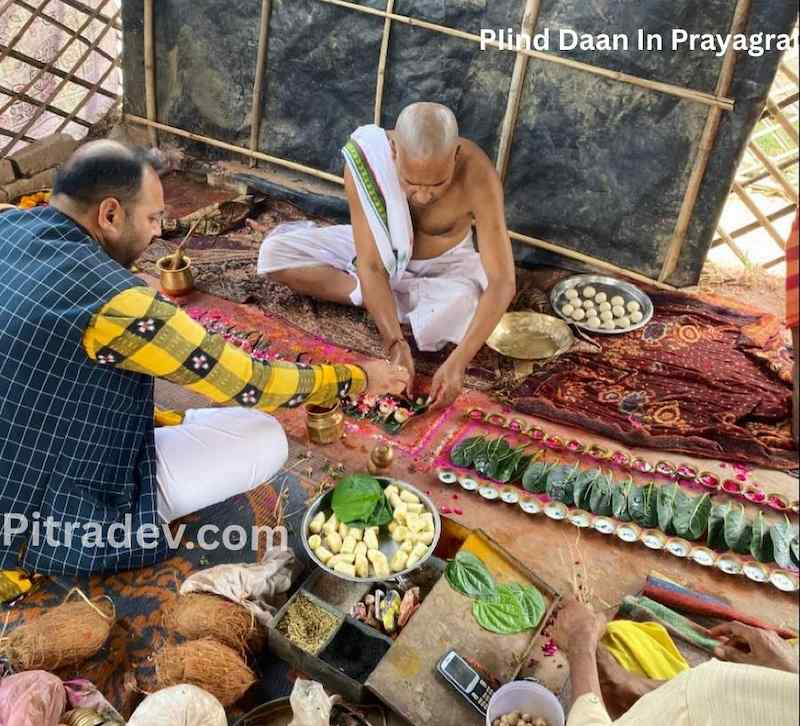
Pind Daan in Prayagraj: Cost, Vidhi & Booking Guide-2026
Pind Daan in Prayagraj is performed only at the Triveni Sangam ghat, with the Pandit ji conducting the full vidhi on the ghat itself. After the puja, the family takes a private boat to the actual confluence point of the Ganga, Yamuna and the invisible Saraswati for the holy dip (snan). Pitradev offers a single all-inclusive package at ₹5,000 covering the pandit, boat, samagri, sankalp and dakshina, with no hidden charges. The complete vidhi takes 1 to 2 hours and is performed as a private puja for each family.
Introduction
The Triveni Sangam at Prayagraj, where the Ganga from Gangotri, the Yamuna from Yamunotri and the invisible Saraswati believed to emerge from beneath the riverbed converge into a single sacred body of water, holds a place in Sanatani tradition that no other tirtha in India can match. For ancestral rites, the Matsya Puran and the Padma Puran name Prayag as the Tirtharaj — the king of all tirthas — and the Vayu Puran specifically prescribes Pind Daan at the Triveni Sangam, in combination with Gayaji, as the offering that liberates 7 generations of ancestors in both the paternal and the maternal lineage. Every year, lakhs of families travel to Prayagraj to perform Pind Daan at the Sangam, with Odia families from Bhubaneswar, Cuttack, Puri and the Odia diaspora forming the single largest segment, followed by Tamil, Telugu, Bengali and North Indian families. This guide explains the Pind Daan in Prayagraj cost, the venue, the step-by-step vidhi at the Triveni Sangam, and the booking process — so families can plan the ritual with full clarity.
Why Pind Daan at Triveni Sangam in Prayagraj specifically
Pind Daan at the Triveni Sangam is considered in scripture as the offering with the highest merit after Gaya itself, and the Vayu Puran prescribes the 2 together — Gayaji followed by Triveni Sangam, or in reverse — as the complete ancestral-rites pilgrimage that grants moksha to the family lineage. The reason scripture places the Sangam so highly is the simultaneous presence of 3 rivers, each one of which is independently a moksha-granting tirtha. The Ganga alone is considered sufficient to wash sins; the Yamuna is the river of Yamraj and is associated with the release of atmas from his domain; the invisible Saraswati represents inner knowledge and the formless aspect of divinity. Their confluence creates a single tirtha whose sanctity, scripture holds, is exponentially greater than any one of them alone.
For Odia families in particular, the Triveni Sangam holds a specific place in the ancestral-rites calendar. The Odia tradition recognises Jajpur on the banks of the Baitarani in Odisha as the Nabhi Gaya — the Gaya of the navel — and the larger Jajpur-Gayaji-Prayagraj-Varanasi sequence is followed by many families as the complete pitru-rites journey. For families considering the parallel rituals at other tirthas, the Pind Daan in Gaya complete guide and the Pind Daan in Varanasi by expert priests pages cover the respective locations. However, Prayagraj is the irreplaceable Sangam stop in this sequence, and the rituals here cannot be substituted at any other location.
Where exactly Pind Daan is performed at Triveni Sangam
Pitradev performs Pind Daan only at the Triveni Sangam in Prayagraj — nowhere else in the city. The full Pind Daan vidhi is conducted on the Triveni Sangam ghat itself, where the Pandit ji sets up the ritual space, leads the sankalp, and guides the karta through the pind preparation and offering. The ghat provides the open, riverside setting that scripture prescribes for the offering, and allows the family to be seated comfortably for the duration of the puja.
After the Pind Daan is complete, the family takes a private boat from the ghat to the actual confluence point — the spot where the visible waters of the Ganga and Yamuna meet, with the invisible Saraswati believed to join from beneath. At the confluence, the karta and the family take the holy dip (snan) in the Sangam waters, which scripturally completes the ritual cycle. The pind offerings are also visarjit (immersed) at this point. The boat journey from the ghat to the confluence takes 15 to 20 minutes each way.
The ghat itself is approximately 12 to 14 kilometres from Prayagraj Junction railway station and accessible by taxi, auto-rickshaw or e-rickshaw. Families who plan to combine the ritual with Asthi Visarjan at Triveni Sangam on the same trip can do so in a single day, since both rituals are performed at the same Sangam point with the same Pandit ji.
Pind Daan in Prayagraj cost — the ₹5,000 complete package
The Pind Daan in Prayagraj cost at Pitradev is fixed at a single all-inclusive price of ₹5,000, regardless of the time of year, with no hidden charges, no surge pricing during Pitru Paksh, and no separate boat fee added at the ghat. The package is structured so that the family does not encounter any on-site negotiation or surprise charge once they arrive in Prayagraj.
The ₹5,000 package includes:
Pandit Ji At The Sangam — A Vedic-Trained Priest Who Performs The Full Sankalp, Gotra-Pravara Recitation And The Pind Daan Vidhi.
Private Boat From The Sangam Ghat To The Confluence Point And Back, For The Post-Pind-Daan Snan And Visarjan.
Complete Samagri — Pind Rice Flour, Sesame Seeds (Til), Water, Kusha Grass, Flowers, And All Offering Items Prescribed In The Vidhi.
Sankalp With The Family's Gotra And The Names Of All Ancestors Being Offered To, Recited In Full As Per The Family's Paddhati.
Dakshina For The Pandit Ji — Included In The Package, Not Collected Separately At The Ghat.
Pre-booking the ritual through Pitradev before arriving in Prayagraj is strongly recommended over on-spot arrangement. Families who reach the Sangam without a pre-booked slot are often approached by local pandas at the ghat with informal quotes that start low and expand as the puja proceeds — the dakshina is asked for separately, the boat is charged separately, the samagri is charged separately, and the final outlay is significantly higher than ₹5,000 with no certainty of the priest's qualification. A pre-booked Pitradev slot avoids all of this and is confirmed at the Pind Daan in Prayagraj direct booking page.
The vidhi step-by-step — what happens in 1 to 2 hours
The complete Pind Daan vidhi at Triveni Sangam takes 1 to 2 hours from start to finish and follows a fixed scriptural sequence. The puja is conducted on the ghat, and the snan at the confluence point happens immediately after.
The puja begins with the karta changing into a fresh white dhoti and being seated at the ritual space prepared by the Pandit ji on the Triveni Sangam ghat. The Pandit ji opens with the sankalp — the formal vow in which the karta names the family gotra, the names of all ancestors being offered to, and the purpose of the puja. The sankalp is the single most important verbal element of the entire ritual, as scripture holds that only the ancestors named in the sankalp receive the offering. The Pandit ji then guides the karta through the preparation of the pind — small balls made from rice flour mixed with water, sesame and kusha grass — and each pind is offered with specific mantras, one for each named ancestor. After all the pinds are offered, the puja on the ghat closes with the aarti.
The family then boards the private boat at the ghat and is taken to the confluence point, where the karta and the family take the snan in the Sangam waters, and the pind offerings are visarjit at the confluence. The boat returns to the ghat, and the photo and video documentation is completed before the family leaves.
For couples who wish to do so, Veni Daan can be performed at the Sangam immediately after the Pind Daan — a ritual exclusive to the Triveni Sangam in which the husband and wife together offer a small portion of the wife's braided hair to the confluence waters, considered scripturally powerful for the longevity of the husband and the 7-lifetime bond between the couple. A separate detailed guide on Veni Daan will follow, and the ritual can be requested as an add-on at the time of booking Pind Daan.
When to do Pind Daan in Prayagraj — Pitru Paksh and year-round
Pind Daan in Prayagraj can be performed throughout the year and is not restricted to Pitru Paksh, but the 15-day Pitru Paksh window is considered the most auspicious in scripture. In 2026, Pitru Paksh begins on 26 September 2026 and ends on 10 October 2026, with the final day observed as Sarva Pitri Amavasya, also known as Mahalaya Amavasya — the most powerful single day in the entire ancestral-rites calendar.
During these 15 days, families from across India and the diaspora descend on Prayagraj, with Odia, Tamil, Telugu and Bengali families travelling in particularly large numbers. The Triveni Sangam becomes significantly more crowded, accommodation in Prayagraj gets booked 30 to 45 days in advance, and Pandit ji availability tightens. Families planning to perform Pind Daan during Pitru Paksh 2026 are advised to book by mid-August at the latest. Outside Pitru Paksh, the ghat is far less crowded, the booking is easier, and the scriptural merit of the puja itself remains the same — the difference is only in the additional merit attributed to the Pitru Paksh tithis.
For families bound by a specific tithi — the death anniversary of an ancestor, or a shraddh tithi during the year — Pind Daan is performed on that exact date, regardless of whether it falls in Pitru Paksh or otherwise. The booking is locked to the tithi rather than to the season.
Step-by-step booking process
Booking Pind Daan at Triveni Sangam with Pitradev is designed to be completed in 4 steps, and the family's involvement is limited to providing details and choosing the date. Everything else is arranged at the Prayagraj end.
The 4 steps are:
- Share family details over WhatsApp or call — the preferred date or the tithi, the family gotra, the names of the ancestors being offered to, and the family's paddhati (Odia, Tamil, Telugu, Bengali or North Indian) so the appropriate Pandit ji is allocated.
- Choose Pind Daan only or Pind Daan with Veni Daan — if the couple wishes to do Veni Daan after the Pind Daan, this is noted at the time of booking and the additional time and arrangement is planned in.
- Pay 20 percent advance to confirm the booking — the balance is settled in Prayagraj on the day of the puja after completion.
- Arrive in Prayagraj 1 day before the muhurat — rest is important before the morning puja, and arriving the previous day allows the family to complete the ritual without rushing.
Conclusion
Pind Daan in Prayagraj at the Triveni Sangam is among the most scripturally important offerings a family can make for the peace of their ancestors, and the value of the ritual is in its correctness, not in its complexity. The ₹5,000 all-inclusive package at Pitradev is structured so that the family can perform the puja with the Pandit ji on the Sangam ghat, take the holy dip at the actual confluence point on a private boat, and complete the entire vidhi within 1 to 2 hours — without the on-spot negotiation that families face when they arrive at the ghat without a pre-booked slot.
For families ready to book, the Pind Daan in Prayagraj direct booking page confirms the date, the Pandit ji and the language paddhati within 24 hours. For families planning the full Vayu Puran sequence with Gaya and Varanasi, a short WhatsApp consultation with Pitradev helps sequence the rituals across cities so that the entire pilgrimage is completed in a single coordinated journey.
FAQ
1. How much does Pind Daan at Triveni Sangam in Prayagraj cost in 2026?
Pitradev offers a single all-inclusive Pind Daan at Triveni Sangam package at ₹5,000. The price includes the Pandit ji, a private boat to the confluence point for the post-Pind-Daan snan, complete samagri, sankalp with the family gotra and ancestor names, dakshina, and photo and video on completion. There is no surge pricing during Pitru Paksh and no separate boat charge at the ghat.
2. Where exactly is the Pind Daan performed at Triveni Sangam?
The full Pind Daan vidhi is performed on the Triveni Sangam ghat itself, where the Pandit ji sets up the ritual space and leads the sankalp, pind preparation and offering. After the puja, the family takes a private boat from the ghat to the actual confluence point of the Ganga, Yamuna and the invisible Saraswati, where the holy dip (snan) is taken and the pind offerings are visarjit at the Sangam waters. The boat journey takes 15 to 20 minutes each way.
3. Will my Pind Daan be performed as a separate puja or in a group with other families?
Pitradev's ₹5,000 package is a separate, private puja for your family alone — the Pandit ji, the boat, the sankalp and the entire vidhi are dedicated to your family from start to finish. Group Pind Daan, where multiple families share a single sankalp and a single Pandit ji, is not what Pitradev offers at this price. Every family gets their own private boat, their own Pandit ji and their own complete vidhi.
4. How many days does Pind Daan in Prayagraj take, and when is the best time?
The complete Pind Daan vidhi at Triveni Sangam takes 1 to 2 hours on a single day, with the puja on the ghat followed by the snan and visarjan at the confluence. The most auspicious time is during the 15-day Pitru Paksh window — in 2026, this is 26 September to 10 October, ending with Sarva Pitri Amavasya. The puja can also be performed year-round on the death anniversary tithi of the ancestor or on any auspicious day, with the same scriptural merit.
5. Should we do Pind Daan at Prayagraj or at Gaya — or both?
Scripture, specifically the Vayu Puran, prescribes both — Pind Daan at Gayaji and at the Triveni Sangam at Prayagraj together liberates 7 generations of ancestors in the paternal and maternal lineage. Families who can travel to both perform the ritual at Gaya and at Prayagraj in a single pilgrimage. Families who can travel to only one are advised by scripture to choose Gaya first; however, those who have already done Gaya are expected to complete the journey at Prayagraj.
6. Can daughters or daughters-in-law perform Pind Daan at Triveni Sangam?
Yes, daughters, daughters-in-law and any female family member can perform Pind Daan at the Triveni Sangam. Scripture cites the precedent of Sita Mata performing the Pind Daan for her father-in-law King Dashrath, and many Odia, Tamil and Bengali families today have ladies of the family performing the ritual at the Sangam, particularly when there is no surviving male heir or when the daughter wishes to discharge the ancestral duty personally.
Shashank Mishra
Manager, Pitradev.com
Shashank Mishra comes with over 15 years of experience in religious tourism and organising Vedic rituals and ancestral ceremonies. At Pitradev, he oversees the coordination of Asthi Visarjan, Pind Daan, Shraadh, Grihapravesh, Vastu Shanti Puja, Satyanarayan Katha, Rudrabhishek, and other sacred rites across Varanasi, Prayagraj, Gaya, Bangalore, Hyderabad, Pune, and Mumbai. His deep understanding of Hindu customs across regional traditions — North Indian, Tamil, Telugu, Odia, and Kannada — allows him to guide families through the correct vidhi with care and clarity, whether it is an ancestral ceremony at a tirtha kshetra or a housewarming puja in a metro city.
Latest Blog
- Pind Daan for Dogs in Varanasi: Complete Rituals at Kashi
- Things To Know Before Booking A Pandit for Satyanarayan Puja
- How To Choose Right Muhurat for Griha Pravesh for Your New Home
- 7 Key Rituals and Stages of Pind Daan in Gaya
- Gand Mool Nakshatra Shanti Puja: Complete Process
- Grihapravesh Muhurat in November and December 2026
- Asthi Visarjan in Varanasi for Pets: Dogs And Cats
- Pind Daan in Varanasi: Guide to Ritual, Process, Cost, Booking
- Mistakes to Avoid During Asthi Visarjan in Varanasi
- How to book satyanarayn puja
- Verified South Indian Purohits in Gaya
- Samvatsarikam in Varanasi: Cost and Vidhi
- Best South Indian Purohits in Kashi Varanasi
- Pind Daan in Varanasi by Telugu Purohit
- Telugu Purohit in Gaya: Pind Daan Packages
- Tripindi Shraadh in Gaya
- Pitradev- Hindi, Tamil, Telugu & Bengali Pandit in Bangalore
- Narayan Bali Puja in Gaya
- Can I Do Pind Daan Within One Year of Death?
- One Day Narayan Bali Puja at Trimbakeshwar
- Asthi Visarjan at Manikarnika Ghat in Kashi Varanasi
- Cost of Asthi Visarjan in Varanasi: Packages and Precautions
- Pandit for Tripindi Shradh in Varanasi: 2026 Dates & Cost
- Pind Daan in Gaya in Pitru Paksha 2026: Dates and Packages
- Vastu Shanti Puja Cost in Pune by North Indian Pandit
- Pitra Dosh: Causes, Symptoms and Remedies — A Complete Guide
- How to Find Genuine Tamil Vadhyars in Kashi Varanasi
- How to Carry Asthi in Flight in India?
- Pind Daan in Gaya by Tamil Iyer: Cost, Packages and Process
- Asthi Visarjan in Srirangapatna from Bangalore — Full Guide
- Send Ashes from Coimbatore to Kashi — Asthi Visarjan Service
- Cost of Asthi Visarjan in Prayagraj by Telugu Pandit
- Asthi Visarjan and Pind Daan in Prayagraj for Odia Families
- North Indian Pandit Bangalore for Annaprashan Puja
- Telugu Grihapravesham Bangalore: 4 Packages Cost & Inclusion
- Cost of Tripindi Shraadh in Varanasi -Pishachmochan Kund
- North Indian Pandit in Pune for Grihapravesh: Package Guide
- Pind Daan in Prayagraj: Cost, Vidhi & Booking Guide-2026
- Narayan Bali Puja in Varanasi — Complete Cost Breakdown for 2026
- Book a Verified North Indian Pandit in Pune: Cost & Packages
- How to Send Asthi to Kashi: A Step-by-Step Guide
- Book Tamil Iyer in Bangalore for Grihapravesham – Complete Guide
- How to Plan 10th 11th and 12th Day Rituals in Varanasi
- Pitru Paksha 2026 – Pind Daan in Prayagraj, Kashi and Gaya
- Pitru Paksha 2026 – Book Online Pind Daan in Varanasi
- Asthi Visarjan in Varanasi for Tamil Families – Complete Guide
- How to Send Asthi (Ashes) from USA to India – Complete Guide
- Narayan Bali Puja in Varanasi – Complete Guide 2026
- Pind Daan in Gaya from Malaysia – Complete Guide
- Pind Pradanam in Varanasi from Malaysia – Complete Guide
- Grihapravesh Puja in Bangalore by Kannada Purohit
- Online Pind Daan in Varanasi for NRIs
- Book Verified Telugu Purohits in Bangalore for Grihapravesham
- Best Ghat for Asthi Visarjan in Varanasi: A Practical Comparison
- Asthi Visarjan in Prayagraj – Complete Guide 2026
- Tripindi Shradh in Varanasi – Complete Guide
- Asthi Visarjan in Varanasi –Best Ghat & Package 2026
- Grihapravesh Puja in Prestige City Sarjapur
- Gaya Ji Pind Daan 2026 – Quick Guide for Planning Your Trip
- Online Puja Booking for Griha Pravesh, Shradh & Satyanarayan
- Pitru Paksha 2026 Dates, Rituals and Pind Daan Guide
- Akshaya Tritiya 2026 (19 April): Best Muhurat for Griha Pravesh
- North Indian Pandit in Bangalore for All Hindu Pujas
- How to Do Asthi Visarjan When You Cannot Travel: Complete Guide
- Asthi Visarjan in Kashi: Complete Guide with Cost & Time
- Griha Pravesh Muhurat 2026: Auspicious Dates & Timings
- Complete Guide to Gaya Pind Daan Ritual, Samagri & Best Time
- Asthi Visarjan By Post in Kashi Varanasi – Complete Guide
- How to Book a Bengali Pandit for Puja: Step-by-Step Process
- Book Verified Pandit for Puja in Bangalore
- Book Verified North Indian Pandit in Hyderabad Online
- Book North Indian Pandit in Bangalore for Satyanarayan Puja
- How to Book a Pandit in Bangalore Online for Puja:Complete Guide
- Find and Book Pandits in Hyderabad for Griha Pravesh Puja Online
- How to Find and Book Experienced Pandit Online for Puja?
- Exploring the History and Origins of Griha Pravesh Puja Rituals
- Top 5 Ancient Places for Gayaji Pind Daan - 2024 Guide
- Significance of Performing Griha Pravesh Puja in Hindu Culture
- How to Choose the Right Pandit for Pind Daan in Gaya
- Why is Pind Daan in Gaya so Famous?
- Where to Find Experienced Pandit for Griha Pravesh Puja Online?
- Cost of Pind Daan in Gaya: Packages, Procedure and How to Book
- Griha Pravesh Puja and Housewarming Ceremony 2024
- How Gaya Pind Daan Brings Closure and Peace to Your Ancestors
- Gayaji Pind Daan: Achieve Eternal Peace for Your Ancestors
- Online Pind daan: Importance, Cost, and Procedure
- Gaya Pind Daan Puja is Performed by an Experienced Pandit ji
- The Sacred Ritual of Brahma Kapal Pind Daan
- A Complete Guide About Pind Daan in India: Update 2023
- Unveiling the Significance of Pind Daan in Gaya
- The Ultimate Guide to Pind Daan Tour Packages
- Where to do Asthi Visarjan in Haridwar?
- Rudrabhishek Pooja Why Hindus Perform Rudrabhishek pooja At home
- Varanasi's Asthi Visarjan: Embracing Life's Eternal Journey
- Unveiling the Sacred Ritual:
- Significance of Asthi Visarjan in Haridwar
- Exploring the Profound Significance of Asthi Visarjan in Kashi
- The Science of Pind Daan:
- What are the rituals of Pind Daan?
- Varanasi Ayodhya Tour Package with Prayagraj
- Pind Daan Puja in Varanasi | Book Your Puja Online
- Prayagraj: The Enchanting Journey of Asthi Visarjan
- Pind Daan Gaya : When and Where to Do Pind Daan in Gayaji
- Exploring the Mystical Rituals of Asthi Visarjan Poojan
- Which are the Best Places to do Pind Daan in Gaya?
- Everything You Need to Know About Rudrabhishek Puja
- Why Is Pind Daan At Gaya Important To Hindus?
- Asthi Visarjan: When to Perform It, Where to Go, and Cost
- Rudra Abhishek Puja's Purpose:
- Ganga Pushkaralu 2023
- Pind daan for people having unnatural deaths
- Is doing pind daan beneficial without self presence of related?