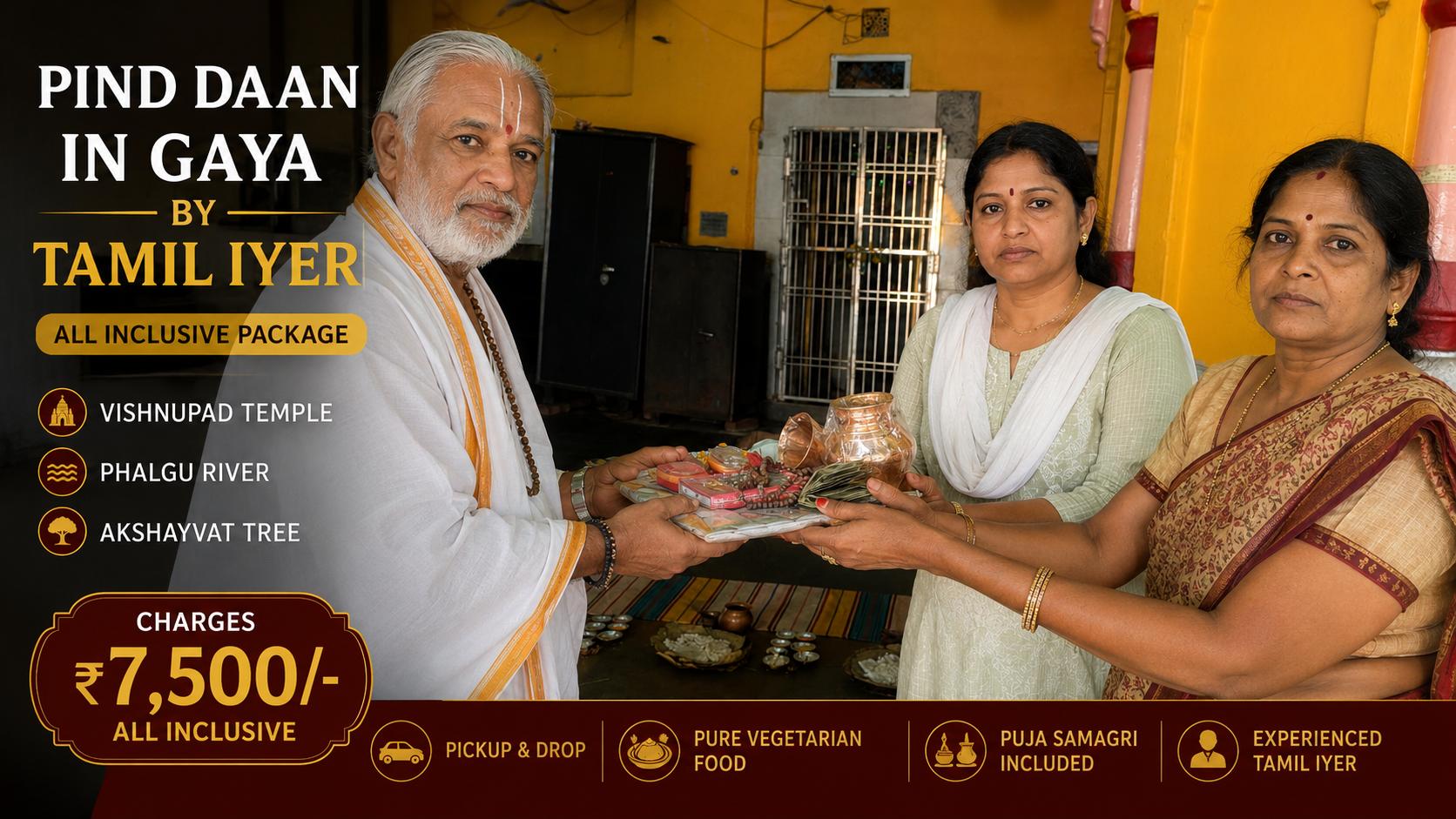
Pind Daan in Gaya by Tamil Iyer: Cost, Packages and Process
Pind Daan in Gaya by a Tamil Iyer is offered by Pitradev in 2 packages. The first package, performed at the Vishnupad Temple alone, is priced at Rs 5,000, and the second package, covering the Vishnupad Temple, the Falguni River and the Akshayvat tree, is priced at Rs 7,500. Learned and experienced Tamil speaking purohits conduct the complete vidhi in the Tamil tradition.
For Tamil families who wish to perform Pind Daan in Gaya by a Tamil Iyer, the difficulty is rarely the decision to travel and is almost always the question of finding a purohit who will conduct the rites in the family's own tradition and in a language the karta understands. Gaya is regarded across the scriptures as Moksha Bhoomi, the land of salvation, and the offerings made here to departed ancestors are believed to secure their liberation in a way that no other tirth allows. Many a time a Tamil family reaches Gaya only to find purohits who recite the sankalp in Hindi or in a North Indian style, which leaves an already grieving family uncertain about whether the rite has been performed as their own elders would have done it. This guide sets out the cost of Pind Daan in Gaya by a Tamil Iyer, the 2 packages and what each one covers, the 3 sacred sites at which the rituals are performed, the sequence followed on the day, and the right time in 2026 to undertake the ritual.
Why Pind Daan in Gaya holds special significance
Pind Daan in Gaya holds a position that no other place of pilgrimage holds, because the scriptures treat Gaya as the single site where the offering made to ancestors secures their final liberation, and because Lord Vishnu is believed to be present here in the form of his footprint preserved within the Vishnupad Temple.
The standing of Gaya rests on an old account in which a demon named Gayasura obtained a boon so powerful that anyone who saw him attained salvation, and Lord Vishnu, in order to regulate this, pressed the demon beneath the earth with his foot, leaving the sacred footprint that gives the Vishnupad Temple its name. The Ramayana records that Lord Rama travelled to Gaya to offer Pind Daan for his father King Dasharatha, and this example is cited even today as the reason a son carries the duty of performing the rite for his forefathers. The Garuda Puran and other texts place Gaya Shraddha above shraddha performed at any other location, and so performing Pind Daan in Gaya is understood not as one option among many, but as the offering that honours the departed in its fullest form.
Why a Tamil Iyer purohit matters for Pind Daan in Gaya
A Tamil Iyer purohit matters because the shraddha and tarpana of a Tamil Brahmin family follow a particular sutra, a particular order of mantras, and a generational ordering of ancestors that differs from North Indian practice, and only a purohit trained in that tradition can perform the sankalp and the offerings correctly.
In the Tamil Brahmin tradition of honouring ancestors, the immediate 3 generations, namely the father, the grandfather and the great grandfather, are propitiated directly through tarpana and shraddha, and the recitation of the gotra and pravara of the family is treated as central to the rite. A purohit who belongs to this tradition knows the correct invocations for each generation, follows the prescribed sequence of offerings, and is able to guide the karta in Tamil at every step, which removes the uncertainty that families face when the rite is conducted in an unfamiliar style. For an elderly karta who does not follow Hindi, hearing the sankalp in his own language allows him to participate with full understanding rather than merely repeating sounds. The same families who would book an experienced Tamil Iyer for a grihapravesham in their home city expect the same standard for the most important of all ancestral rites, and Pitradev arranges learned and experienced Tamil speaking purohits in Gaya who perform the complete vidhi in the Tamil sampradaya with full dedication.
The 3 sacred sites: Vishnupad Temple, Falguni River and the Akshayvat tree
Pind Daan in Gaya is performed at 3 sites that the tradition treats as a connected circuit, and the difference between the 2 packages is the difference between performing the rite at the Vishnupad Temple alone and performing it across all 3.
The Vishnupad Temple
The Vishnupad Temple takes its name from the 40 centimetre footprint of Lord Vishnu, imprinted in solid rock and surrounded by a silver basin, marked with the Shankh, Chakra and Gada associated with the deity. The present structure was built in the 18th century by Devi Ahilya Bai Holkar of Indore upon the older sacred site, and it remains the central point of the Gaya pilgrimage. Pind Daan offered at the footprint of Vishnu is treated as the core of the ritual, and it is the one site included in both packages.
The Falguni River
The Falguni River flows beside the temple and carries its own account within the tradition, in which it was cursed to remain dry through most of the year after giving false witness during an ancient offering of Pind Daan. Even today the river runs without surface water for much of the year, and families take a purifying bath at its bank before proceeding to make the offering. The bank of the Falguni River is one of the sites covered in the second package.
The Akshayvat tree
The Akshayvat is the immortal banyan tree at which the final rites of the departed are performed, and the tradition holds that when other witnesses gave false testimony during Sita's offering of Pind Daan, the tree alone told the truth and was blessed with undying life and with the boon that offerings made beneath it carry imperishable merit. For this reason the Akshayvat is treated as the closing site of the ritual, where the offering is sealed, and it is the third of the sites included in the complete package.
How much does Pind Daan in Gaya by a Tamil Iyer cost?
Pind Daan in Gaya by a Tamil Iyer through Pitradev is offered in 2 packages: the first at Rs 5,000 for the ritual performed at the Vishnupad Temple alone, and the second at Rs 7,500 for the ritual performed across the 3 sacred sites, namely the Vishnupad Temple, the Falguni River and the Akshayvat tree, by an experienced Tamil speaking purohit.
Package 1 — Vishnupad Temple only, Rs 5,000
The first package covers Pind Daan performed at the footprint of Lord Vishnu within the Vishnupad Temple, conducted by a learned Tamil Iyer in the Tamil tradition. This package suits families who have limited time in Gaya, or who wish to perform the central offering at the most important of the 3 sites without undertaking the full circuit, and even in its shorter form the rite is performed with the complete sankalp and the correct mantras for the family's generations.
Package 2 — Vishnupad Temple, Falguni River and Akshayvat tree, Rs 7,500
The second package covers the complete circuit, beginning with the bath and offering at the Falguni River, continuing to the footprint at the Vishnupad Temple, and concluding with the final rite at the Akshayvat tree. Families who wish to honour their ancestors in the fullest manner generally choose this package, and the full details of Pind Daan in Gaya with Pitradev set out what the arrangement includes.
What the ritual involves on the day
On the day of the ritual, the karta first takes a purifying bath, after which the purohit begins with the sankalp, in which the name, gotra and intention of the family are declared so that the offering is directed to the correct ancestors. The pind itself is prepared from rice, til and barley shaped into rounded offerings, and these are placed upon a banana leaf along with water, sesame and the other samagri that the rite requires. Carrying forward through the sequence, the purohit performs the tarpana for each generation and recites the prescribed mantras, and in the complete package the offerings are made at the river, the temple and the tree in turn. The samagri is arranged in advance so that the family is not required to gather materials on the day, and on completion of the offering the rite is understood to have discharged the duty owed to the departed.
When to perform Pind Daan in Gaya: Pitru Paksha 2026 and year-round
The most auspicious period for Pind Daan in Gaya is Pitru Paksha, which in 2026 falls from 26 September to 10 October, during which Gaya hosts the annual Pitru Paksha Mela and lakhs of families arrive to offer tarpan and pind to their ancestors; however, the ritual can also be performed on suitable days through the rest of the year.
During Pitru Paksha the crowds at the Vishnupad Temple and along the Falguni River are very large, and for this reason families who intend to perform the rite during the fortnight are advised to make their arrangements well in advance so that a Tamil speaking purohit and the required samagri are reserved. For a family that has recently lost an elder, or for those unable to travel during the fortnight, the ritual may be performed on other appropriate days, and the same standard of tradition is maintained. Families who are weighing Gaya against other sacred sites often consider Pind Daan in Varanasi as well, though the scriptures place the Gaya offering in a category of its own.
Conclusion
Pind Daan in Gaya is regarded as the most complete way of discharging the duty owed to one's ancestors, and for a Tamil family the assurance that the rite is performed in the correct sampradaya, by a learned purohit who recites the sankalp and mantras in Tamil, is what turns a long journey into a properly completed offering. The choice between the 2 packages is straightforward, namely the Rs 5,000 package at the Vishnupad Temple alone, or the Rs 7,500 package across the Vishnupad Temple, the Falguni River and the Akshayvat tree, and the right time is Pitru Paksha or any other suitable day through the year. For families who would prefer the arrangements to be handled end to end, with an experienced Tamil speaking purohit and all samagri provided, Pitradev offers Pind Daan in Gaya with Pitradev, and families who are also addressing Pitru Dosh or an unnatural death in the lineage may additionally consider Narayan Bali Puja. In either case the purpose remains the same, which is to honour the departed in the manner their own elders would have recognised.
Frequently Asked Questions
How much does Pind Daan in Gaya by a Tamil Iyer cost?
Pind Daan in Gaya by a Tamil Iyer through Pitradev is offered in 2 packages. The first, performed at the Vishnupad Temple alone, is priced at Rs 5,000, and the second, covering the Vishnupad Temple, the Falguni River and the Akshayvat tree, is priced at Rs 7,500. Both are conducted by learned Tamil speaking purohits in the Tamil tradition.
What is the difference between the Rs 5,000 and the Rs 7,500 package?
The Rs 5,000 package covers Pind Daan at the footprint of Lord Vishnu within the Vishnupad Temple, which is the central site of the ritual. The Rs 7,500 package covers the complete circuit across the Falguni River, the Vishnupad Temple and the Akshayvat tree, which the tradition treats as the most thorough form.
Will the rituals be performed in the Tamil tradition and language?
Yes. Pitradev arranges learned and experienced Tamil speaking purohits in Gaya who perform the sankalp, tarpana and pind offerings in the Tamil sampradaya, with the correct recitation of the family gotra and pravara, and who guide the karta in Tamil at every step.
When is the best time to perform Pind Daan in Gaya in 2026?
The most auspicious period is Pitru Paksha, which in 2026 falls from 26 September to 10 October, when Gaya hosts the annual Pitru Paksha Mela. The ritual can also be performed on other suitable days through the year, and because the site is very crowded during Pitru Paksha, arrangements should be reserved in advance.
Is Pind Daan at the Vishnupad Temple alone enough, or are all 3 sites needed?
Pind Daan at the Vishnupad Temple alone is a valid offering at the most important of the 3 sites, and it suits families with limited time in Gaya. The complete circuit across all 3 sites is regarded as the most complete form, and the choice depends on the time available and on the family's own wish.
Latest Blog
- Things To Know Before Booking A Pandit for Satyanarayan Puja
- How To Choose Right Muhurat for Griha Pravesh for Your New Home
- 7 Key Rituals and Stages of Pind Daan in Gaya
- Gand Mool Nakshatra Shanti Puja: Complete Process
- Grihapravesh Muhurat in November and December 2026
- Asthi Visarjan in Varanasi for Pets: Dogs And Cats
- Pind Daan in Varanasi: Guide to Ritual, Process, Cost, Booking
- Mistakes to Avoid During Asthi Visarjan in Varanasi
- How to book satyanarayn puja
- Verified South Indian Purohits in Gaya
- Samvatsarikam in Varanasi: Cost and Vidhi
- Best South Indian Purohits in Kashi Varanasi
- Pind Daan in Varanasi by Telugu Purohit
- Telugu Purohit in Gaya: Pind Daan Packages
- Tripindi Shraadh in Gaya
- Pitradev- Hindi, Tamil, Telugu & Bengali Pandit in Bangalore
- Narayan Bali Puja in Gaya
- Can I Do Pind Daan Within One Year of Death?
- One Day Narayan Bali Puja at Trimbakeshwar
- Asthi Visarjan at Manikarnika Ghat in Kashi Varanasi
- Cost of Asthi Visarjan in Varanasi: Packages and Precautions
- Pandit for Tripindi Shradh in Varanasi: 2026 Dates & Cost
- Pind Daan in Gaya in Pitru Paksha 2026: Dates and Packages
- Vastu Shanti Puja Cost in Pune by North Indian Pandit
- Pitra Dosh: Causes, Symptoms and Remedies — A Complete Guide
- How to Find Genuine Tamil Vadhyars in Kashi Varanasi
- How to Carry Asthi in Flight in India?
- Pind Daan in Gaya by Tamil Iyer: Cost, Packages and Process
- Asthi Visarjan in Srirangapatna from Bangalore — Full Guide
- Send Ashes from Coimbatore to Kashi — Asthi Visarjan Service
- Cost of Asthi Visarjan in Prayagraj by Telugu Pandit
- Asthi Visarjan and Pind Daan in Prayagraj for Odia Families
- North Indian Pandit Bangalore for Annaprashan Puja
- Telugu Grihapravesham Bangalore: 4 Packages Cost & Inclusion
- Cost of Tripindi Shraadh in Varanasi -Pishachmochan Kund
- North Indian Pandit in Pune for Grihapravesh: Package Guide
- Pind Daan in Prayagraj: Cost, Vidhi & Booking Guide-2026
- Narayan Bali Puja in Varanasi — Complete Cost Breakdown for 2026
- Book a Verified North Indian Pandit in Pune: Cost & Packages
- How to Send Asthi to Kashi: A Step-by-Step Guide
- Book Tamil Iyer in Bangalore for Grihapravesham – Complete Guide
- How to Plan 10th 11th and 12th Day Rituals in Varanasi
- Pitru Paksha 2026 – Pind Daan in Prayagraj, Kashi and Gaya
- Pitru Paksha 2026 – Book Online Pind Daan in Varanasi
- Asthi Visarjan in Varanasi for Tamil Families – Complete Guide
- How to Send Asthi (Ashes) from USA to India – Complete Guide
- Narayan Bali Puja in Varanasi – Complete Guide 2026
- Pind Daan in Gaya from Malaysia – Complete Guide
- Pind Pradanam in Varanasi from Malaysia – Complete Guide
- Grihapravesh Puja in Bangalore by Kannada Purohit
- Online Pind Daan in Varanasi for NRIs
- Book Verified Telugu Purohits in Bangalore for Grihapravesham
- Best Ghat for Asthi Visarjan in Varanasi: A Practical Comparison
- Asthi Visarjan in Prayagraj – Complete Guide 2026
- Tripindi Shradh in Varanasi – Complete Guide
- Asthi Visarjan in Varanasi –Best Ghat & Package 2026
- Grihapravesh Puja in Prestige City Sarjapur
- Gaya Ji Pind Daan 2026 – Quick Guide for Planning Your Trip
- Online Puja Booking for Griha Pravesh, Shradh & Satyanarayan
- Pitru Paksha 2026 Dates, Rituals and Pind Daan Guide
- Akshaya Tritiya 2026 (19 April): Best Muhurat for Griha Pravesh
- North Indian Pandit in Bangalore for All Hindu Pujas
- How to Do Asthi Visarjan When You Cannot Travel: Complete Guide
- Asthi Visarjan in Kashi: Complete Guide with Cost & Time
- Griha Pravesh Muhurat 2026: Auspicious Dates & Timings
- Complete Guide to Gaya Pind Daan Ritual, Samagri & Best Time
- Asthi Visarjan By Post in Kashi Varanasi – Complete Guide
- How to Book a Bengali Pandit for Puja: Step-by-Step Process
- Book Verified Pandit for Puja in Bangalore
- Book Verified North Indian Pandit in Hyderabad Online
- Book North Indian Pandit in Bangalore for Satyanarayan Puja
- How to Book a Pandit in Bangalore Online for Puja:Complete Guide
- Find and Book Pandits in Hyderabad for Griha Pravesh Puja Online
- How to Find and Book Experienced Pandit Online for Puja?
- Exploring the History and Origins of Griha Pravesh Puja Rituals
- Top 5 Ancient Places for Gayaji Pind Daan - 2024 Guide
- Significance of Performing Griha Pravesh Puja in Hindu Culture
- How to Choose the Right Pandit for Pind Daan in Gaya
- Why is Pind Daan in Gaya so Famous?
- Where to Find Experienced Pandit for Griha Pravesh Puja Online?
- Cost of Pind Daan in Gaya: Packages, Procedure and How to Book
- Griha Pravesh Puja and Housewarming Ceremony 2024
- How Gaya Pind Daan Brings Closure and Peace to Your Ancestors
- Gayaji Pind Daan: Achieve Eternal Peace for Your Ancestors
- Online Pind daan: Importance, Cost, and Procedure
- Gaya Pind Daan Puja is Performed by an Experienced Pandit ji
- The Sacred Ritual of Brahma Kapal Pind Daan
- A Complete Guide About Pind Daan in India: Update 2023
- Unveiling the Significance of Pind Daan in Gaya
- The Ultimate Guide to Pind Daan Tour Packages
- Where to do Asthi Visarjan in Haridwar?
- Rudrabhishek Pooja Why Hindus Perform Rudrabhishek pooja At home
- Varanasi's Asthi Visarjan: Embracing Life's Eternal Journey
- Unveiling the Sacred Ritual:
- Significance of Asthi Visarjan in Haridwar
- Exploring the Profound Significance of Asthi Visarjan in Kashi
- The Science of Pind Daan:
- What are the rituals of Pind Daan?
- Varanasi Ayodhya Tour Package with Prayagraj
- Pind Daan Puja in Varanasi | Book Your Puja Online
- Prayagraj: The Enchanting Journey of Asthi Visarjan
- Pind Daan Gaya : When and Where to Do Pind Daan in Gayaji
- Exploring the Mystical Rituals of Asthi Visarjan Poojan
- Which are the Best Places to do Pind Daan in Gaya?
- Everything You Need to Know About Rudrabhishek Puja
- Why Is Pind Daan At Gaya Important To Hindus?
- Asthi Visarjan: When to Perform It, Where to Go, and Cost
- Rudra Abhishek Puja's Purpose:
- Ganga Pushkaralu 2023
- Pind daan for people having unnatural deaths
- Is doing pind daan beneficial without self presence of related?