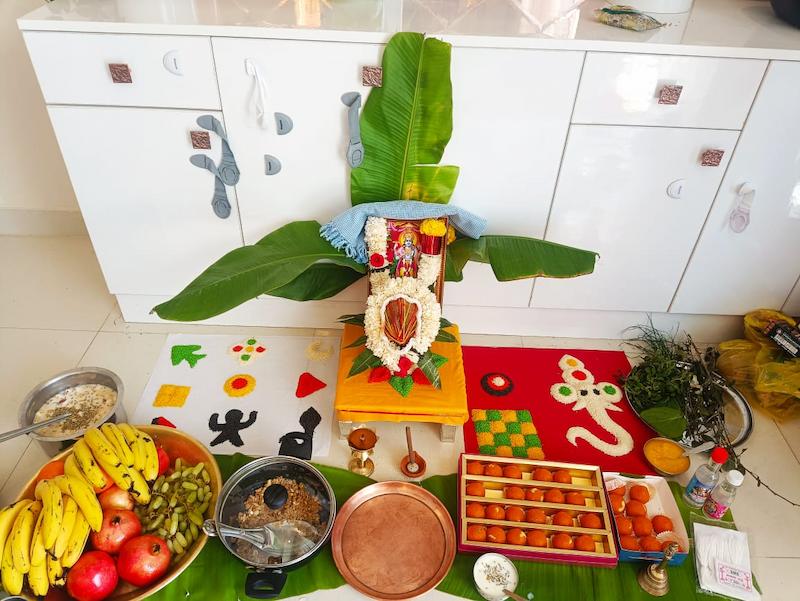
Satyanarayan Katha in Pune by North Indian Pandit
TL;DR: Pitradev arranges Satyanarayan Katha at your home in Pune by an experienced North Indian pandit at a fixed cost of ₹4,500. The puja takes approximately 3 hours and includes the complete vidhi from Gauri Ganesh Pujan to the final Visarjan. Pandit ji brings all puja items. Available across Hinjewadi, Wakad, Baner, Kharadi, Viman Nagar, Pimpri-Chinchwad, and all Pune areas.
The One Puja Every North Indian Family Performs
Whether it is a new home, a new job, a birthday, a recovery from illness, or simply a Thursday when the family wants to express gratitude — Satyanarayan Katha is the one puja that North Indian families turn to for every occasion. It is the most commonly performed puja across UP, Bihar, Delhi, Rajasthan, and Jharkhand, and for families from these states who have now made Pune their home, the tradition does not change.
What changes is the challenge of finding the right pandit.
Pune’s pandit ecosystem is predominantly Marathi. For a North Indian family living in Blue Ridge at Hinjewadi, or in Gera’s Planet of Joy at Kharadi, or in Godrej Infinity at Wakad, finding a pandit who performs the Satyanarayan Katha in the exact North Indian tradition — with the correct mantras, the familiar sequence, and the same vidhi that their family has followed for generations — is genuinely difficult.
This is why Pitradev arranges verified North Indian pandits in Pune who perform the Satyanarayan Katha exactly as it is done back home.
When Do Families Perform Satyanarayan Katha
Satyanarayan Katha does not require a specific muhurat or auspicious date. It can be performed on any day, though Purnima (full moon day) and Thursday are traditionally considered the most suitable. Families commonly perform Satyanarayan Katha on these occasions:
After moving into a new home — many families perform it alongside or shortly after Grihapravesh as a way of inviting continued blessings into the new space.
On birthdays and anniversaries — as a way of expressing gratitude for the year gone by and seeking blessings for the year ahead.
After a recovery from illness — as a thanksgiving for restored health.
After a promotion or professional milestone — many North Indian professionals in Pune’s IT corridor perform the katha after a job change, a promotion, or a successful project.
On the completion of a vow (mannat) — when a prayer has been answered, performing Satyanarayan Katha is the traditional way of fulfilling the promise made to the Lord.
During festivals — on Diwali, Navratri, or any occasion when the family wishes to worship at home.
There is no restriction on how many times Satyanarayan Katha can be performed. Some families do it once a year, some do it multiple times. The puja is inherently auspicious and brings only positive energy.
Satyanarayan Katha Package in Pune — ₹4,500- Book Now
Pitradev offers the complete Satyanarayan Katha at your home in Pune at a fixed, all-inclusive cost of ₹4,500.
What is included:
- 1 experienced North Indian pandit ji
- All puja samagri brought by pandit ji
- Pandit ji dakshina
- No hidden charges
What pandit ji brings:
- Shaligram
- Satyanarayan Swami photo
- Banana leaves and mango leaves
- Rice for the mandal
- Havan kund and all havan items
- All other ritual materials
Duration: Approximately 3 hours
What you need to arrange:
- Fruits — 5 types
- Sweets — 1 kg
- Milk — 500 ml
- Curd — 250 grams
- Loose flowers with Tulsi dal or Tulsi mala
- Ghee — 250 grams
- 2 steel plates
- 2 bowls
- 2 spoons
The complete list is shared at the time of booking so there is no confusion on the day.
The Complete Satyanarayan Katha Vidhi — Step by Step
The pandit ji performs the following pujas in sequence over the 3-hour ceremony:
Gauri Ganesh Pujan — The ceremony opens with the invocation of Lord Ganesha and Goddess Gauri, seeking their blessings for the successful completion of the katha.
Kalash Pujan — The sacred Kalash is established with water, coconut, mango leaves, and flowers, representing the divine presence.
Navgraha Pujan — All 9 planets are worshipped to harmonise their influence and to remove any planetary obstacles.
Satyanarayan Bhagwan Pujan and Abhishek — Lord Satyanarayan (a form of Lord Vishnu) is worshipped with the prescribed offerings. The Abhishek is performed on the Shaligram with milk, curd, honey, ghee, and Ganga jal.
Katha — The 5 chapters of the Satyanarayan Katha are recited by the pandit ji. Each chapter tells the story of a devotee who was blessed by Lord Satyanarayan’s grace, and the moral significance is explained. The family sits and listens throughout the katha, participating at key moments as guided by the pandit.
Shanti Havan — The sacred fire is lit in the havan kund, and offerings of ghee, samagri, and other items are made with Vedic mantras. The havan purifies the atmosphere of the home.
Aarti — The family performs the Aarti together, singing the Satyanarayan Aarti with the pandit ji.
Prasad Distribution — The prasad, typically made of soaked chana, banana, Tulsi, and mishri, is distributed to all family members and guests present.
Visarjan — The Kalash water is sprinkled in every room of the home, and the ceremony is formally concluded.
Why North Indian Pandit Matters for Satyanarayan Katha
A family from UP or Bihar who has grown up listening to the Satyanarayan Katha in a specific way — the rhythm of the mantras, the sequence of the chapters, the way the prasad is prepared, the havan items used — will immediately notice if the vidhi is different.
A Marathi pandit performing Satyanarayan Katha follows the Maharashtrian tradition, which has its own sequence and customs. There is nothing wrong with it — but it is not what a North Indian family recognises as their tradition. The katha feels different, the mantras sound different, and the overall experience does not carry the same emotional connection.
Pitradev’s North Indian pandits in Pune come from Prayagraj, Banaras, Gaya, and Mithila. They perform the Satyanarayan Katha in the same tradition that your family has followed for generations — so the ceremony feels like home, even though you are in Pune.
Satyanarayan Katha in Pune Apartments — What to Know
Most North Indian families in Pune live in apartments and gated societies, and performing a puja with havan in a flat requires specific awareness:
Smoke management during havan. Our pandit ji is experienced in performing havan in apartments. He uses a controlled amount of samagri to minimise smoke while maintaining the completeness of the havan. Windows and balcony doors are kept open for ventilation.
Society rules. Some gated societies like Megapolis at Hinjewadi, Kolte Patil Life Republic, or Paranjape Blue Ridge have specific rules about fire and smoke inside flats. If your society has such rules, inform us at the time of booking and the pandit ji will adjust the havan setup accordingly — sometimes performing it on the balcony or in the society’s common area is the practical solution.
Space. The puja setup requires approximately 6 feet by 6 feet of clear floor space. Most living rooms in 2 BHK and 3 BHK apartments in Pune can accommodate this comfortably.
Timing. Morning pujas (starting 8 to 9 AM) are generally preferred as they cause less disruption to neighbours. The 3-hour duration means you finish by noon.
Areas We Serve in Pune for Satyanarayan Katha
Pitradev arranges North Indian pandit for Satyanarayan Katha across all major residential areas in Pune:
Hinjewadi — Phase 1, 2, and 3. Serving families in Megapolis, Blue Ridge, Kolte Patil Life Republic, and all other societies. This is the single highest demand area for North Indian pandit services in Pune due to the concentration of IT professionals from UP, Bihar, and Delhi.
Wakad — My Home Wakad, Godrej Infinity, Tata Aria, Kolte Patil Western Avenue, and surrounding societies. Wakad has the second highest concentration of North Indian families after Hinjewadi.
Baner and Balewadi — Premium residential area with high demand for Satyanarayan Katha, especially among senior professionals and families who have moved from smaller apartments to larger homes.
Kharadi — Gera’s Planet of Joy, Gera’s Island of Joy, Kolte Patil Downtown, and all surrounding societies. The eastern IT corridor of Pune with a rapidly growing North Indian population.
Viman Nagar — Close to the airport, popular with families who travel frequently and want a convenient location.
Pimpri-Chinchwad — The industrial twin city of Pune with a large North Indian population working in manufacturing and automobile sectors.
Hadapsar and Magarpatta — Magarpatta City township and surrounding areas, serving IT professionals in the Fursungi and Hadapsar IT parks.
Aundh and Pimple Saudagar — Established residential areas with a mix of families and working professionals.
Wagholi — One of the most affordable residential areas in Pune, popular with young North Indian families buying their first home.
Kalyani Nagar — Premium residential area with a growing North Indian professional community.
No matter which area of Pune you are in, a verified North Indian pandit ji can be arranged at your doorstep for Satyanarayan Katha.
Best Occasions to Combine Satyanarayan Katha with Other Pujas
Many families in Pune combine Satyanarayan Katha with other ceremonies on the same day or over a weekend:
Satyanarayan Katha + Grihapravesh — Our ₹21,000 grand Grihapravesh package already includes Satyanarayan Katha along with Vastu Shanti Puja and Durga Saptshati Path. This is the most complete housewarming ceremony.
Satyanarayan Katha + Sunderkand Path — Some families perform both on the same day, with Sunderkand in the morning and Satyanarayan in the afternoon, or on consecutive days.
Satyanarayan Katha after Barsi — After the first death anniversary ceremony is completed, many families perform Satyanarayan Katha as a way of inviting positive energy back into the home after a year of mourning.
How to Book a Pandit in Pune
- Contact Pitradev on WhatsApp or phone
- Share your preferred date and address
- Confirm the booking — pandit ji and timing details are shared
- Pandit ji arrives at your home with all samagri on the confirmed date
Booking 3 to 5 days in advance is recommended. On Purnima days and during festival season, book at least 1 week in advance.
Conclusion
Satyanarayan Katha is the simplest and most universally performed puja in the North Indian tradition, and there is no reason why moving to Pune should change the way your family observes it. With Pitradev, an experienced North Indian pandit ji arrives at your home in any area of Pune — from Megapolis in Hinjewadi to Gera’s Planet of Joy in Kharadi — with all the samagri, performs the complete 3-hour vidhi as per your tradition, and the cost is a fixed ₹4,500 with no hidden charges.
Your tradition travelled with you. The pandit is just a booking away.
Frequently Asked Questions
Shashank Mishra
Manager, Pitradev.com
Shashank Mishra comes with over 15 years of experience in religious tourism and organising Vedic rituals and ancestral ceremonies. At Pitradev, he oversees the coordination of Asthi Visarjan, Pind Daan, Shraadh, Grihapravesh, Vastu Shanti Puja, Satyanarayan Katha, Rudrabhishek, and other sacred rites across Varanasi, Prayagraj, Gaya, Bangalore, Hyderabad, Pune, and Mumbai.
Latest Blog
- Satyanarayan Katha in Pune by North Indian Pandit
- Odia Pandit Prayagraj | Asthi Bisarjan & Pind Daan Same Day
- How to Book Asthi Visarjan in Kashi Online
- Book Pandit Services Online A Complete Step by Step Guide
- Book Verified Pandit Ji in Bangalore for Any Puja Easy Guide
- How to Book a Vastu Pujan Griha Pravesh Puja for Your New Home
- How to Book Pind Daan in Gaya Online Complete Guide
- Pind Daan in Varanasi After Pitru Paksha
- Pind Daan for Dogs in Varanasi: Complete Rituals at Kashi
- Things To Know Before Booking A Pandit for Satyanarayan Puja
- How To Choose Right Muhurat for Griha Pravesh for Your New Home
- 7 Key Rituals and Stages of Pind Daan in Gaya
- Gand Mool Nakshatra Shanti Puja: Complete Process
- Grihapravesh Muhurat in November and December 2026
- Asthi Visarjan in Varanasi for Pets: Dogs And Cats
- Pind Daan in Varanasi: Guide to Ritual, Process, Cost, Booking
- Mistakes to Avoid During Asthi Visarjan in Varanasi
- How to book satyanarayn puja
- Verified South Indian Purohits in Gaya
- Samvatsarikam in Varanasi: Cost and Vidhi
- Best South Indian Purohits in Kashi Varanasi
- Pind Daan in Varanasi by Telugu Purohit
- Telugu Purohit in Gaya: Pind Daan Packages
- Tripindi Shraadh in Gaya
- Pitradev- Hindi, Tamil, Telugu & Bengali Pandit in Bangalore
- Narayan Bali Puja in Gaya
- Can I Do Pind Daan Within One Year of Death?
- One Day Narayan Bali Puja at Trimbakeshwar
- Asthi Visarjan at Manikarnika Ghat in Kashi Varanasi
- Cost of Asthi Visarjan in Varanasi: Packages and Precautions
- Pandit for Tripindi Shradh in Varanasi: 2026 Dates & Cost
- Pind Daan in Gaya in Pitru Paksha 2026: Dates and Packages
- Vastu Shanti Puja Cost in Pune by North Indian Pandit
- Pitra Dosh: Causes, Symptoms and Remedies — A Complete Guide
- How to Find Genuine Tamil Vadhyars in Kashi Varanasi
- How to Carry Asthi in Flight in India?
- Pind Daan in Gaya by Tamil Iyer: Cost, Packages and Process
- Asthi Visarjan in Srirangapatna from Bangalore — Full Guide
- Send Ashes from Coimbatore to Kashi — Asthi Visarjan Service
- Cost of Asthi Visarjan in Prayagraj by Telugu Pandit
- Asthi Visarjan and Pind Daan in Prayagraj for Odia Families
- North Indian Pandit Bangalore for Annaprashan Puja
- Telugu Grihapravesham Bangalore: 4 Packages Cost & Inclusion
- Cost of Tripindi Shraadh in Varanasi -Pishachmochan Kund
- North Indian Pandit in Pune for Grihapravesh: Package Guide
- Pind Daan in Prayagraj: Cost, Vidhi & Booking Guide-2026
- Narayan Bali Puja in Varanasi — Complete Cost Breakdown for 2026
- Book a Verified North Indian Pandit in Pune: Cost & Packages
- How to Send Asthi to Kashi: A Step-by-Step Guide
- Book Tamil Iyer in Bangalore for Grihapravesham – Complete Guide
- How to Plan 10th 11th and 12th Day Rituals in Varanasi
- Pitru Paksha 2026 – Pind Daan in Prayagraj, Kashi and Gaya
- Pitru Paksha 2026 – Book Online Pind Daan in Varanasi
- Asthi Visarjan in Varanasi for Tamil Families – Complete Guide
- How to Send Asthi (Ashes) from USA to India – Complete Guide
- Narayan Bali Puja in Varanasi – Complete Guide 2026
- Pind Daan in Gaya from Malaysia – Complete Guide
- Pind Pradanam in Varanasi from Malaysia – Complete Guide
- Grihapravesh Puja in Bangalore by Kannada Purohit
- Online Pind Daan in Varanasi for NRIs
- Book Verified Telugu Purohits in Bangalore for Grihapravesham
- Best Ghat for Asthi Visarjan in Varanasi: A Practical Comparison
- Asthi Visarjan in Prayagraj – Complete Guide 2026
- Tripindi Shradh in Varanasi – Complete Guide
- Asthi Visarjan in Varanasi –Best Ghat & Package 2026
- Grihapravesh Puja in Prestige City Sarjapur
- Gaya Ji Pind Daan 2026 – Quick Guide for Planning Your Trip
- Online Puja Booking for Griha Pravesh, Shradh & Satyanarayan
- Pitru Paksha 2026 Dates, Rituals and Pind Daan Guide
- Akshaya Tritiya 2026 (19 April): Best Muhurat for Griha Pravesh
- How to Do Asthi Visarjan When You Cannot Travel: Complete Guide
- Asthi Visarjan in Kashi: Complete Guide with Cost & Time
- Griha Pravesh Muhurat 2026: Auspicious Dates & Timings
- Complete Guide to Gaya Pind Daan Ritual, Samagri & Best Time
- Asthi Visarjan By Post in Kashi Varanasi – Complete Guide
- How to Book a Bengali Pandit for Puja: Step-by-Step Process
- Book Verified Pandit for Puja in Bangalore
- Book Verified North Indian Pandit in Hyderabad Online
- Book North Indian Pandit in Bangalore for Satyanarayan Puja
- How to Book a Pandit in Bangalore Online for Puja:Complete Guide
- Find and Book Pandits in Hyderabad for Griha Pravesh Puja Online
- How to Find and Book Experienced Pandit Online for Puja?
- Exploring the History and Origins of Griha Pravesh Puja Rituals
- Top 5 Ancient Places for Gayaji Pind Daan - 2024 Guide
- Significance of Performing Griha Pravesh Puja in Hindu Culture
- How to Choose the Right Pandit for Pind Daan in Gaya
- Why is Pind Daan in Gaya so Famous?
- Where to Find Experienced Pandit for Griha Pravesh Puja Online?
- Cost of Pind Daan in Gaya: Packages, Procedure and How to Book
- Griha Pravesh Puja and Housewarming Ceremony 2024
- How Gaya Pind Daan Brings Closure and Peace to Your Ancestors
- Gayaji Pind Daan: Achieve Eternal Peace for Your Ancestors
- Online Pind daan: Importance, Cost, and Procedure
- Gaya Pind Daan Puja is Performed by an Experienced Pandit ji
- The Sacred Ritual of Brahma Kapal Pind Daan
- A Complete Guide About Pind Daan in India: Update 2023
- Unveiling the Significance of Pind Daan in Gaya
- The Ultimate Guide to Pind Daan Tour Packages
- Where to do Asthi Visarjan in Haridwar?
- Rudrabhishek Pooja Why Hindus Perform Rudrabhishek pooja At home
- Varanasi's Asthi Visarjan: Embracing Life's Eternal Journey
- Unveiling the Sacred Ritual:
- Significance of Asthi Visarjan in Haridwar
- Exploring the Profound Significance of Asthi Visarjan in Kashi
- The Science of Pind Daan:
- What are the rituals of Pind Daan?
- Varanasi Ayodhya Tour Package with Prayagraj
- Pind Daan Puja in Varanasi | Book Your Puja Online
- Prayagraj: The Enchanting Journey of Asthi Visarjan
- Pind Daan Gaya : When and Where to Do Pind Daan in Gayaji
- Exploring the Mystical Rituals of Asthi Visarjan Poojan
- Which are the Best Places to do Pind Daan in Gaya?
- Everything You Need to Know About Rudrabhishek Puja
- Why Is Pind Daan At Gaya Important To Hindus?
- Asthi Visarjan: When to Perform It, Where to Go, and Cost
- Rudra Abhishek Puja's Purpose:
- Ganga Pushkaralu 2023
- Pind daan for people having unnatural deaths
- Is doing pind daan beneficial without self presence of related?