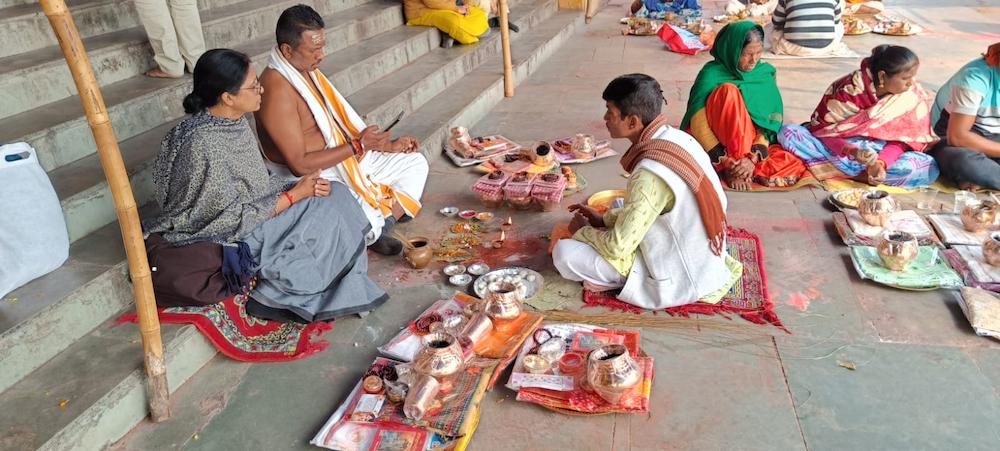
Can I Do Pind Daan Within One Year of Death?
Tirth Shradh or Pind Daan at places like Kashi, Prayagraj, Gaya, or Nashik should generally be done only after the Varshik Shradh (Barsi/annual shradh) is completed, which happens in the 11th month after death. However, Asthi Sanchay Pind Daan (3 pinds done along with Asthi Visarjan), tarpan during Pitru Paksha, and special-purpose rituals like Tripindi Shradh and Narayan Bali can be performed within one year. Gaya Shradh is the final Pind Daan and is ideally done when both parents have passed away, usually after 3 to 4 years.
The Confusion Families Face
When a person passes away, the family enters a period of intense emotional and ritual responsibility. The first few days are consumed by the cremation and immediate rites. But very quickly, questions begin to arise. Should we go to Gaya or Varanasi now? Can we do Pind Daan at a tirth within the first year? What about Pitru Paksha — should we perform Shradh this year? These questions create genuine confusion, because different family members, priests, and online sources often give different answers.
The short answer is that Hindu scripture prescribes a clear and specific sequence of rituals after death, and certain things are meant to happen within the first year while others are meant to happen only after the first year is completed. Understanding this sequence removes most of the confusion, and this guide lays it out step by step.
The Complete Sequence of Rituals After Death — Day by Day
The rituals that follow a person's death are not a single event but a carefully prescribed sequence that unfolds over an entire year. Each step serves a specific spiritual purpose, and they are meant to be followed in order.
Cremation and Asthi Visarjan (within 10 days):
Daswan — 10th Day (10 Pinds):
Ekadasha — 11th Day (1 Pind):
Dwadasha — 12th Day (12 Pinds and Daan):
- Gau Daan — donation of a cow and calf
- Vastra Daan — donation of clothes
- Patra Daan — donation of utensils
- Brahmin Bhojan — feeding of Brahmins
- Saiya Daan — donation of a bed (cot with bedding)
These daans are believed to assist the departed soul on its onward journey, providing it with sustenance and comfort in the afterlife.
Terahvi — 13th Day (Brahmin Bhojan):
Masik Shradh — Monthly Pind Daan (every month till the 10th month):
Varshik Shradh / Barsi / Annual Shradh (11th month):
What Can Be Done Within One Year
Within the first year after death, the following rituals are permitted and appropriate:
Asthi Sanchay Pind Daan: This is the Pind Daan of 3 rice balls done specifically for the departed soul, performed along with the Asthi Visarjan within the first 10 days. This is not the same as Tirth Shradh — it is a part of the immediate post-cremation rites and is both permitted and encouraged within the first year.
Tarpan during Pitru Paksha: During the first Pitru Paksha that falls within the year of mourning, the family should not perform the full Shradh with pind daan for the recently deceased. However, they can and should perform tarpan — the offering of water mixed with black sesame seeds (til) — for the departed soul. This is a simpler offering and is specifically allowed within the first year. Full Pitru Paksha Shradh with pind daan for the recently deceased begins only from the second year onwards.
Tripindi Shradh: Tripindi Shradh in Varanasi is a special-purpose ritual performed for ancestors whose Shradh has not been conducted for 3 or more consecutive years, or when Pitra Dosh is identified in the kundali. Because it addresses a different spiritual need (removal of Pitra Dosh or clearing the backlog of missed Shradh for older generations), it can be performed within one year of a recent death.
Narayan Bali: Narayan Bali in Varanasi is performed specifically for the soul of a person who died an unnatural or untimely death — such as an accident, suicide, drowning, or murder. Because the soul of such a person is believed to be trapped in preta yoni and requires immediate spiritual intervention, Narayan Bali can and should be performed within one year of the death. It does not need to wait for the Barsi.
What Should Not Be Done Within One Year
The following should generally not be performed within the first year after death:
Tirth Shradh at Kashi, Prayagraj, Gaya, or Nashik: Tirth Shradh — the pilgrimage-based Pind Daan performed at the major tirthas — should be done only after the Varshik Shradh (Barsi) is completed. The reason is scriptural: the soul's journey through the first year follows a specific path, and the monthly shradhs and the annual shradh are the prescribed way to support that journey. Tirth Shradh is meant for a soul that has already completed its first-year transition and has formally entered pitru loka.
Full Pitru Paksha Shradh: During the first Pitru Paksha after the death, the family should offer only tarpan (water and til) for the recently deceased. The full Shradh with pind daan during Pitru Paksha begins from the second year onwards. This is an important distinction that many families are not aware of.
Gaya Shradh: Gaya Pind Daan is the ultimate and final Shradh, and it should absolutely not be done within the first year. More on this below.
After Barsi — When Tirth Shradh Begins
Once the Varshik Shradh (Barsi) is completed in the 11th month, the family can perform Tirth Shradh at the sacred cities. This means you can now visit Pind Daan in Varanasi at the Ganga ghats, or perform the rite at Prayagraj, Haridwar, or Nashik. The Tirth Shradh can be done at any time after the Barsi — even the very next day if the family has planned ahead.
From the second year onwards, the family also begins performing the full Pitru Paksha Shradh with pind daan for the departed, on the tithi that matches the date of death. The annual tithi Shradh and the Pitru Paksha Shradh become the two regular annual observances from this point forward.
Many families choose to perform Tirth Shradh at Varanasi or Prayagraj in the first or second Pitru Paksha after the Barsi is completed, combining the pilgrimage with the annual Shradh observance. This is a practical and scripturally sound approach.
When to Do Gaya Shradh — The Final Pind Daan
Gaya holds a unique and singular position among all the tirthas. Pind Daan in Gaya at the Vishnupad Temple is considered the ultimate and final Shradh in the Hindu tradition. Once Gaya Shradh is performed, it is believed that the ancestors are permanently liberated, and no further Pind Daan at any other place is required — though some families choose to continue annual observances out of personal devotion.
Because of this finality, Gaya Shradh should not be rushed. Here are the general guidelines that most families and traditional pandits follow:
Wait for both parents to pass away. Gaya Shradh is ideally performed when both the mother and the father have passed away. Performing it while one parent is still alive is not recommended, because the rite addresses the entire ancestral chain, and performing it prematurely can create a spiritual incompleteness.
Wait 3 to 4 years after death. Even after both parents have passed, many families wait 3 to 4 years before going to Gaya. During this period, they perform the annual tithi Shradh and the Pitru Paksha Shradh each year, fulfilling the regular annual duty. After 3 to 4 years of regular observance, the family travels to Gaya for the final Pind Daan.
After Gaya Shradh, annual observances stop. Once the Gaya Shradh is completed, the annual Pitru Paksha Shradh and the tithi Shradh are traditionally no longer required. The ancestors are considered permanently liberated, and the family's Pitra Rin (debt to ancestors) is considered fully discharged. Some families, however, choose to continue offering tarpan during Pitru Paksha as a personal expression of gratitude, even after Gaya Shradh.
Tripindi Shradh and Narayan Bali — Exceptions That Can Be Done Within One Year
Two important rituals stand outside the general one-year restriction, because they address specific and urgent spiritual needs.
Narayan Bali is performed for a person who died an unnatural death. The soul of such a person is believed to be trapped in preta yoni and unable to progress on its spiritual journey without the specific rites that Narayan Bali provides. Since this is essentially a second funeral rite for a trapped soul, it does not need to wait for the Barsi and can be performed as soon as the family is ready. Pitradev arranges Narayan Bali in Varanasi at Pisachmochan Kund with packages starting at ₹15,000.
Tripindi Shradh addresses a different need — either Pitra Dosh in the kundali, or ancestors for whom Shradh has not been performed for 3 or more consecutive years. Because it targets older ancestral generations and not the recently deceased, it is permitted within the first year. Tripindi Shradh in Varanasi is performed at Pisachmochan Kund, which is the scripturally prescribed location for this ritual.
Neither of these two rituals is a substitute for the regular post-death sequence (Daswan, Ekadasha, Dwadasha, Masik Shradh, Barsi). They serve different purposes and are prescribed for different conditions.
Quick Reference — What Is Allowed and What Is Not Within One Year
Allowed within one year:
- Asthi Visarjan (within 10 days)
- Asthi Sanchay Pind Daan (3 pinds, done with Asthi Visarjan)
- Daswan, Ekadasha, Dwadasha, Terahvi (10th to 13th day)
- Masik Shradh (monthly, on the same tithi)
- Tarpan during Pitru Paksha (water and til only)
- Narayan Bali (for unnatural death)
- Tripindi Shradh (for Pitra Dosh or missed Shradh of older ancestors)
Not allowed within one year:
- Tirth Shradh at Kashi, Prayagraj, Gaya, Nashik, or Haridwar
- Full Pitru Paksha Shradh with pind daan for the recently deceased
- Gaya Shradh (the final Pind Daan)
Allowed only after 3 to 4 years (and ideally after both parents have passed):
- Gaya Shradh (the final and ultimate Pind Daan)
Conclusion
The rituals after death in Hinduism follow a clear and carefully prescribed sequence, and understanding this sequence removes most of the confusion that families face. Within the first year, the focus should be on completing the immediate rites (Asthi Visarjan, Daswan, Ekadasha, Dwadasha, Terahvi), the monthly Masik Shradh, and the Varshik Shradh (Barsi). Tirth Shradh at the sacred cities begins only after the Barsi is completed. Gaya Shradh, the final Pind Daan, should be reserved for when both parents have passed and the family has observed regular annual Shradh for a few years.
For special situations — unnatural death or Pitra Dosh — Narayan Bali and Tripindi Shradh can be performed within the first year itself.
If you have any doubt about which ritual is appropriate for your family's situation at this time, speak with a qualified pandit who can assess the specifics and guide you correctly. Pitradev's pandit team is available to advise families on the correct sequence and timing, whether you are in the first year after a death or planning the final Gaya Shradh years later.
Frequently Asked Questions
1. Can Pind Daan be done within one year of death?
2. What is Asthi Sanchay Pind Daan and can it be done within one year?
3. Can I do Pitru Paksha Shradh within the first year?
4. When should I go to Gaya for Pind Daan after a death in the family?
5. Can Narayan Bali or Tripindi Shradh be done within one year?
6. What is the difference between Tirth Shradh and annual Shradh?
Shashank Mishra
Manager, Pitradev.com
Shashank Mishra comes with over 15 years of experience in religious tourism and organising Vedic rituals and ancestral ceremonies. At Pitradev, he oversees the coordination of Asthi Visarjan, Pind Daan, Shraadh, Grihapravesh, Vastu Shanti Puja, Satyanarayan Katha, Rudrabhishek, and other sacred rites across Varanasi, Prayagraj, Gaya, Bangalore, Hyderabad, Pune, and Mumbai. His deep understanding of Hindu customs across regional traditions — North Indian, Tamil, Telugu, Odia, and Kannada — allows him to guide families through the correct vidhi with care and clarity, whether it is an ancestral ceremony at a tirtha kshetra or a housewarming puja in a metro city.
Latest Blog
- Gaya Pind Daan vs Varanasi Pind Daan
- Satyanarayan Katha in Pune by North Indian Pandit
- Odia Pandit Prayagraj | Asthi Bisarjan & Pind Daan Same Day
- How to Book Asthi Visarjan in Kashi Online
- Book Pandit Services Online A Complete Step by Step Guide
- Book Verified Pandit Ji in Bangalore for Any Puja Easy Guide
- How to Book a Vastu Pujan Griha Pravesh Puja for Your New Home
- How to Book Pind Daan in Gaya Online Complete Guide
- Pind Daan in Varanasi After Pitru Paksha
- Pind Daan for Dogs in Varanasi: Complete Rituals at Kashi
- Things To Know Before Booking A Pandit for Satyanarayan Puja
- How To Choose Right Muhurat for Griha Pravesh for Your New Home
- 7 Key Rituals and Stages of Pind Daan in Gaya
- Gand Mool Nakshatra Shanti Puja: Complete Process
- Grihapravesh Muhurat in November and December 2026
- Asthi Visarjan in Varanasi for Pets: Dogs And Cats
- Pind Daan in Varanasi: Guide to Ritual, Process, Cost, Booking
- Mistakes to Avoid During Asthi Visarjan in Varanasi
- How to book satyanarayn puja
- Verified South Indian Purohits in Gaya
- Samvatsarikam in Varanasi: Cost and Vidhi
- Best South Indian Purohits in Kashi Varanasi
- Pind Daan in Varanasi by Telugu Purohit
- Telugu Purohit in Gaya: Pind Daan Packages
- Tripindi Shraadh in Gaya
- Pitradev- Hindi, Tamil, Telugu & Bengali Pandit in Bangalore
- Narayan Bali Puja in Gaya
- Can I Do Pind Daan Within One Year of Death?
- One Day Narayan Bali Puja at Trimbakeshwar
- Asthi Visarjan at Manikarnika Ghat in Kashi Varanasi
- Cost of Asthi Visarjan in Varanasi: Packages and Precautions
- Pandit for Tripindi Shradh in Varanasi: 2026 Dates & Cost
- Pind Daan in Gaya in Pitru Paksha 2026: Dates and Packages
- Vastu Shanti Puja Cost in Pune by North Indian Pandit
- Pitra Dosh: Causes, Symptoms and Remedies — A Complete Guide
- How to Find Genuine Tamil Vadhyars in Kashi Varanasi
- How to Carry Asthi in Flight in India?
- Pind Daan in Gaya by Tamil Iyer: Cost, Packages and Process
- Asthi Visarjan in Srirangapatna from Bangalore — Full Guide
- Send Ashes from Coimbatore to Kashi — Asthi Visarjan Service
- Cost of Asthi Visarjan in Prayagraj by Telugu Pandit
- Asthi Visarjan and Pind Daan in Prayagraj for Odia Families
- North Indian Pandit Bangalore for Annaprashan Puja
- Telugu Grihapravesham Bangalore: 4 Packages Cost & Inclusion
- Cost of Tripindi Shraadh in Varanasi -Pishachmochan Kund
- North Indian Pandit in Pune for Grihapravesh: Package Guide
- Pind Daan in Prayagraj: Cost, Vidhi & Booking Guide-2026
- Narayan Bali Puja in Varanasi — Complete Cost Breakdown for 2026
- Book a Verified North Indian Pandit in Pune: Cost & Packages
- How to Send Asthi to Kashi: A Step-by-Step Guide
- Book Tamil Iyer in Bangalore for Grihapravesham – Complete Guide
- How to Plan 10th 11th and 12th Day Rituals in Varanasi
- Pitru Paksha 2026 – Pind Daan in Prayagraj, Kashi and Gaya
- Pitru Paksha 2026 – Book Online Pind Daan in Varanasi
- Asthi Visarjan in Varanasi for Tamil Families – Complete Guide
- How to Send Asthi (Ashes) from USA to India – Complete Guide
- Narayan Bali Puja in Varanasi – Complete Guide 2026
- Pind Daan in Gaya from Malaysia – Complete Guide
- Pind Pradanam in Varanasi from Malaysia – Complete Guide
- Grihapravesh Puja in Bangalore by Kannada Purohit
- Online Pind Daan in Varanasi for NRIs
- Book Verified Telugu Purohits in Bangalore for Grihapravesham
- Best Ghat for Asthi Visarjan in Varanasi: A Practical Comparison
- Asthi Visarjan in Prayagraj – Complete Guide 2026
- Tripindi Shradh in Varanasi – Complete Guide
- Asthi Visarjan in Varanasi –Best Ghat & Package 2026
- Grihapravesh Puja in Prestige City Sarjapur
- Gaya Ji Pind Daan 2026 – Quick Guide for Planning Your Trip
- Online Puja Booking for Griha Pravesh, Shradh & Satyanarayan
- Pitru Paksha 2026 Dates, Rituals and Pind Daan Guide
- Akshaya Tritiya 2026 (19 April): Best Muhurat for Griha Pravesh
- How to Do Asthi Visarjan When You Cannot Travel: Complete Guide
- Asthi Visarjan in Kashi: Complete Guide with Cost & Time
- Griha Pravesh Muhurat 2026: Auspicious Dates & Timings
- Complete Guide to Gaya Pind Daan Ritual, Samagri & Best Time
- Asthi Visarjan By Post in Kashi Varanasi – Complete Guide
- How to Book a Bengali Pandit for Puja: Step-by-Step Process
- Book Verified Pandit for Puja in Bangalore
- Book Verified North Indian Pandit in Hyderabad Online
- Book North Indian Pandit in Bangalore for Satyanarayan Puja
- How to Book a Pandit in Bangalore Online for Puja:Complete Guide
- Find and Book Pandits in Hyderabad for Griha Pravesh Puja Online
- How to Find and Book Experienced Pandit Online for Puja?
- Exploring the History and Origins of Griha Pravesh Puja Rituals
- Top 5 Ancient Places for Gayaji Pind Daan - 2024 Guide
- Significance of Performing Griha Pravesh Puja in Hindu Culture
- How to Choose the Right Pandit for Pind Daan in Gaya
- Why is Pind Daan in Gaya so Famous?
- Where to Find Experienced Pandit for Griha Pravesh Puja Online?
- Cost of Pind Daan in Gaya: Packages, Procedure and How to Book
- Griha Pravesh Puja and Housewarming Ceremony 2024
- How Gaya Pind Daan Brings Closure and Peace to Your Ancestors
- Gayaji Pind Daan: Achieve Eternal Peace for Your Ancestors
- Online Pind daan: Importance, Cost, and Procedure
- Gaya Pind Daan Puja is Performed by an Experienced Pandit ji
- The Sacred Ritual of Brahma Kapal Pind Daan
- A Complete Guide About Pind Daan in India: Update 2023
- Unveiling the Significance of Pind Daan in Gaya
- The Ultimate Guide to Pind Daan Tour Packages
- Where to do Asthi Visarjan in Haridwar?
- Rudrabhishek Pooja Why Hindus Perform Rudrabhishek pooja At home
- Varanasi's Asthi Visarjan: Embracing Life's Eternal Journey
- Unveiling the Sacred Ritual:
- Significance of Asthi Visarjan in Haridwar
- Exploring the Profound Significance of Asthi Visarjan in Kashi
- The Science of Pind Daan:
- What are the rituals of Pind Daan?
- Varanasi Ayodhya Tour Package with Prayagraj
- Pind Daan Puja in Varanasi | Book Your Puja Online
- Prayagraj: The Enchanting Journey of Asthi Visarjan
- Pind Daan Gaya : When and Where to Do Pind Daan in Gayaji
- Exploring the Mystical Rituals of Asthi Visarjan Poojan
- Which are the Best Places to do Pind Daan in Gaya?
- Everything You Need to Know About Rudrabhishek Puja
- Why Is Pind Daan At Gaya Important To Hindus?
- Asthi Visarjan: When to Perform It, Where to Go, and Cost
- Rudra Abhishek Puja's Purpose:
- Ganga Pushkaralu 2023
- Pind daan for people having unnatural deaths
- Is doing pind daan beneficial without self presence of related?