Pandit for Tripindi Shradh in Varanasi: 2026 Dates & Cost
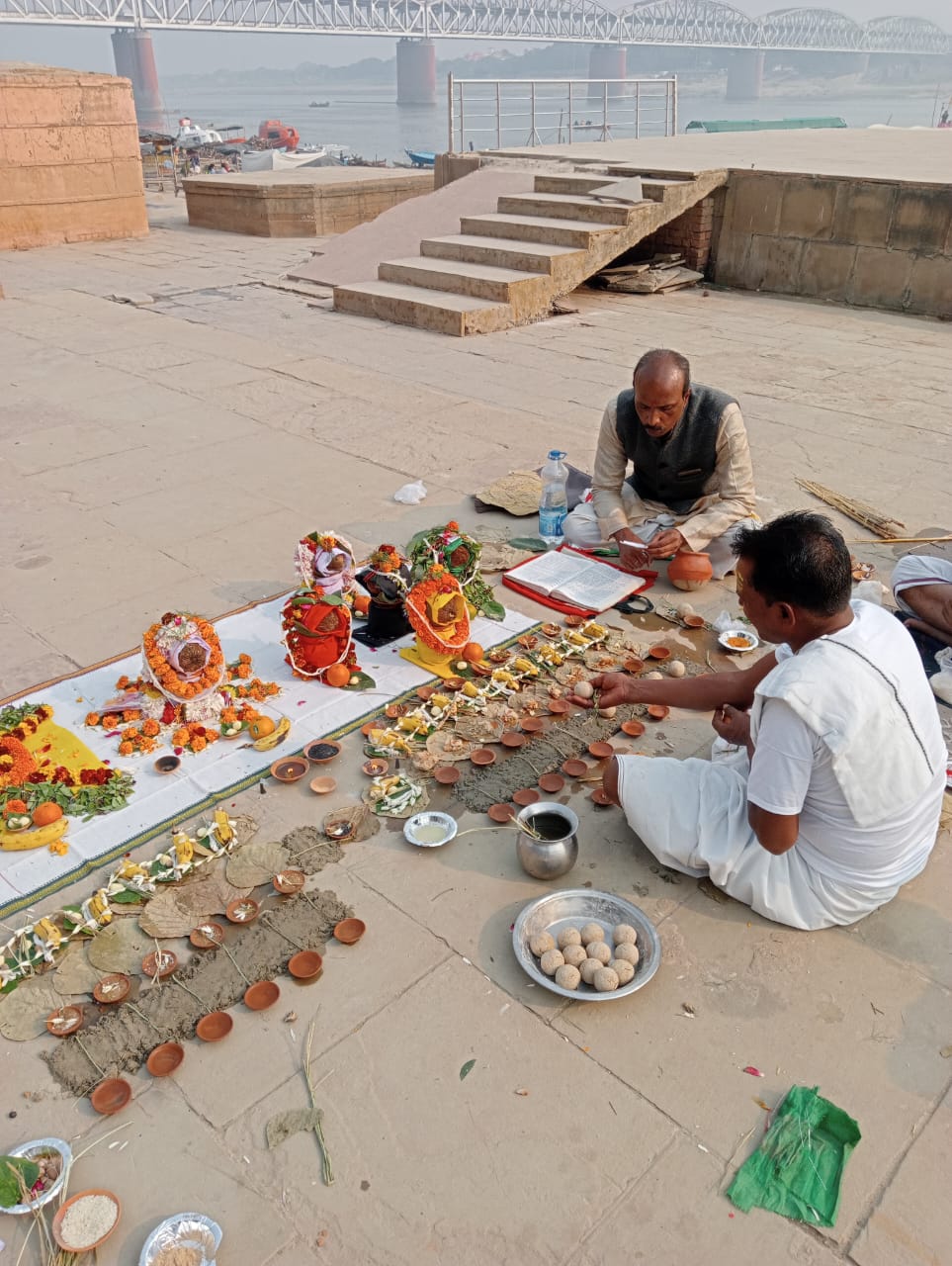
Tripindi Shraadh is a special remedial ritual, not an ordinary Shraadh, and selecting the right pandit for Tripindi Shraadh in Varanasi matters far more than it does for routine Pind Daan. The rite is performed at Pishachmochan Kund on Amavasya, by a team of 3 to 5 experienced pandits, with packages from ₹15,000. This guide gives the month-wise 2026 Amavasya dates, the package details, and what to verify before selecting a pandit.
When a family sets out to arrange a pitra ritual, the common assumption is that any pandit will be able to perform it, and for routine Pind Daan or annual Shraadh that assumption largely holds. Selecting a pandit for Tripindi Shraadh in Varanasi is a different matter, and it deserves more care, because Tripindi Shraadh is a specialised remedial rite performed to resolve pitra dosh and to settle ancestors whose Shraadh has lapsed across generations, and a pandit who conducts only ordinary pujas may not hold its full vidhi. This guide explains why the choice of pandit matters for Tripindi Shraadh, lists the month-wise Amavasya dates for 2026 on which the ritual can be performed, sets out the packages and what each one includes, and describes how the rite is booked, whether in person at Varanasi or remotely for a family that cannot travel.
What is Tripindi Shraadh, and why is it not an ordinary Shraadh?
Tripindi Shraadh, also written as Tripindi Shradh or Tripindi Shraddha, is a special remedial ritual performed to appease 3 generations of ancestors — pitru, pitamah and prapitamah — in a single Sankalp, and to relieve the pitra dosh that arises when ancestral rites have lapsed or when ancestors are unknown. In Varanasi it is performed at Pishachmochan Kund on Amavasya, and it differs in both purpose and procedure from routine Shraadh or Pind Daan.
The 3-generation Sankalp — pitru, pitamah and prapitamah
Where an annual Shraadh is offered to 1 named ancestor, Tripindi Shraadh takes a Sankalp that covers 3 generations together, and offers a symbolic pind to each, so that ancestors across the paternal line are addressed in one rite. Many families no longer know the names of ancestors beyond a generation or two, and in such cases the Sankalp is made in a form that addresses the unknown souls of the gotra, which the scriptures recognise as valid. This is one reason Tripindi Shraadh suits families carrying an old, accumulated burden rather than a single recent bereavement, and why it is closely linked with the resolution of pitra dosh.
How it differs from annual Shraadh and from Pind Daan
Annual Shraadh is repeated every year on the death tithi of a particular ancestor, and Pind Daan offers pindas for the peace of the departed, but Tripindi Shraadh is remedial in intent, combining deity worship, a Homa and Tarpan directed at releasing ancestors from the restless preta state. Because it is both remedial and multi-generational, it is generally performed once, and repeated only after a long interval rather than every year. Considering this difference in purpose, the ritual carries a more elaborate procedure, and the procedure is precisely where the experience of the pandit begins to matter.
Why not every pandit can perform Tripindi Shraadh
For ordinary Pind Daan and Tarpan a family will find many capable priests at the ghats of Varanasi, and Pind Daan in Varanasi is widely offered as a standard service that most pandits are equipped to conduct. Tripindi Shraadh sits in a different category, because the rite involves a gotra-based Sankalp spanning 3 generations, a Homa with specific mantras intended for the liberation of ancestors from preta yoni, and a fixed sequence of deity worship, pind offering, Homa and Tarpan that must be followed correctly for the ritual to serve its remedial purpose. A pandit accustomed only to routine ceremonies may not hold the complete Tripindi vidhi, and a ritual performed in an incomplete or incorrectly sequenced manner defeats the very reason the family undertook it.
Further to this, Tripindi Shraadh is usually taken up on the strength of a pitra dosh reading, and the pandit performing it should understand the shastraic basis of the rite rather than treating it as a longer Pind Daan. The ritual is also location-specific in Varanasi, performed at Pishachmochan Kund, the site associated with the release of trapped souls, and it is conducted by a team of 3 to 5 pandits reciting in parallel rather than by a single priest. Where the ancestral difficulty traces specifically to an unnatural death in the family, the correct remedy is not Tripindi Shraadh at all but Narayan Bali Puja in Varanasi and an experienced pandit is the person who can tell the family which of the two rites their situation actually calls for.
What to verify before selecting a pandit for Tripindi Shraadh
Before entrusting the ritual to anyone, a family does well to confirm that the pandit knows the Tripindi vidhi specifically and not merely general Shraadh, that he has performed the rite at Pishachmochan Kund, and that he can structure a gotra Sankalp when the names of the ancestors are not known. It is equally worth confirming that a proper team of 3 to 5 pandits will conduct the rite, that all samagri will be arranged, and that the sequence and duration of the puja are explained in advance. A knowledgeable pandit will set these matters out clearly, and the clarity itself is a reliable sign that the ritual is in capable hands.
Tripindi Shraadh in Varanasi 2026 dates: month-wise Amavasya calendar
Tripindi Shraadh is performed on Amavasya, the new moon day on which the ancestral realm is considered closest to the living, and during Pitru Paksha. The month-wise Amavasya dates for 2026 on which Tripindi Shraadh in Varanasi can be scheduled are set out below.
Month | 2026 Amavasya | Day | Note |
January | 18 January | Sunday | Magha Amavasya (Mauni Amavasya) |
February | 17 February | Tuesday | Phalguna Amavasya |
March | 18 March | Wednesday | Chaitra Amavasya |
April | 17 April | Friday | Vaishakha Amavasya |
May | 16 May | Saturday | Jyeshtha Amavasya (Shani Amavasya) |
June | 14 June | Sunday | Adhika Jyeshtha Amavasya (Adhik Maas) |
July | 14 July | Tuesday | Ashadha Amavasya |
August | 12 August | Wednesday | Shravana Amavasya |
September | 10 September | Thursday | Bhadrapada Amavasya |
October | 10 October | Saturday | Ashwina Amavasya (Sarva Pitru Amavasya) |
November | 9 November | Monday | Kartika Amavasya (Somvati Amavasya) |
December | 8 December | Tuesday | Margashirsha Amavasya |
Among these, 4 dates carry additional weight for ancestral rites. Mauni Amavasya on 18 January is one of the most sacred days of the year for Pitru Tarpan. Shani Amavasya on 16 May, falling on a Saturday, is considered especially suited to relieving doshas. Sarva Pitru Amavasya on 10 October falls within Pitru Paksha and is regarded as the single most powerful day of the year for rites offered to the ancestors. Somvati Amavasya on 9 November, falling on a Monday, is likewise held to be highly auspicious.
It should be noted that the date on which a Shraadh is observed follows the aparahna, the afternoon portion of the tithi, and in a few months the observance day can shift by a day depending on when the Amavasya prevails. For this reason the exact date and muhurat should always be confirmed with the Pandit ji before the booking is fixed.
Pitru Paksha 2026 and the most auspicious window
Pitru Paksha, the 16-day fortnight dedicated entirely to the ancestors, runs from 26 September to 10 October in 2026 and closes with Sarva Pitru Amavasya on 10 October. This fortnight, and its concluding Amavasya in particular, is the most auspicious window in the year for Tripindi Shraadh.
For families whose matter is pressing, however, waiting for Pitru Paksha is not necessary, and any Amavasya through the year is a suitable day on which the rite may be performed. The full Pitru Paksha 2026 dates can be consulted for planning, though for a remedial rite tied to an ongoing difficulty the sooner date is often the better one, and there is no need to postpone the ritual for several months only to align it with the fortnight.
Tripindi Shraadh packages in Varanasi
Tripindi Shraadh in Varanasi is offered in 3 packages — Basic at ₹15,000, Standard at ₹25,000, and Premium at ₹51,000 — each performed at Pishachmochan Kund with all samagri arranged. The packages differ in the number of pandits, the supplementary worship included, and the daan performed at the close.
- Basic — ₹15,000. A 4-hour vidhi conducted by 3 pandits, covering the Sankalp, deity worship, the Tripindi Shraadh Homa, the symbolic pind offered for 3 generations, and Tarpan at Pishachmochan Kund, with all samagri included.
- Standard — ₹25,000. A 4 to 5 hour vidhi conducted by 5 pandits, adding Navagraha worship and supplementary devata worship to the core Tripindi rite.
- Premium — ₹51,000. The full rite conducted by 5 pandits, with Gho Daan, the gifting of a cow, and Brahman Bhojan for 11 brahmins performed at the conclusion.
Considering that the ritual is remedial, the choice of package depends less on display and more on the extent of the observance a family wishes to make, and the fuller packages suit those carrying a long-standing or multi-generational burden. The complete inclusions and the current booking details are set out on the Tripindi Shraadh in Varanasi cost and packages page.
How the ritual is performed and how to book
On the chosen Amavasya, the rite begins with a Sankalp taken in the name and gotra of the family member arranging it, after which the presiding deities are worshipped, the symbolic pinds are offered for the 3 generations of ancestors, the Homa is performed, and Tarpan is offered at Pishachmochan Kund. The samagri is arranged by the pandit team, so the family is not required to source materials, and the sequence runs for 4 to 5 hours depending on the package.
For families living in Bangalore, Hyderabad, Pune and other cities who are unable to travel to Varanasi, the ritual is performed on their behalf, with the Sankalp taken in the family member's name and gotra and with photo and video documentation of the complete rite shared afterwards. To book, a family shares the details and gotra of the ancestors, selects a date from the 2026 Amavasya calendar above, and confirms the package, after which the Pandit ji fixes the muhurat and makes the arrangements.
Conclusion
Tripindi Shraadh is not a ritual in which the choice of pandit is a formality. Because it is a remedial rite that must address 3 generations of ancestors in the correct sequence, and because it is undertaken to resolve a real difficulty rather than to observe a routine, the knowledge and experience of the pandit performing it is what decides whether the obligation is discharged properly. For routine Pind Daan a family may reasonably approach any capable priest, but for Tripindi Shraadh the sounder course is to select an experienced pandit and a suitable 2026 Amavasya date together, so that the rite is both correctly performed and correctly timed.
For families who would prefer the arrangements to be handled end to end, Pitradev conducts the complete rite at Pishachmochan Kund, and you can review the options and book Tripindi Shraadh in Varanasi with an experienced team of pandits and all samagri included. For families whose ancestral difficulty traces specifically to an unnatural death in the lineage, Narayan Bali Puja in Varanasi is the more appropriate remedy, and a short consultation before booking will confirm which of the two rites the situation calls for, so that the effort made on behalf of the departed is not misdirected.
Frequently Asked Questions
Can any pandit perform Tripindi Shraadh, or does it need an experienced specialist?
Tripindi Shraadh should be performed by an experienced pandit who knows its specific vidhi, and not by a priest accustomed only to routine ceremonies. The rite involves a gotra-based Sankalp for 3 generations, a Homa with mantras for the liberation of ancestors from preta yoni, and a fixed sequence that must be followed correctly, usually by a team of 3 to 5 pandits. For ordinary Pind Daan many priests are suitable, but for Tripindi Shraadh the pandit's knowledge determines whether the remedial purpose is served.
What are the Tripindi Shraadh Amavasya dates in Varanasi for 2026?
Tripindi Shraadh is performed on Amavasya, and in 2026 these dates are 18 January, 17 February, 18 March, 17 April, 16 May, 14 June, 14 July, 12 August, 10 September, 10 October, 9 November and 8 December. Sarva Pitru Amavasya on 10 October, which falls within Pitru Paksha, is the most auspicious of these. The observance day follows the aparahna tithi, so the exact date should be confirmed with the Pandit ji before booking.
How much does Tripindi Shraadh in Varanasi cost?
Tripindi Shraadh in Varanasi is offered in 3 packages — Basic at ₹15,000, Standard at ₹25,000, and Premium at ₹51,000. The Basic package covers the core rite with 3 pandits and all samagri, the Standard package adds Navagraha and supplementary worship with 5 pandits, and the Premium package adds Gho Daan and Brahman Bhojan for 11 brahmins. All 3 are performed at Pishachmochan Kund.
Is Pitru Paksha 2026 a good time for Tripindi Shraadh?
Pitru Paksha in 2026 runs from 26 September to 10 October and is the most auspicious window of the year for ancestral rites, with Sarva Pitru Amavasya on 10 October being the strongest single day. Tripindi Shraadh performed during this fortnight carries particular merit. For an urgent matter, however, waiting is not necessary, as any Amavasya through the year is suitable.
Can Tripindi Shraadh be performed if the ancestors' names are unknown or the family cannot travel to Varanasi?
Yes. Where the names of the ancestors are not known, the Sankalp is made in a form that addresses the unknown souls of the gotra, which the scriptures recognise as valid. For families who cannot travel, the rite is performed at Varanasi on their behalf, with the Sankalp taken in the family member's name and gotra and with photo and video documentation shared afterwards, an option used by families in Bangalore, Hyderabad, Pune and other cities.
Latest Blog
- Pind Daan for Dogs in Varanasi: Complete Rituals at Kashi
- Things To Know Before Booking A Pandit for Satyanarayan Puja
- How To Choose Right Muhurat for Griha Pravesh for Your New Home
- 7 Key Rituals and Stages of Pind Daan in Gaya
- Gand Mool Nakshatra Shanti Puja: Complete Process
- Grihapravesh Muhurat in November and December 2026
- Asthi Visarjan in Varanasi for Pets: Dogs And Cats
- Pind Daan in Varanasi: Guide to Ritual, Process, Cost, Booking
- Mistakes to Avoid During Asthi Visarjan in Varanasi
- How to book satyanarayn puja
- Verified South Indian Purohits in Gaya
- Samvatsarikam in Varanasi: Cost and Vidhi
- Best South Indian Purohits in Kashi Varanasi
- Pind Daan in Varanasi by Telugu Purohit
- Telugu Purohit in Gaya: Pind Daan Packages
- Tripindi Shraadh in Gaya
- Pitradev- Hindi, Tamil, Telugu & Bengali Pandit in Bangalore
- Narayan Bali Puja in Gaya
- Can I Do Pind Daan Within One Year of Death?
- One Day Narayan Bali Puja at Trimbakeshwar
- Asthi Visarjan at Manikarnika Ghat in Kashi Varanasi
- Cost of Asthi Visarjan in Varanasi: Packages and Precautions
- Pandit for Tripindi Shradh in Varanasi: 2026 Dates & Cost
- Pind Daan in Gaya in Pitru Paksha 2026: Dates and Packages
- Vastu Shanti Puja Cost in Pune by North Indian Pandit
- Pitra Dosh: Causes, Symptoms and Remedies — A Complete Guide
- How to Find Genuine Tamil Vadhyars in Kashi Varanasi
- How to Carry Asthi in Flight in India?
- Pind Daan in Gaya by Tamil Iyer: Cost, Packages and Process
- Asthi Visarjan in Srirangapatna from Bangalore — Full Guide
- Send Ashes from Coimbatore to Kashi — Asthi Visarjan Service
- Cost of Asthi Visarjan in Prayagraj by Telugu Pandit
- Asthi Visarjan and Pind Daan in Prayagraj for Odia Families
- North Indian Pandit Bangalore for Annaprashan Puja
- Telugu Grihapravesham Bangalore: 4 Packages Cost & Inclusion
- Cost of Tripindi Shraadh in Varanasi -Pishachmochan Kund
- North Indian Pandit in Pune for Grihapravesh: Package Guide
- Pind Daan in Prayagraj: Cost, Vidhi & Booking Guide-2026
- Narayan Bali Puja in Varanasi — Complete Cost Breakdown for 2026
- Book a Verified North Indian Pandit in Pune: Cost & Packages
- How to Send Asthi to Kashi: A Step-by-Step Guide
- Book Tamil Iyer in Bangalore for Grihapravesham – Complete Guide
- How to Plan 10th 11th and 12th Day Rituals in Varanasi
- Pitru Paksha 2026 – Pind Daan in Prayagraj, Kashi and Gaya
- Pitru Paksha 2026 – Book Online Pind Daan in Varanasi
- Asthi Visarjan in Varanasi for Tamil Families – Complete Guide
- How to Send Asthi (Ashes) from USA to India – Complete Guide
- Narayan Bali Puja in Varanasi – Complete Guide 2026
- Pind Daan in Gaya from Malaysia – Complete Guide
- Pind Pradanam in Varanasi from Malaysia – Complete Guide
- Grihapravesh Puja in Bangalore by Kannada Purohit
- Online Pind Daan in Varanasi for NRIs
- Book Verified Telugu Purohits in Bangalore for Grihapravesham
- Best Ghat for Asthi Visarjan in Varanasi: A Practical Comparison
- Asthi Visarjan in Prayagraj – Complete Guide 2026
- Tripindi Shradh in Varanasi – Complete Guide
- Asthi Visarjan in Varanasi –Best Ghat & Package 2026
- Grihapravesh Puja in Prestige City Sarjapur
- Gaya Ji Pind Daan 2026 – Quick Guide for Planning Your Trip
- Online Puja Booking for Griha Pravesh, Shradh & Satyanarayan
- Pitru Paksha 2026 Dates, Rituals and Pind Daan Guide
- Akshaya Tritiya 2026 (19 April): Best Muhurat for Griha Pravesh
- North Indian Pandit in Bangalore for All Hindu Pujas
- How to Do Asthi Visarjan When You Cannot Travel: Complete Guide
- Asthi Visarjan in Kashi: Complete Guide with Cost & Time
- Griha Pravesh Muhurat 2026: Auspicious Dates & Timings
- Complete Guide to Gaya Pind Daan Ritual, Samagri & Best Time
- Asthi Visarjan By Post in Kashi Varanasi – Complete Guide
- How to Book a Bengali Pandit for Puja: Step-by-Step Process
- Book Verified Pandit for Puja in Bangalore
- Book Verified North Indian Pandit in Hyderabad Online
- Book North Indian Pandit in Bangalore for Satyanarayan Puja
- How to Book a Pandit in Bangalore Online for Puja:Complete Guide
- Find and Book Pandits in Hyderabad for Griha Pravesh Puja Online
- How to Find and Book Experienced Pandit Online for Puja?
- Exploring the History and Origins of Griha Pravesh Puja Rituals
- Top 5 Ancient Places for Gayaji Pind Daan - 2024 Guide
- Significance of Performing Griha Pravesh Puja in Hindu Culture
- How to Choose the Right Pandit for Pind Daan in Gaya
- Why is Pind Daan in Gaya so Famous?
- Where to Find Experienced Pandit for Griha Pravesh Puja Online?
- Cost of Pind Daan in Gaya: Packages, Procedure and How to Book
- Griha Pravesh Puja and Housewarming Ceremony 2024
- How Gaya Pind Daan Brings Closure and Peace to Your Ancestors
- Gayaji Pind Daan: Achieve Eternal Peace for Your Ancestors
- Online Pind daan: Importance, Cost, and Procedure
- Gaya Pind Daan Puja is Performed by an Experienced Pandit ji
- The Sacred Ritual of Brahma Kapal Pind Daan
- A Complete Guide About Pind Daan in India: Update 2023
- Unveiling the Significance of Pind Daan in Gaya
- The Ultimate Guide to Pind Daan Tour Packages
- Where to do Asthi Visarjan in Haridwar?
- Rudrabhishek Pooja Why Hindus Perform Rudrabhishek pooja At home
- Varanasi's Asthi Visarjan: Embracing Life's Eternal Journey
- Unveiling the Sacred Ritual:
- Significance of Asthi Visarjan in Haridwar
- Exploring the Profound Significance of Asthi Visarjan in Kashi
- The Science of Pind Daan:
- What are the rituals of Pind Daan?
- Varanasi Ayodhya Tour Package with Prayagraj
- Pind Daan Puja in Varanasi | Book Your Puja Online
- Prayagraj: The Enchanting Journey of Asthi Visarjan
- Pind Daan Gaya : When and Where to Do Pind Daan in Gayaji
- Exploring the Mystical Rituals of Asthi Visarjan Poojan
- Which are the Best Places to do Pind Daan in Gaya?
- Everything You Need to Know About Rudrabhishek Puja
- Why Is Pind Daan At Gaya Important To Hindus?
- Asthi Visarjan: When to Perform It, Where to Go, and Cost
- Rudra Abhishek Puja's Purpose:
- Ganga Pushkaralu 2023
- Pind daan for people having unnatural deaths
- Is doing pind daan beneficial without self presence of related?