Namkaran Sanskar in Pune | Baby Naming Ceremony ₹5100
TL;DR: Pitradev arranges Namkaran Sanskar (baby naming ceremony) at your home in Pune at a fixed cost of ₹5,100. 1 pandit ji performs the complete vidhi in 1.5 to 2 hours, including Sankalp, Gauri Ganesh Puja, Kalash Puja, Punyavachan, Navgrah Pujan, Namkaran Sanskar, Shanti Havan, Ashirvachan, Maha Aarti, and Prasad Distribution. All puja samagri brought by pandit ji. Both Marathi Guruji and North Indian pandit available.
Your Baby’s First Sanskar — The Name That Shapes a Life
In the Hindu tradition, a name is not just a word — it is the first identity your child receives, chosen through Vedic wisdom based on the baby’s nakshatra (birth star), the planetary positions at the time of birth, and the family’s gotra and tradition. The Namkaran Sanskar formally bestows this name upon the child in the presence of family, elders, and the divine.
Namkaran is one of the 16 Samskaras prescribed in the Vedic texts and is considered the most important ceremony in a newborn’s early life. It is believed that the vibrations of the chosen name — when selected correctly based on the nakshatra — positively influence the child’s personality, temperament, and destiny throughout their life.
For families in Pune, whether you follow the Marathi tradition or the North Indian tradition, Pitradev arranges an experienced pandit at your home for the complete Namkaran Sanskar with all puja items included.
When Is Namkaran Sanskar Performed
The traditional timing for Namkaran Sanskar is:
11th or 12th day after birth — This is the most common timing. The first 10 days after birth are considered the Sutaka (birth impurity) period, and the Namkaran is performed after this period ends. In most North Indian families, the ceremony is done on the 11th day (Gyarahveen) or the 12th day (Barahveen).
21st day after birth — Some families, particularly when the mother needs more recovery time, prefer the 21st day.
Within the first year — If the 11th or 12th day is missed due to the mother’s health, travel, or any other reason, the Namkaran can be performed on any auspicious day within the first year. The baby should not remain unnamed for too long, as the name carries spiritual significance.
Preferred tithis — Shukla Paksha (waxing moon phase) tithis like Dwitiya, Tritiya, Panchami, Saptami, Dashami, Ekadashi, and Trayodashi are traditionally considered favourable for Namkaran.
If you are unsure about the best date, our pandit ji can calculate the correct muhurat based on the baby’s date and time of birth.
The Complete Namkaran Sanskar Vidhi — Step by Step
The ceremony is performed by 1 pandit ji at your home and takes approximately 1.5 to 2 hours. Here is the complete sequence:
Sankalp
The ceremony opens with the Sankalp, in which the father (or the person performing the ceremony) formally declares the intention — the baby’s date, time, and place of birth, the family gotra, and the purpose of the ceremony. Coins are held in the hand during the Sankalp as per tradition.
Gauri Ganesh Puja
Lord Ganesha and Goddess Gauri are invoked and worshipped, seeking their blessings for the successful completion of the ceremony and for the obstacle-free life of the child.
Kalash Puja
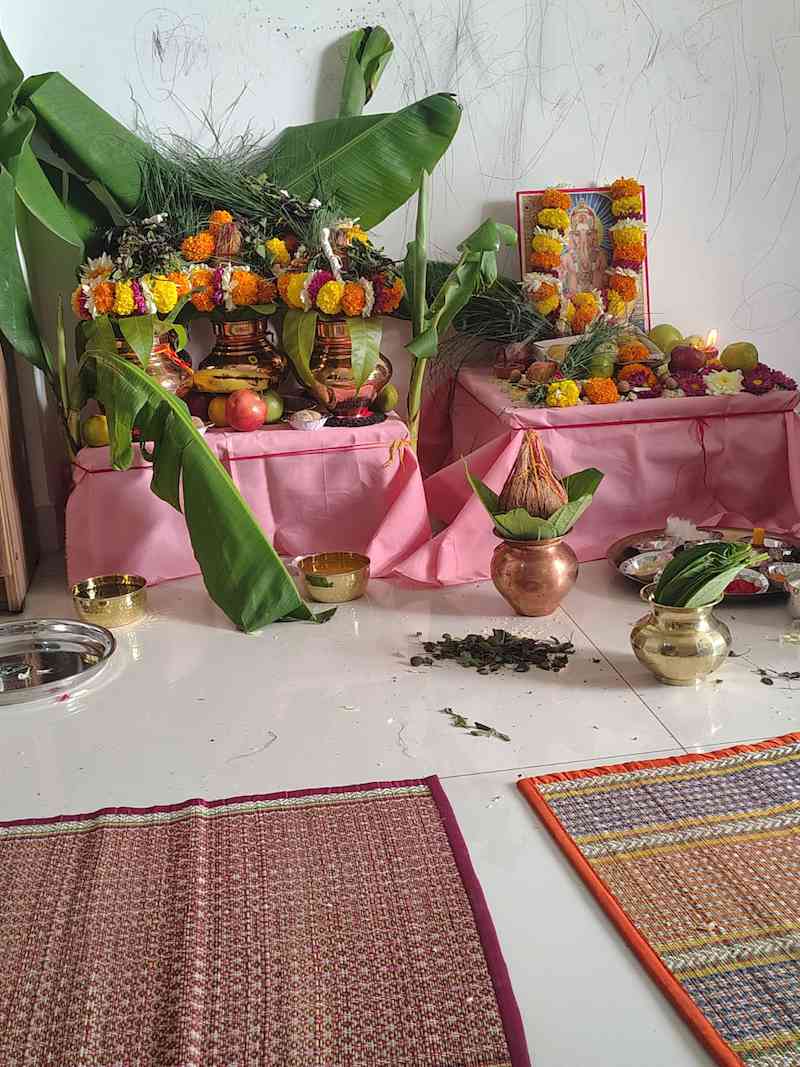
The sacred Kalash is established with water, mango leaves, and a coconut, representing the divine presence during the ceremony.
Punyavachan
Purification mantras are recited to sanctify the home, the family, and the puja space. Sacred water is sprinkled, preparing the environment for the Namkaran.
Navgrah Pujan
All 9 planets are worshipped to harmonise their influence on the baby’s horoscope and to seek their blessings for the child’s health, intellect, and prosperity.
Namkaran Sanskar — The Main Ceremony
This is the heart of the entire ceremony. The pandit ji guides the parents on the selection of the baby’s name based on the nakshatra. Each nakshatra has specific syllables (aksharas) that are considered auspicious for the name’s first letter:
For example, if the baby is born in Ashwini Nakshatra, names starting with “Chu”, “Che”, “Cho”, or “La” are recommended. If born in Rohini Nakshatra, names starting with “O”, “Va”, “Vi”, or “Vu” are suitable.
The father then whispers the chosen name into the baby’s right ear three times while the pandit ji recites the Vedic mantras. The mother and other family members repeat the name. This formal announcement — with the mantras, the whisper, and the family’s collective voice — is the moment the child officially receives their identity.
Shanti Havan
The sacred fire is lit in the havan kund, and offerings of ghee and samagri are made with Vedic mantras. The havan purifies the atmosphere and seals the blessings invoked during the Namkaran.
Ashirvachan
The pandit ji formally blesses the child with prayers for a long, healthy, and prosperous life. Elders present in the family also bless the baby at this point.
Maha Aarti
The family performs the Aarti together, offering light to the deities and seeking their continued protection for the newborn.
Prasad Distribution
The sanctified prasad is distributed to all family members and guests present, marking the joyful conclusion of the ceremony.
Namkaran Sanskar Package — ₹5,100
Pitradev offers the complete Namkaran Sanskar at your home in Pune at a fixed, all-inclusive cost of ₹5,100.
What is included:
- 1 experienced pandit ji (Marathi Guruji or North Indian pandit — your choice)
- All puja samagri brought by pandit ji including Kalash, banana leaves, flowers, havan kund, and all havan items
- Pandit dakshina
- Name suggestion based on baby’s nakshatra
- No hidden charges
What you need to arrange:
- Fruits — 5 types
- Sweets — 1 kg
- Milk — 500 ml
- Curd — 250 grams
- 2 steel plates
- 2 bowls
- 2 spoons
- Coins (change) for Sankalp — ₹1, ₹2, ₹5, or ₹10 coins, 10 to 15 numbers
- A clean, comfortable space for the baby and the puja setup
Duration: Approximately 1.5 to 2 hours
The complete item list is shared after booking so there is no confusion on the day.
How the Baby’s Name Is Selected — The Nakshatra Method
The most important spiritual element of the Namkaran is the selection of the name based on the baby’s nakshatra (birth star). Each of the 27 Nakshatras has 4 padas (quarters), and each pada corresponds to specific syllables. The baby’s name should ideally begin with the syllable corresponding to their birth nakshatra and pada.
Here is a quick reference for the most common Nakshatras:
Ashwini — Chu, Che, Cho, La
Bharani — Li, Lu, Le, Lo
Krittika — A, Ee, U, Ea
Rohini — O, Va, Vi, Vu
Mrigashira — Ve, Vo, Ka, Ki
Punarvasu — Ke, Ko, Ha, Hi
Pushya — Hu, He, Ho, Da
Magha — Ma, Mi, Mu, Me
Uttara Phalguni — To, Pa, Pi, Pu
Hasta — Pu, Sha, Na, Tha
Swati — Ru, Re, Ro, Taa
Vishakha — Ti, Tu, Te, To
Anuradha — Na, Ni, Nu, Ne
Moola — Ye, Yo, Bha, Bhi
The pandit ji brings the complete nakshatra chart and guides the family on the correct syllables. Many families come prepared with a shortlist of names and the pandit ji confirms which names are most aligned with the baby’s horoscope.
Both Marathi Guruji and North Indian Pandit Available
Pune has a large population of both Marathi and North Indian families, and the Namkaran vidhi differs between traditions.
For Marathi families: A Marathi Guruji performs the ceremony as per the Maharashtrian tradition, with the specific sankalp form, Barsa ceremony customs, and naming conventions that Marathi families follow.
For North Indian families: A North Indian pandit in Pune from Uttar Pradesh performs the ceremony as per the UP-Bihar tradition — the mantras, the havan, the name whispered in the ear, and the overall flow are exactly what North Indian families recognise.
The language and tradition preference is confirmed at the time of booking.
Namkaran in Pune Apartments — Practical Tips
Space. The puja setup requires approximately 4 by 4 feet of clear floor space. Any living room can accommodate this comfortably.
Baby’s comfort. The ceremony is designed to be baby-friendly. The baby needs to be present for only the main Namkaran portion (approximately 15 to 20 minutes), not for the entire 1.5 to 2 hours. The mother can hold the baby throughout. If the baby sleeps during the puja, that is perfectly fine — the pandit ji will gently time the key moment when the baby needs to be present.
Havan smoke. The Shanti Havan in a Namkaran is smaller than a Grihapravesh havan. The smoke is minimal and lasts only about 10 to 15 minutes. Keep a window or balcony door open for ventilation.
Guest seating. Many families invite relatives and friends. Arrange seating for guests, as the puja itself is performed by the parents and the pandit ji on the floor.
Photography. The moment when the father whispers the name into the baby’s ear is the most memorable moment of the ceremony. Have your photographer ready for this moment — the pandit ji will signal when it is about to happen.
When Families in Pune Perform Namkaran
On the 11th or 12th day — The most traditional timing. Families who have elderly parents visiting from their native place often choose this date so that the grandparents can be present and bless the child.
On the 21st day — When the mother needs more recovery time, especially after a C-section delivery.
After returning from the hospital — Some families who are in Pune temporarily (on deputation or short-term transfer) perform the Namkaran as soon as they are settled at home.
Combined with Naamkaran and Grihapravesh — A few families who have recently moved into a new flat and also have a newborn combine the Namkaran with a Grihapravesh ceremony on the same day. Pitradev can coordinate both ceremonies with the same pandit ji.
Areas We Serve in Pune for Namkaran Sanskar
Pitradev arranges pandit for Namkaran Sanskar across every area of Pune:
Hinjewadi, Wakad, Baner, Balewadi, Kharadi, Viman Nagar, Pimpri-Chinchwad, Hadapsar, Magarpatta, Aundh, Pimple Saudagar, Wagholi, Kalyani Nagar, NIBM Road, Kondhwa, Bavdhan, Pashan, HSR Layout (Pune), Koregaon Park, Deccan, and all surrounding localities.
For all areas, visit our Pandit in Pune page.
How to Book
- Contact Pitradev on WhatsApp or phone
- Share the baby’s date and time of birth, your gotra, and your preferred date for the Namkaran
- Specify your tradition — Marathi or North Indian
- Pandit ji will calculate the correct nakshatra and suggest auspicious name syllables
- Confirm the booking — pandit ji name, timing, and the item list are shared
- Pandit ji arrives at your home with all samagri on the confirmed date
Book at least 3 to 5 days in advance. For the 11th day ceremony, contact us immediately after the baby’s birth so the booking can be confirmed before the Sutaka period ends.
Conclusion
The Namkaran Sanskar is your baby’s first formal introduction to the world — the moment a name is chosen through Vedic wisdom, whispered into their ear by their father, and blessed by the family and the divine. It deserves to be performed with the correct vidhi, the right mantras, and a pandit who understands your tradition.
With Pitradev, the Namkaran Sanskar in Pune is arranged at your home for ₹5,100 — with 1 pandit ji, all samagri included, the complete 1.5 to 2 hour vidhi, and a name chosen from the baby’s own nakshatra. Both Marathi Guruji and North Indian pandit available.
Give your child a name that carries the blessings of the stars and the love of your family.
Frequently Asked Questions
1. What is the cost of Namkaran Sanskar in Pune?
The complete Namkaran Sanskar in Pune with Pitradev costs ₹5,100, all-inclusive. This covers 1 pandit ji, all puja samagri, havan items, and pandit dakshina. No hidden charges.
2. When should Namkaran Sanskar be performed?
Traditionally on the 11th or 12th day after birth. It can also be done on the 21st day or any auspicious day within the first year if the traditional date is missed. The pandit ji can calculate the best muhurat based on the baby’s birth details.
3. How long does the ceremony take?
The complete Namkaran Sanskar takes approximately 1.5 to 2 hours, covering Sankalp, Gauri Ganesh Puja, Kalash Puja, Punyavachan, Navgrah Pujan, Namkaran, Shanti Havan, Ashirvachan, Maha Aarti, and Prasad Distribution.
4. Does the pandit help choose the baby’s name?
Yes. The pandit ji identifies the baby’s nakshatra and pada from the birth details and provides the auspicious syllables for the name. The family selects the final name from these syllables, and the pandit ji confirms its alignment with the horoscope.
5. Is a Marathi Guruji available for Namkaran in Pune?
Yes. Pitradev provides both Marathi Guruji and North Indian pandit for Namkaran Sanskar in Pune. The ceremony is performed as per your community’s tradition.
6. What items do I need to arrange at home?
You need to arrange 5 types of fruits, 1 kg sweets, 500 ml milk, 250 grams curd, 2 steel plates, 2 bowls, 2 spoons, and coins for Sankalp. The pandit ji brings all other puja materials including Kalash, banana leaves, flowers, havan kund, and havan items.
Shashank Mishra comes with over 15 years of experience in religious tourism and organising Vedic rituals and ancestral ceremonies. At Pitradev, he oversees the coordination of Asthi Visarjan, Pind Daan, Shraadh, Grihapravesh, Vastu Shanti Puja, Satyanarayan Katha, Rudrabhishek, and other sacred rites across Varanasi, Prayagraj, Gaya, Bangalore, Hyderabad, Pune, and Mumbai.
Latest Blog
- Namkaran Sanskar in Pune | Baby Naming Ceremony ₹5100
- North Indian Pandit in Hinjewadi for All Pujas
- North Indian Pandit in Pimpri-Chinchwad
- Pind Daan in Gaya by Odia Pandit | Odia Shraddha Paddhati
- Vastu Shanti Puja in Pune | 6 Mandals, 2 Pandits | ₹15000
- Gaya Pind Daan vs Varanasi Pind Daan
- Satyanarayan Katha in Pune by North Indian Pandit
- Odia Pandit Prayagraj | Asthi Bisarjan & Pind Daan Same Day
- How to Book Asthi Visarjan in Kashi Online
- Book Pandit Services Online A Complete Step by Step Guide
- Book Verified Pandit Ji in Bangalore for Any Puja Easy Guide
- How to Book a Vastu Pujan Griha Pravesh Puja for Your New Home
- How to Book Pind Daan in Gaya Online Complete Guide
- Pind Daan in Varanasi After Pitru Paksha
- Pind Daan for Dogs in Varanasi: Complete Rituals at Kashi
- Things To Know Before Booking A Pandit for Satyanarayan Puja
- How To Choose Right Muhurat for Griha Pravesh for Your New Home
- 7 Key Rituals and Stages of Pind Daan in Gaya
- Gand Mool Nakshatra Shanti Puja: Complete Process
- Grihapravesh Muhurat in November and December 2026
- Asthi Visarjan in Varanasi for Pets: Dogs And Cats
- Pind Daan in Varanasi: Guide to Ritual, Process, Cost, Booking
- Mistakes to Avoid During Asthi Visarjan in Varanasi
- How to book satyanarayn puja
- Verified South Indian Purohits in Gaya
- Samvatsarikam in Varanasi: Cost and Vidhi
- Best South Indian Purohits in Kashi Varanasi
- Pind Daan in Varanasi by Telugu Purohit
- Telugu Purohit in Gaya: Pind Daan Packages
- Tripindi Shraadh in Gaya
- Pitradev- Hindi, Tamil, Telugu & Bengali Pandit in Bangalore
- Narayan Bali Puja in Gaya
- Can I Do Pind Daan Within One Year of Death?
- One Day Narayan Bali Puja at Trimbakeshwar
- Asthi Visarjan at Manikarnika Ghat in Kashi Varanasi
- Cost of Asthi Visarjan in Varanasi: Packages and Precautions
- Pandit for Tripindi Shradh in Varanasi: 2026 Dates & Cost
- Pind Daan in Gaya in Pitru Paksha 2026: Dates and Packages
- Vastu Shanti Puja Cost in Pune by North Indian Pandit
- Pitra Dosh: Causes, Symptoms and Remedies — A Complete Guide
- How to Find Genuine Tamil Vadhyars in Kashi Varanasi
- How to Carry Asthi in Flight in India?
- Pind Daan in Gaya by Tamil Iyer: Cost, Packages and Process
- Asthi Visarjan in Srirangapatna from Bangalore — Full Guide
- Send Ashes from Coimbatore to Kashi — Asthi Visarjan Service
- Cost of Asthi Visarjan in Prayagraj by Telugu Pandit
- Asthi Visarjan and Pind Daan in Prayagraj for Odia Families
- North Indian Pandit Bangalore for Annaprashan Puja
- Telugu Grihapravesham Bangalore: 4 Packages Cost & Inclusion
- Cost of Tripindi Shraadh in Varanasi -Pishachmochan Kund
- North Indian Pandit in Pune for Grihapravesh: Package Guide
- Pind Daan in Prayagraj: Cost, Vidhi & Booking Guide-2026
- Narayan Bali Puja in Varanasi — Complete Cost Breakdown for 2026
- Book a Verified North Indian Pandit in Pune: Cost & Packages
- How to Send Asthi to Kashi: A Step-by-Step Guide
- Book Tamil Iyer in Bangalore for Grihapravesham – Complete Guide
- How to Plan 10th 11th and 12th Day Rituals in Varanasi
- Pitru Paksha 2026 – Pind Daan in Prayagraj, Kashi and Gaya
- Pitru Paksha 2026 – Book Online Pind Daan in Varanasi
- Asthi Visarjan in Varanasi for Tamil Families – Complete Guide
- How to Send Asthi (Ashes) from USA to India – Complete Guide
- Narayan Bali Puja in Varanasi – Complete Guide 2026
- Pind Daan in Gaya from Malaysia – Complete Guide
- Pind Pradanam in Varanasi from Malaysia – Complete Guide
- Grihapravesh Puja in Bangalore by Kannada Purohit
- Online Pind Daan in Varanasi for NRIs
- Book Verified Telugu Purohits in Bangalore for Grihapravesham
- Best Ghat for Asthi Visarjan in Varanasi: A Practical Comparison
- Asthi Visarjan in Prayagraj – Complete Guide 2026
- Tripindi Shradh in Varanasi – Complete Guide
- Asthi Visarjan in Varanasi –Best Ghat & Package 2026
- Grihapravesh Puja in Prestige City Sarjapur
- Gaya Ji Pind Daan 2026 – Quick Guide for Planning Your Trip
- Online Puja Booking for Griha Pravesh, Shradh & Satyanarayan
- Pitru Paksha 2026 Dates, Rituals and Pind Daan Guide
- Akshaya Tritiya 2026 (19 April): Best Muhurat for Griha Pravesh
- How to Do Asthi Visarjan When You Cannot Travel: Complete Guide
- Asthi Visarjan in Kashi: Complete Guide with Cost & Time
- Griha Pravesh Muhurat 2026: Auspicious Dates & Timings
- Complete Guide to Gaya Pind Daan Ritual, Samagri & Best Time
- Asthi Visarjan By Post in Kashi Varanasi – Complete Guide
- How to Book a Bengali Pandit for Puja: Step-by-Step Process
- Book Verified Pandit for Puja in Bangalore
- Book Verified North Indian Pandit in Hyderabad Online
- Book North Indian Pandit in Bangalore for Satyanarayan Puja
- How to Book a Pandit in Bangalore Online for Puja:Complete Guide
- Find and Book Pandits in Hyderabad for Griha Pravesh Puja Online
- How to Find and Book Experienced Pandit Online for Puja?
- Exploring the History and Origins of Griha Pravesh Puja Rituals
- Top 5 Ancient Places for Gayaji Pind Daan - 2024 Guide
- Significance of Performing Griha Pravesh Puja in Hindu Culture
- How to Choose the Right Pandit for Pind Daan in Gaya
- Why is Pind Daan in Gaya so Famous?
- Where to Find Experienced Pandit for Griha Pravesh Puja Online?
- Cost of Pind Daan in Gaya: Packages, Procedure and How to Book
- Griha Pravesh Puja and Housewarming Ceremony 2024
- How Gaya Pind Daan Brings Closure and Peace to Your Ancestors
- Gayaji Pind Daan: Achieve Eternal Peace for Your Ancestors
- Online Pind daan: Importance, Cost, and Procedure
- Gaya Pind Daan Puja is Performed by an Experienced Pandit ji
- The Sacred Ritual of Brahma Kapal Pind Daan
- A Complete Guide About Pind Daan in India: Update 2023
- Unveiling the Significance of Pind Daan in Gaya
- The Ultimate Guide to Pind Daan Tour Packages
- Where to do Asthi Visarjan in Haridwar?
- Rudrabhishek Pooja Why Hindus Perform Rudrabhishek pooja At home
- Varanasi's Asthi Visarjan: Embracing Life's Eternal Journey
- Unveiling the Sacred Ritual:
- Significance of Asthi Visarjan in Haridwar
- Exploring the Profound Significance of Asthi Visarjan in Kashi
- The Science of Pind Daan:
- What are the rituals of Pind Daan?
- Varanasi Ayodhya Tour Package with Prayagraj
- Pind Daan Puja in Varanasi | Book Your Puja Online
- Prayagraj: The Enchanting Journey of Asthi Visarjan
- Pind Daan Gaya : When and Where to Do Pind Daan in Gayaji
- Exploring the Mystical Rituals of Asthi Visarjan Poojan
- Which are the Best Places to do Pind Daan in Gaya?
- Everything You Need to Know About Rudrabhishek Puja
- Why Is Pind Daan At Gaya Important To Hindus?
- Asthi Visarjan: When to Perform It, Where to Go, and Cost
- Rudra Abhishek Puja's Purpose:
- Ganga Pushkaralu 2023
- Pind daan for people having unnatural deaths
- Is doing pind daan beneficial without self presence of related?