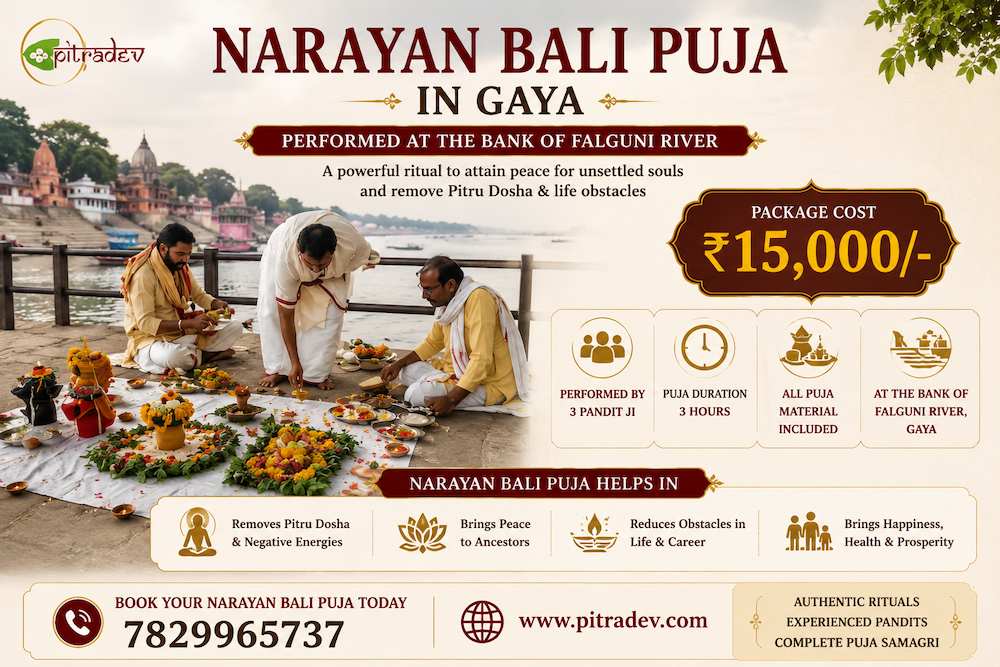
Narayan Bali Puja in Gaya
Narayan Bali Puja in Gaya is the scriptural rite performed for a family member who has died an unnatural death, and it is undertaken to release the departed atma from the restless preta state and to relieve the Pitra Dosh that such a death leaves upon the family. Pitradev arranges the complete ritual on the bank of the Phalgu river at Gaya, performed by 3 priests over a duration of around 3 hours, for a fixed cost of ₹15,000 with all puja materials and samagri included. Gaya holds a singular place among the tirthas for rites of this kind, and for families who have suffered an unnatural death the tradition is to perform Narayan Bali first and to offer Pind Daan thereafter, a sequence this page explains in full.
Who needs Narayan Bali Puja
Narayan Bali Puja is prescribed where a death in the family has occurred by unnatural means, which the scriptures classify as akaal mrityu, the untimely death. This includes death by accident, drowning, fire, snakebite, poisoning, suicide, murder, or any sudden and unexpected cause that took the person before the natural span of life was complete.
The reason the ordinary rites do not suffice in such cases is set out in the Garuda Puran. When a person dies an untimely death, the atma is held to remain trapped in preta yoni, an unsettled intermediate state, and in that condition it cannot receive the offerings made through routine Shraddh or Pind Daan, so the offerings do not reach their intended recipient and the family continues to carry the burden. Narayan Bali Puja addresses this directly, by performing the funeral rites afresh in symbolic form so that the atma is released from that state, after which the ordinary ancestral rites become effective once again.
Many a time the rite surfaces not after a recent bereavement but through a kundali reading, when a family that has no memory of any unnatural death is found to be carrying Pitra Dosh traced to an unnatural death in an earlier generation whose rites were never completed.
Why Gaya is uniquely suited to Narayan Bali
Among all the tirthas at which ancestral rites are performed, Gaya holds a position that the scriptures set above the rest, being known as the Mukti Kshetra, the field of liberation, and being identified in tradition with the body of Lord Vishnu himself. The Vishnupad temple stands at its heart, built over the footprint of Vishnu, and the ground of Gaya is held to be charged with the liberating power of Vishnu, which is why Pind Daan performed here is believed to grant release even to ancestors held in the lower realms.
For Narayan Bali in particular, Gaya carries a further and specific aptness. The rite is addressed to Vishnu in the form of Narayan, and the Vayu Purana, in its Gaya Mahatmya, names the Phalgu river an incarnation of Vishnu Narayan himself. Considering that the ritual invokes Narayan to receive the funeral rites on behalf of the departed, there is a particular fitness in performing it on the bank of a river that the scriptures identify with Narayan, and it is here, at the Phalgu, that Pitradev conducts the rite and the concluding immersion and Tarpan.
Narayan Bali first, and Pind Daan at the three places thereafter
For a family that has suffered an unnatural death, the correct order of the rites matters, and it is worth understanding before the visit to Gaya is planned.
Where the death was natural, the Gaya Shraddh is offered at the 3 principal vedis, being the Phalgu river, the Vishnupad temple and the Akshayavat, and this is sufficient. Where the death was unnatural, however, the soul is first held in preta yoni and cannot receive those offerings, and so Narayan Bali is performed first, to release the atma from that state, and only thereafter is Pind Daan offered so that the released soul may be nourished and settled. Further to this, the tradition holds that for an unnatural death the Pind Daan is not confined to the usual 3 vedis but is extended to further places, namely Pretshila, Brahma Kund and Dharmaranya, which are the vedis specifically associated with the release of souls held in a troubled state.
The practical sequence for such a family is therefore to perform Narayan Bali on the bank of the Phalgu, and then to offer Pind Daan in Gaya at the prescribed places, so that the obligation is discharged in full and in the order the scriptures intend. A family unsure whether its situation calls for Narayan Bali before Pind Daan, or for Pind Daan alone, is well advised to establish this in a short consultation before the booking is made.
The Narayan Bali vidhi in Gaya
The ritual runs for around 3 hours, is conducted by 3 priests, and follows the sequence set out in the Garuda Puran.
- Sankalp. The rite opens with a formal declaration taken in the name and gotra of the family member performing it, naming the departed and stating the purpose of the ritual.
- Purification and Kalash Sthapana. A holy bath is taken at the Phalgu, the sacred vessel is established, and Ganesh is invoked so that the ritual proceeds without obstruction.
- Installation of the deities. Brahma, Vishnu, Rudra, Yama and Savitr are invoked and worshipped, with Yama, as the lord of the departed, petitioned for the release of the atma.
- Narayan Bali Homa. The fire ritual is performed with the mantras that invoke Narayan and that are prescribed for the liberation of the atma from preta yoni, and this is the core of the rite.
- Preparation of the effigy. A symbolic body is prepared, traditionally from wheat flour or darbha grass, to stand in place of the physical body that could not receive its proper rites at the time of death.
- The symbolic funeral. The funeral rites are performed over the effigy, completing in symbolic form the cremation that was left undone, and thereby releasing the atma.
- Pind Daan and Tarpan. The pindas are offered to nourish the released soul, and water oblations are made at the Phalgu for the peace of the atma and the ancestral line.
- Dakshina to Brahmin. The rite is concluded with the giving of dakshina to Purohit.
Narayan Bali Puja cost in Gaya
Narayan Bali Puja in Gaya is offered as a single package at a fixed cost of ₹15,000, which includes all puja materials and samagri, the dakshina of the 3 priests, and the complete arrangement of the ritual, so that there are no further charges of any kind at the ghat.
The rite is conducted by 3 experienced priests over a duration of around 3 hours on the bank of the Phalgu river, and the family is required to provide only 2 details at the time of booking, being the name of the departed person and the gotra of the family. Where the gotra is not known, the priests will structure the Sankalp in the form the scriptures prescribe for such cases, and the ritual remains entirely valid. Where a family wishes to perform Pind Daan after the Narayan Bali, that is arranged separately and the two are scheduled together across the visit.
When Narayan Bali should be performed
The scripturally ideal time to perform Narayan Bali is before the 12th day rites, and where a family is able to arrange it within that window it should do so. In practice, however, most families come to this ritual much later, often years or even generations after the death, having learnt of the requirement only through a kundali reading or through a persistent pattern of obstacles at home, and in such cases the delay does not diminish the rite in any way.
The suitable days are Amavasya, Chaturdashi and Ekadashi, and the fortnight of Pitru Paksha, which in 2026 runs from 26 September to 10 October and closes with Sarva Pitru Amavasya on 10 October, carries the greatest merit of the year for rites of this kind, and it is also the period in which families most commonly combine Narayan Bali with Pind Daan at Gaya. Since these dates are in demand, a family intending to perform the rite during Pitru Paksha should confirm the date well in advance.
For families who cannot travel to Gaya
Where a family is unable to come to Gaya, whether on account of distance, health or the circumstances of the bereavement, the ritual is performed at Gaya on the family's behalf. The Sankalp is taken in the name and gotra of the family member arranging it, the full vidhi is conducted on the bank of the Phalgu exactly as it would be with the family present, and photographs and video of the complete ritual are shared afterwards along with the details of the priests who performed it. Families living in Bangalore, Hyderabad, Pune and other cities have had the rite performed in this manner.
Conclusion
Narayan Bali in Gaya is the rite by which a family releases an ancestor who died an untimely death from the restless state in which the scriptures hold such a soul to remain, and performed on the bank of the Phalgu, the river the Gaya Mahatmya identifies with Narayan himself, it carries a particular fitness that few other tirthas offer. For a family that has suffered such a death, the sound course is to perform Narayan Bali first and to offer Pind Daan thereafter, in the order the scriptures intend, so that the obligation owed to the departed is discharged completely.
Families who would prefer to perform the rite at Kashi may consider Narayan Bali Puja in Varanasi, which is likewise completed in a single day at the Ganga ghats and at Pishach Mochan Kund, and families wishing to offer the ordinary ancestral rites may arrange Pind Daan in Gaya or Pind Daan in Varanasi. A short consultation before booking will establish which rite and which place your situation calls for, so that the effort made on behalf of the departed is not misdirected.
Frequently Asked Questions
What is Narayan Bali Puja in Gaya, and who needs it?
Should Narayan Bali be done before Pind Daan in Gaya?
Where in Gaya is Narayan Bali performed?
What is the cost of Narayan Bali Puja in Gaya?
When should Narayan Bali be performed in Gaya?
Can Narayan Bali in Gaya be done if the family cannot travel?
Shashank Mishra
Manager, Pitradev.com
Shashank Mishra comes with over 15 years of experience in religious tourism and organising Vedic rituals and ancestral ceremonies. At Pitradev, he oversees the coordination of Asthi Visarjan, Pind Daan, Shraadh, Grihapravesh, Vastu Shanti Puja, Satyanarayan Katha, Rudrabhishek, and other sacred rites across Varanasi, Prayagraj, Gaya, Bangalore, Hyderabad, Pune, and Mumbai. His deep understanding of Hindu customs across regional traditions — North Indian, Tamil, Telugu, Odia, and Kannada — allows him to guide families through the correct vidhi with care and clarity, whether it is an ancestral ceremony at a tirtha kshetra or a housewarming puja in a metro city.
Latest Blog
- Pind Daan in Gaya by Odia Pandit | Odia Shraddha Paddhati
- Vastu Shanti Puja in Pune | 6 Mandals, 2 Pandits | ₹15000
- Gaya Pind Daan vs Varanasi Pind Daan
- Satyanarayan Katha in Pune by North Indian Pandit
- Odia Pandit Prayagraj | Asthi Bisarjan & Pind Daan Same Day
- How to Book Asthi Visarjan in Kashi Online
- Book Pandit Services Online A Complete Step by Step Guide
- Book Verified Pandit Ji in Bangalore for Any Puja Easy Guide
- How to Book a Vastu Pujan Griha Pravesh Puja for Your New Home
- How to Book Pind Daan in Gaya Online Complete Guide
- Pind Daan in Varanasi After Pitru Paksha
- Pind Daan for Dogs in Varanasi: Complete Rituals at Kashi
- Things To Know Before Booking A Pandit for Satyanarayan Puja
- How To Choose Right Muhurat for Griha Pravesh for Your New Home
- 7 Key Rituals and Stages of Pind Daan in Gaya
- Gand Mool Nakshatra Shanti Puja: Complete Process
- Grihapravesh Muhurat in November and December 2026
- Asthi Visarjan in Varanasi for Pets: Dogs And Cats
- Pind Daan in Varanasi: Guide to Ritual, Process, Cost, Booking
- Mistakes to Avoid During Asthi Visarjan in Varanasi
- How to book satyanarayn puja
- Verified South Indian Purohits in Gaya
- Samvatsarikam in Varanasi: Cost and Vidhi
- Best South Indian Purohits in Kashi Varanasi
- Pind Daan in Varanasi by Telugu Purohit
- Telugu Purohit in Gaya: Pind Daan Packages
- Tripindi Shraadh in Gaya
- Pitradev- Hindi, Tamil, Telugu & Bengali Pandit in Bangalore
- Narayan Bali Puja in Gaya
- Can I Do Pind Daan Within One Year of Death?
- One Day Narayan Bali Puja at Trimbakeshwar
- Asthi Visarjan at Manikarnika Ghat in Kashi Varanasi
- Cost of Asthi Visarjan in Varanasi: Packages and Precautions
- Pandit for Tripindi Shradh in Varanasi: 2026 Dates & Cost
- Pind Daan in Gaya in Pitru Paksha 2026: Dates and Packages
- Vastu Shanti Puja Cost in Pune by North Indian Pandit
- Pitra Dosh: Causes, Symptoms and Remedies — A Complete Guide
- How to Find Genuine Tamil Vadhyars in Kashi Varanasi
- How to Carry Asthi in Flight in India?
- Pind Daan in Gaya by Tamil Iyer: Cost, Packages and Process
- Asthi Visarjan in Srirangapatna from Bangalore — Full Guide
- Send Ashes from Coimbatore to Kashi — Asthi Visarjan Service
- Cost of Asthi Visarjan in Prayagraj by Telugu Pandit
- Asthi Visarjan and Pind Daan in Prayagraj for Odia Families
- North Indian Pandit Bangalore for Annaprashan Puja
- Telugu Grihapravesham Bangalore: 4 Packages Cost & Inclusion
- Cost of Tripindi Shraadh in Varanasi -Pishachmochan Kund
- North Indian Pandit in Pune for Grihapravesh: Package Guide
- Pind Daan in Prayagraj: Cost, Vidhi & Booking Guide-2026
- Narayan Bali Puja in Varanasi — Complete Cost Breakdown for 2026
- Book a Verified North Indian Pandit in Pune: Cost & Packages
- How to Send Asthi to Kashi: A Step-by-Step Guide
- Book Tamil Iyer in Bangalore for Grihapravesham – Complete Guide
- How to Plan 10th 11th and 12th Day Rituals in Varanasi
- Pitru Paksha 2026 – Pind Daan in Prayagraj, Kashi and Gaya
- Pitru Paksha 2026 – Book Online Pind Daan in Varanasi
- Asthi Visarjan in Varanasi for Tamil Families – Complete Guide
- How to Send Asthi (Ashes) from USA to India – Complete Guide
- Narayan Bali Puja in Varanasi – Complete Guide 2026
- Pind Daan in Gaya from Malaysia – Complete Guide
- Pind Pradanam in Varanasi from Malaysia – Complete Guide
- Grihapravesh Puja in Bangalore by Kannada Purohit
- Online Pind Daan in Varanasi for NRIs
- Book Verified Telugu Purohits in Bangalore for Grihapravesham
- Best Ghat for Asthi Visarjan in Varanasi: A Practical Comparison
- Asthi Visarjan in Prayagraj – Complete Guide 2026
- Tripindi Shradh in Varanasi – Complete Guide
- Asthi Visarjan in Varanasi –Best Ghat & Package 2026
- Grihapravesh Puja in Prestige City Sarjapur
- Gaya Ji Pind Daan 2026 – Quick Guide for Planning Your Trip
- Online Puja Booking for Griha Pravesh, Shradh & Satyanarayan
- Pitru Paksha 2026 Dates, Rituals and Pind Daan Guide
- Akshaya Tritiya 2026 (19 April): Best Muhurat for Griha Pravesh
- How to Do Asthi Visarjan When You Cannot Travel: Complete Guide
- Asthi Visarjan in Kashi: Complete Guide with Cost & Time
- Griha Pravesh Muhurat 2026: Auspicious Dates & Timings
- Complete Guide to Gaya Pind Daan Ritual, Samagri & Best Time
- Asthi Visarjan By Post in Kashi Varanasi – Complete Guide
- How to Book a Bengali Pandit for Puja: Step-by-Step Process
- Book Verified Pandit for Puja in Bangalore
- Book Verified North Indian Pandit in Hyderabad Online
- Book North Indian Pandit in Bangalore for Satyanarayan Puja
- How to Book a Pandit in Bangalore Online for Puja:Complete Guide
- Find and Book Pandits in Hyderabad for Griha Pravesh Puja Online
- How to Find and Book Experienced Pandit Online for Puja?
- Exploring the History and Origins of Griha Pravesh Puja Rituals
- Top 5 Ancient Places for Gayaji Pind Daan - 2024 Guide
- Significance of Performing Griha Pravesh Puja in Hindu Culture
- How to Choose the Right Pandit for Pind Daan in Gaya
- Why is Pind Daan in Gaya so Famous?
- Where to Find Experienced Pandit for Griha Pravesh Puja Online?
- Cost of Pind Daan in Gaya: Packages, Procedure and How to Book
- Griha Pravesh Puja and Housewarming Ceremony 2024
- How Gaya Pind Daan Brings Closure and Peace to Your Ancestors
- Gayaji Pind Daan: Achieve Eternal Peace for Your Ancestors
- Online Pind daan: Importance, Cost, and Procedure
- Gaya Pind Daan Puja is Performed by an Experienced Pandit ji
- The Sacred Ritual of Brahma Kapal Pind Daan
- A Complete Guide About Pind Daan in India: Update 2023
- Unveiling the Significance of Pind Daan in Gaya
- The Ultimate Guide to Pind Daan Tour Packages
- Where to do Asthi Visarjan in Haridwar?
- Rudrabhishek Pooja Why Hindus Perform Rudrabhishek pooja At home
- Varanasi's Asthi Visarjan: Embracing Life's Eternal Journey
- Unveiling the Sacred Ritual:
- Significance of Asthi Visarjan in Haridwar
- Exploring the Profound Significance of Asthi Visarjan in Kashi
- The Science of Pind Daan:
- What are the rituals of Pind Daan?
- Varanasi Ayodhya Tour Package with Prayagraj
- Pind Daan Puja in Varanasi | Book Your Puja Online
- Prayagraj: The Enchanting Journey of Asthi Visarjan
- Pind Daan Gaya : When and Where to Do Pind Daan in Gayaji
- Exploring the Mystical Rituals of Asthi Visarjan Poojan
- Which are the Best Places to do Pind Daan in Gaya?
- Everything You Need to Know About Rudrabhishek Puja
- Why Is Pind Daan At Gaya Important To Hindus?
- Asthi Visarjan: When to Perform It, Where to Go, and Cost
- Rudra Abhishek Puja's Purpose:
- Ganga Pushkaralu 2023
- Pind daan for people having unnatural deaths
- Is doing pind daan beneficial without self presence of related?