How to Plan 10th 11th and 12th Day Rituals in Varanasi
Losing a loved one is a deeply emotional experience, and along with grief comes the responsibility of performing the final rites correctly so that the departed soul attains peace. In Hindu tradition, the rituals performed after cremation hold immense spiritual importance, especially those conducted on the 10th, 11th and 12th day. These rituals are not just customs but are considered essential steps in helping the soul transition from the preta state to becoming part of the ancestral lineage. Among all places in India, Varanasi is considered the most sacred location to perform these rites because of its deep association with the Ganga and Lord Shiva. Families from across India and abroad choose to perform these rituals in Varanasi to ensure that everything is done correctly and with proper guidance. Whether you are able to travel or not, today it is possible to arrange these rituals in Varanasi either by visiting personally or by booking them online.
Asthi Visarjan in Varanasi – First and Most Important Ritual
Before starting the 10th, 11th and 12th day rituals, the ashes immersion, known as asthi visarjan, should be completed. This is usually performed within a few days after death and is considered the first important step in the entire process. Asthi visarjan in Varanasi is highly auspicious as it is believed that immersion of ashes in the Ganga helps the departed soul attain peace.
We provide complete arrangements for asthi visarjan at the Ganga ghats in Varanasi. The ritual includes asthi pujan, proper guidance by pandit ji and immersion of ashes in the middle of the river.
Asthi Visarjan Packages
Asthi Visarjan Only – Rs2000
Asthi Visarjan with Pind Daan – Rs3500
Asthi Visarjan with Pind Daan and Gau Daan – Rs5000
All rituals are performed properly under the guidance of experienced pandit ji, and assistance is provided throughout the process.
10th Day Ritual in Varanasi – Dashgatra and Pind Daan
The 10th day ritual, commonly known as Dashgatra or Daswan, marks the first major purification stage after death. This day is associated with shuddhikaran, or purification of the family, and the gradual formation of the subtle body of the departed soul. It is believed that during the first ten days, the soul undergoes transformation, and through pind daan, the family helps in forming this new subtle existence.
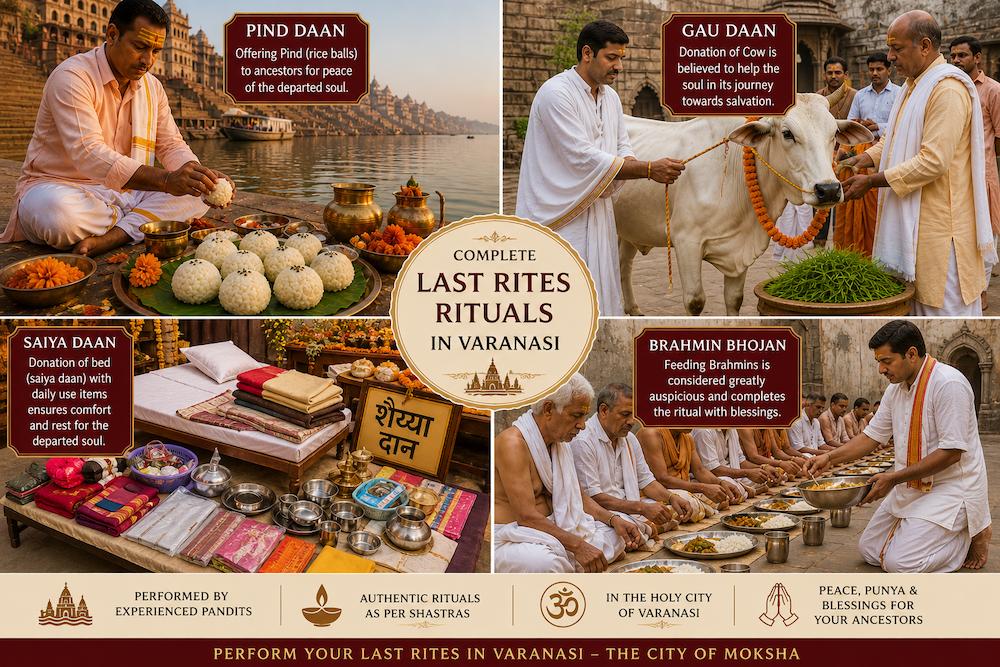
On the 10th day, the karta, usually the eldest son or main performer, undertakes purification rituals such as head shaving, nail cutting and ritual bathing. The most important part of the day is pind daan, where ten pind or rice balls are offered to the departed soul. These ten pind represent the formation of the subtle body. The ritual is performed under the guidance of an experienced pandit, usually at the Ganga ghats in Varanasi. The process also includes tarpan and food offerings for the ancestors, completing the first stage of post-death rituals.
11th Day Ritual – Ekadasha Performed by Mahabrahmin
The 11th day, known as Ekadasha or Gyarahvi, is one of the most spiritually significant stages. This day focuses on helping the soul move beyond the preta state and continue its journey towards becoming a pitru.
The rituals on this day are performed by a Mahabrahmin or Mahapatra, who is specially trained in conducting post-death ceremonies. These priests follow traditional procedures and ensure that all rituals are performed correctly.
On the 11th day, eleven pind are offered during pind daan, symbolizing further progression of the soul. Along with pind daan, specific shradh rituals are conducted, and daan is given to Brahmins in the form of food, clothes and dakshina. This day plays a crucial role in ensuring that the soul progresses smoothly without obstacles.
12th Day Ritual and Terahvi – Dwadasha Pind Daan, Gau Daan, Shaiya Daan and Brahmin Bhojan
The 12th day ritual, known as Dwadasha or Barahvi, is one of the most important stages in the entire sequence of post-death ceremonies. This day marks the completion of the soul’s transition and prepares it for merging with the ancestral lineage.
On this day, twelve pind are offered during pind daan, symbolizing the completion of the soul’s journey from the preta state. In many traditions, sapindikaran is also performed during this stage, where the departed soul is symbolically merged with the ancestors.
In addition to pind daan, important acts of charity are performed. Gau daan, which is the donation of a cow, is considered highly auspicious and is believed to help the soul in its journey. Shaiya daan, or donation of a bed, represents providing comfort to the departed soul.
After completing Dwadasha pind daan and all daan rituals, Brahmin bhojan is performed. This feeding of Brahmins is also commonly referred to as Terahvi, and it marks the completion of the entire ritual process. After this, the mourning period comes to an end, and the family gradually returns to normal life.
Why Perform These Rituals in Varanasi
Varanasi has been a center for moksha rituals for centuries. Performing 10th, 11th and 12th day rituals here, especially on the banks of the Ganga, is believed to bring peace and liberation to the departed soul. The presence of experienced pandits and the sacred environment make it one of the most preferred locations for these ceremonies.
Cost of 10th 11th and 12th Day Rituals in Varanasi
We provide complete arrangements for all three days of rituals in Varanasi, including 10th day pind daan, 11th day pind daan and 12th day pind daan along with Gau Daan, Shaiya Daan and Brahmin Bhojan.
The total cost for all three days rituals is Rs11000, which includes one Brahmin for bhojan.
In case you want to include more Brahmins for bhojan, the additional charge is Rs700 per Brahmin. For example, if you choose to feed 11 Brahmins, the total cost will be Rs11000 plus Rs7700, making the total Rs18700.
How to Book 10th 11th and 12th Day Rituals in Varanasi
You can book the service in advance by paying 20% advance through our website and rest after puja. We will arrange experienced pandits, including Mahabrahmins, all required puja materials and complete assistance at the ghat. You will be guided step by step throughout the entire process.
Online 10th 11th and 12th Day Rituals in Varanasi
If you are not willing or able to travel to Varanasi, you can opt for online booking.
In this option, our pandit ji performs the complete rituals on your behalf. Sankalp is taken with your name and gotra, and all rituals including pind daan, daan and Brahmin bhojan are completed properly. The entire process is recorded, and photos and videos are shared with you. This option is especially useful for families living outside Varanasi or abroad.
Important Things to Keep in Mind
These rituals should be performed on the correct tithi and under proper guidance. It is always recommended to plan in advance, as availability of experienced pandits becomes limited, especially during peak periods.
FAQs
What should I bring for the rituals
You only need to provide the names and gotra of the last three generations of your family. All other arrangements and materials are provided by us.
How many days are required to complete these rituals
Generally, the rituals take three days to complete. However, they can also be completed in two days, where Dashgatra and Ekadasha are performed on the first day and Dwadasha along with other rituals is completed on the second day.
Can women perform these rituals
Yes, women can perform these rituals and can act as the karta if required.
Latest Blog
- Things To Know Before Booking A Pandit for Satyanarayan Puja
- How To Choose Right Muhurat for Griha Pravesh for Your New Home
- 7 Key Rituals and Stages of Pind Daan in Gaya
- Gand Mool Nakshatra Shanti Puja: Complete Process
- Grihapravesh Muhurat in November and December 2026
- Asthi Visarjan in Varanasi for Pets: Dogs And Cats
- Pind Daan in Varanasi: Guide to Ritual, Process, Cost, Booking
- Mistakes to Avoid During Asthi Visarjan in Varanasi
- How to book satyanarayn puja
- Verified South Indian Purohits in Gaya
- Samvatsarikam in Varanasi: Cost and Vidhi
- Best South Indian Purohits in Kashi Varanasi
- Pind Daan in Varanasi by Telugu Purohit
- Telugu Purohit in Gaya: Pind Daan Packages
- Tripindi Shraadh in Gaya
- Pitradev- Hindi, Tamil, Telugu & Bengali Pandit in Bangalore
- Narayan Bali Puja in Gaya
- Can I Do Pind Daan Within One Year of Death?
- One Day Narayan Bali Puja at Trimbakeshwar
- Asthi Visarjan at Manikarnika Ghat in Kashi Varanasi
- Cost of Asthi Visarjan in Varanasi: Packages and Precautions
- Pandit for Tripindi Shradh in Varanasi: 2026 Dates & Cost
- Pind Daan in Gaya in Pitru Paksha 2026: Dates and Packages
- Vastu Shanti Puja Cost in Pune by North Indian Pandit
- Pitra Dosh: Causes, Symptoms and Remedies — A Complete Guide
- How to Find Genuine Tamil Vadhyars in Kashi Varanasi
- How to Carry Asthi in Flight in India?
- Pind Daan in Gaya by Tamil Iyer: Cost, Packages and Process
- Asthi Visarjan in Srirangapatna from Bangalore — Full Guide
- Send Ashes from Coimbatore to Kashi — Asthi Visarjan Service
- Cost of Asthi Visarjan in Prayagraj by Telugu Pandit
- Asthi Visarjan and Pind Daan in Prayagraj for Odia Families
- North Indian Pandit Bangalore for Annaprashan Puja
- Telugu Grihapravesham Bangalore: 4 Packages Cost & Inclusion
- Cost of Tripindi Shraadh in Varanasi -Pishachmochan Kund
- North Indian Pandit in Pune for Grihapravesh: Package Guide
- Pind Daan in Prayagraj: Cost, Vidhi & Booking Guide-2026
- Narayan Bali Puja in Varanasi — Complete Cost Breakdown for 2026
- Book a Verified North Indian Pandit in Pune: Cost & Packages
- How to Send Asthi to Kashi: A Step-by-Step Guide
- Book Tamil Iyer in Bangalore for Grihapravesham – Complete Guide
- How to Plan 10th 11th and 12th Day Rituals in Varanasi
- Pitru Paksha 2026 – Pind Daan in Prayagraj, Kashi and Gaya
- Pitru Paksha 2026 – Book Online Pind Daan in Varanasi
- Asthi Visarjan in Varanasi for Tamil Families – Complete Guide
- How to Send Asthi (Ashes) from USA to India – Complete Guide
- Narayan Bali Puja in Varanasi – Complete Guide 2026
- Pind Daan in Gaya from Malaysia – Complete Guide
- Pind Pradanam in Varanasi from Malaysia – Complete Guide
- Grihapravesh Puja in Bangalore by Kannada Purohit
- Online Pind Daan in Varanasi for NRIs
- Book Verified Telugu Purohits in Bangalore for Grihapravesham
- Best Ghat for Asthi Visarjan in Varanasi: A Practical Comparison
- Asthi Visarjan in Prayagraj – Complete Guide 2026
- Tripindi Shradh in Varanasi – Complete Guide
- Asthi Visarjan in Varanasi –Best Ghat & Package 2026
- Grihapravesh Puja in Prestige City Sarjapur
- Gaya Ji Pind Daan 2026 – Quick Guide for Planning Your Trip
- Online Puja Booking for Griha Pravesh, Shradh & Satyanarayan
- Pitru Paksha 2026 Dates, Rituals and Pind Daan Guide
- Akshaya Tritiya 2026 (19 April): Best Muhurat for Griha Pravesh
- North Indian Pandit in Bangalore for All Hindu Pujas
- How to Do Asthi Visarjan When You Cannot Travel: Complete Guide
- Asthi Visarjan in Kashi: Complete Guide with Cost & Time
- Griha Pravesh Muhurat 2026: Auspicious Dates & Timings
- Complete Guide to Gaya Pind Daan Ritual, Samagri & Best Time
- Asthi Visarjan By Post in Kashi Varanasi – Complete Guide
- How to Book a Bengali Pandit for Puja: Step-by-Step Process
- Book Verified Pandit for Puja in Bangalore
- Book Verified North Indian Pandit in Hyderabad Online
- Book North Indian Pandit in Bangalore for Satyanarayan Puja
- How to Book a Pandit in Bangalore Online for Puja:Complete Guide
- Find and Book Pandits in Hyderabad for Griha Pravesh Puja Online
- How to Find and Book Experienced Pandit Online for Puja?
- Exploring the History and Origins of Griha Pravesh Puja Rituals
- Top 5 Ancient Places for Gayaji Pind Daan - 2024 Guide
- Significance of Performing Griha Pravesh Puja in Hindu Culture
- How to Choose the Right Pandit for Pind Daan in Gaya
- Why is Pind Daan in Gaya so Famous?
- Where to Find Experienced Pandit for Griha Pravesh Puja Online?
- Cost of Pind Daan in Gaya: Packages, Procedure and How to Book
- Griha Pravesh Puja and Housewarming Ceremony 2024
- How Gaya Pind Daan Brings Closure and Peace to Your Ancestors
- Gayaji Pind Daan: Achieve Eternal Peace for Your Ancestors
- Online Pind daan: Importance, Cost, and Procedure
- Gaya Pind Daan Puja is Performed by an Experienced Pandit ji
- The Sacred Ritual of Brahma Kapal Pind Daan
- A Complete Guide About Pind Daan in India: Update 2023
- Unveiling the Significance of Pind Daan in Gaya
- The Ultimate Guide to Pind Daan Tour Packages
- Where to do Asthi Visarjan in Haridwar?
- Rudrabhishek Pooja Why Hindus Perform Rudrabhishek pooja At home
- Varanasi's Asthi Visarjan: Embracing Life's Eternal Journey
- Unveiling the Sacred Ritual:
- Significance of Asthi Visarjan in Haridwar
- Exploring the Profound Significance of Asthi Visarjan in Kashi
- The Science of Pind Daan:
- What are the rituals of Pind Daan?
- Varanasi Ayodhya Tour Package with Prayagraj
- Pind Daan Puja in Varanasi | Book Your Puja Online
- Prayagraj: The Enchanting Journey of Asthi Visarjan
- Pind Daan Gaya : When and Where to Do Pind Daan in Gayaji
- Exploring the Mystical Rituals of Asthi Visarjan Poojan
- Which are the Best Places to do Pind Daan in Gaya?
- Everything You Need to Know About Rudrabhishek Puja
- Why Is Pind Daan At Gaya Important To Hindus?
- Asthi Visarjan: When to Perform It, Where to Go, and Cost
- Rudra Abhishek Puja's Purpose:
- Ganga Pushkaralu 2023
- Pind daan for people having unnatural deaths
- Is doing pind daan beneficial without self presence of related?