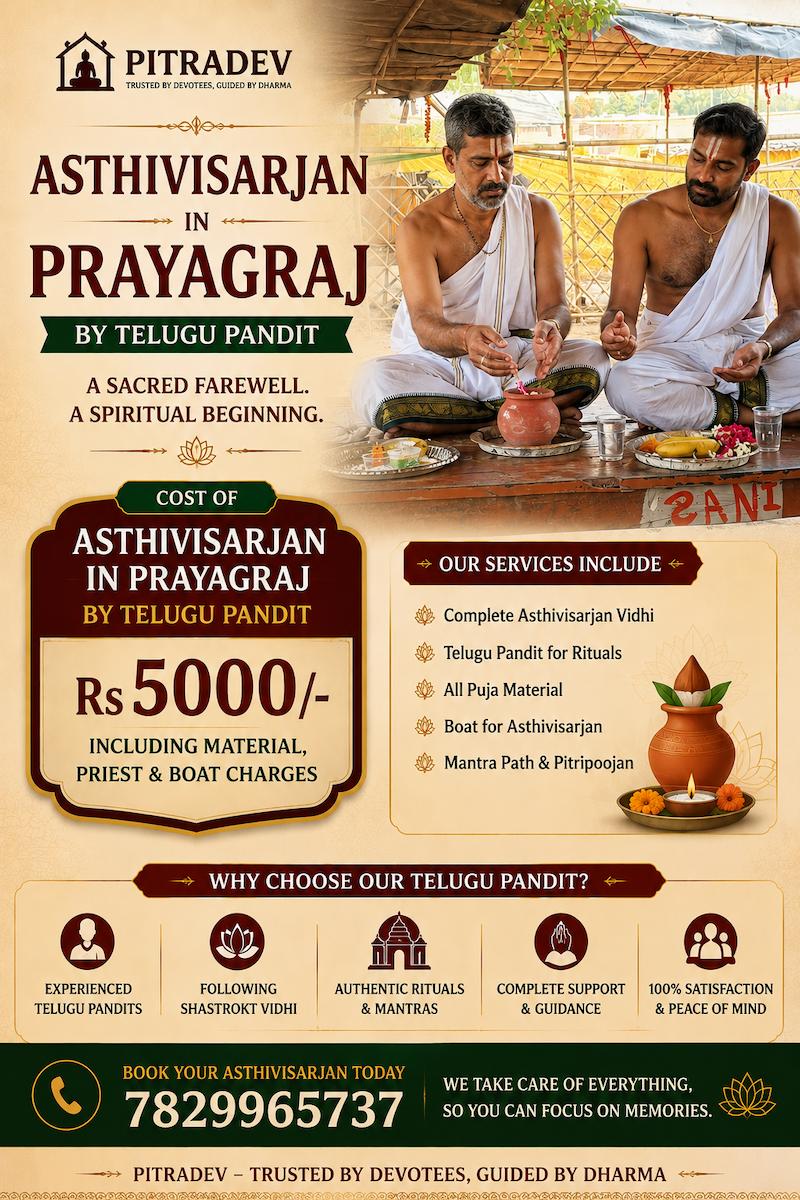
Cost of Asthi Visarjan in Prayagraj by Telugu Pandit
Asthi Visarjan at Triveni Sangam, Prayagraj, with a Telugu-speaking pandit costs ₹5,000 through Pitradev — inclusive of priest dakshina, all puja samagri, and a private boat for 2 persons. Additional family members on the boat are charged at ₹100 per person. No puja materials need to be arranged by the family. The ashes and the willingness to make the journey are all that is required.
For families from Andhra Pradesh and Telangana, the decision to travel to Prayagraj for Asthi Visarjan — rather than a closer tirtha — reflects a deep conviction about the sanctity of Triveni Sangam as the prescribed location for this final rite. The practical concern that follows is almost always the same: finding a Telugu-speaking pandit at Prayagraj who conducts the ritual in the Telugu tradition, who takes the Sankalp correctly, and who arranges everything so the family can arrive, perform the ritual, and complete their obligation without the added burden of coordinating logistics in an unfamiliar city. This post covers the cost of Asthi Visarjan in Prayagraj with a Telugu pandit, what is included, how the ritual is performed at Triveni Sangam, and how to book through Pitradev.
Why Telugu families choose Prayagraj for Asthi Visarjan
Triveni Sangam — the confluence of the Ganga, Yamuna, and the invisible Saraswati at Prayagraj — is described in the Puranas as Tirtharaj, the king of all tirthas, and its significance for Asthi Visarjan is recognised across all regional Hindu traditions, including the Telugu tradition of Andhra Pradesh and Telangana. Families from these states choose Prayagraj for Asthi Visarjan for the same reason families from every other part of India do — the confluence of the 3 sacred rivers is considered among the most meritorious locations for the immersion of a departed person's ashes, and the merit of the ritual performed here is considered far greater than at an ordinary river or local tirtha.
Prayagraj is also practically accessible from Hyderabad, Visakhapatnam, Vijayawada, and other cities in Andhra Pradesh and Telangana by train, making it a feasible destination for families planning the trip within the first weeks after the passing of a family member. For families who are also considering Varanasi, both cities are relatively close to each other and can in some cases be combined in a single trip — though Prayagraj alone is a complete and scripturally sufficient location for Asthi Visarjan.
Cost of Asthi Visarjan in Prayagraj — what ₹5,000 includes
Asthi Visarjan at Triveni Sangam through Pitradev costs ₹5,000, inclusive of Telugu pandit dakshina, all puja samagri, and a private boat for 2 persons. For family members beyond 2 who wish to travel on the boat to the confluence point, an additional charge of ₹100 per person applies. There are no other hidden or additional charges.
The ₹5,000 package covers everything the ritual requires from the pandit's side — the flowers, the pind ingredients, sesame, sacred thread, and all materials used during the Sankalp and the Asthi Visarjan vidhi. The private boat ensures that the family has a dedicated vessel for the journey to Triveni Sangam, with no sharing with other groups, which is important for families who wish to perform the ritual with complete privacy and focus.
From the family's side, the only item to be carried is the asti — the ashes of the departed, preserved in a container. No puja samagri, no flowers, no ritual materials of any kind need to be sourced or carried from Andhra Pradesh or Telangana. The pandit arranges and brings everything. For families travelling as a larger group — 3, 4, or more members who wish to be on the boat — the additional ₹100 per person charge beyond the base 2 is the only variable in the total cost.
Why a Telugu-speaking pandit matters for Asthi Visarjan
The Sankalp is the foundation of Asthi Visarjan — the formal declaration in which the name of the departed, their gotra, native place, and the specific intention of the ritual are stated aloud before the divine. For the Sankalp to be taken correctly, the pandit needs to understand exactly what the family is telling him, and the family needs to be able to communicate the details without ambiguity. When the pandit does not speak the family's language, Sankalp details — particularly the gotra, which has specific pronunciation in the Telugu tradition — can be missed or stated incorrectly, which matters to families who have made a long journey specifically to ensure the ritual is performed properly.
Beyond the Sankalp, a Telugu-speaking pandit understands the specific customs within the Telugu tradition that differ from the North Indian form of Asthi Visarjan — the way the family participates at each stage, the specific offerings made at the Sangam, and the sequence in which the rites are performed. At a moment of grief, being guided through the ritual in one's own language, by a pandit who understands one's tradition, makes a significant difference to how the family experiences the ceremony and to the sense of completion they carry away from it. Pitradev provides a Telugu-speaking pandit at Prayagraj specifically for families from Andhra Pradesh and Telangana.
What happens during Asthi Visarjan at Triveni Sangam
The ritual begins at the ghat, where Pandit ji performs the Sankalp — the formal declaration of the ritual's purpose, stating the name, gotra, and native place of the departed and binding the merit of what follows to the specific soul being honoured. The Sankalp is taken in the Telugu tradition, with the family seated and participating alongside the pandit.
After the Sankalp, the family boards the private boat and is taken to the confluence point at Triveni Sangam — the meeting of the Ganga, Yamuna, and Saraswati — where the immersion of the ashes takes place. The pandit recites the prescribed mantras during the immersion, and the asti is released into the sacred waters at the confluence itself, not at the ghat. Following the immersion, Tarpan — the offering of water and sesame for the departed — is performed at the Sangam, completing the Asthi Visarjan vidhi. The full ritual, including the boat journey to and from the confluence, takes approximately 1.5 to 2 hours.
How to book a Telugu pandit for Asthi Visarjan in Prayagraj
Booking can be done in advance through Pitradev by sharing the preferred date, the name and gotra of the departed, and the number of family members who will be travelling on the boat — so that the total cost including any additional boat charges can be confirmed at the time of booking. The pandit team will contact the family before the travel date to collect all remaining Sankalp details.
For families who are also planning to perform Pind Daan on the same visit to Prayagraj, both rituals can be booked together and performed on the same day at Triveni Sangam. Visit the Asthi Visarjan in Prayagraj page to book the Asthi Visarjan service, and the Pind Daan in Prayagraj page for Pind Daan arrangements.
Conclusion
For Telugu families from Andhra Pradesh and Telangana who have chosen Triveni Sangam as the location for Asthi Visarjan, the combination of a Telugu-speaking pandit, a private boat, and all samagri arranged at ₹5,000 means the family can focus entirely on the ritual itself — which is, ultimately, the only thing that matters on this journey. To book Asthi Visarjan in Prayagraj with a Telugu pandit, visit the Asthi Visarjan in Prayagraj service page on Pitradev. For families who are considering Varanasi as an alternative or an additional location, the Asthi Visarjan in Varanasi service is also available through Pitradev.
Frequently Asked Questions
What is the cost of Asthi Visarjan in Prayagraj with a Telugu pandit?
Asthi Visarjan at Triveni Sangam in Prayagraj with a Telugu-speaking pandit through Pitradev costs ₹5,000. This is an all-inclusive charge covering pandit dakshina, all puja samagri, and a private boat for 2 persons. For family members beyond 2 on the boat, an additional ₹100 per person applies. There are no other charges.
What does the ₹5,000 package include?
The ₹5,000 package includes the Telugu pandit's dakshina, all flowers and puja materials required for the Sankalp and Asthi Visarjan vidhi, and a private boat for 2 persons to travel to the confluence point at Triveni Sangam. All materials are arranged and brought by Pandit ji. The family does not need to source or carry any puja items.
How many people can go on the boat for Asthi Visarjan at Triveni Sangam?
The base package of ₹5,000 covers a private boat for 2 persons. For each additional family member beyond 2 who wishes to travel on the boat to the confluence point, a charge of ₹100 per person applies. Families travelling as a larger group can confirm the total boat charge at the time of booking by sharing the number of members who will be on the boat.
Do families need to carry any puja materials from home?
No. All puja samagri required for the Asthi Visarjan vidhi — including flowers, sesame, sacred thread, and all other ritual materials — is arranged and brought by Pandit ji and is included in the ₹5,000 package. The only item the family needs to carry is the asti — the ashes of the departed in a container.
Can Pind Daan also be performed on the same day in Prayagraj?
Yes, Pind Daan can be performed at Triveni Sangam on the same day as Asthi Visarjan, and this is the most practical arrangement for families travelling from Andhra Pradesh or Telangana who wish to complete both rites in a single visit. Asthi Visarjan is performed first, followed by Pind Daan at the same location. Both rituals together take approximately 3 to 4 hours. Pind Daan in Prayagraj is available at ₹5,000 separately, inclusive of all materials and pandit dakshina.
Shashank Mishra
Manager, Pitradev.com
Shashank Mishra comes with over 15 years of experience in religious tourism and organising Vedic rituals and ancestral ceremonies. At Pitradev, he oversees the coordination of Asthi Visarjan, Pind Daan, Shraadh, Grihapravesh, Vastu Shanti Puja, Satyanarayan Katha, Rudrabhishek, and other sacred rites across Varanasi, Prayagraj, Gaya, Bangalore, Hyderabad, Pune, and Mumbai. His deep understanding of Hindu customs across regional traditions — North Indian, Tamil, Telugu, Odia, and Kannada — allows him to guide families through the correct vidhi with care and clarity, whether it is an ancestral ceremony at a tirtha kshetra or a housewarming puja in a metro city.
Latest Blog
- North Indian Pandit in Pimpri-Chinchwad
- Pind Daan in Gaya by Odia Pandit | Odia Shraddha Paddhati
- Vastu Shanti Puja in Pune | 6 Mandals, 2 Pandits | ₹15000
- Gaya Pind Daan vs Varanasi Pind Daan
- Satyanarayan Katha in Pune by North Indian Pandit
- Odia Pandit Prayagraj | Asthi Bisarjan & Pind Daan Same Day
- How to Book Asthi Visarjan in Kashi Online
- Book Pandit Services Online A Complete Step by Step Guide
- Book Verified Pandit Ji in Bangalore for Any Puja Easy Guide
- How to Book a Vastu Pujan Griha Pravesh Puja for Your New Home
- How to Book Pind Daan in Gaya Online Complete Guide
- Pind Daan in Varanasi After Pitru Paksha
- Pind Daan for Dogs in Varanasi: Complete Rituals at Kashi
- Things To Know Before Booking A Pandit for Satyanarayan Puja
- How To Choose Right Muhurat for Griha Pravesh for Your New Home
- 7 Key Rituals and Stages of Pind Daan in Gaya
- Gand Mool Nakshatra Shanti Puja: Complete Process
- Grihapravesh Muhurat in November and December 2026
- Asthi Visarjan in Varanasi for Pets: Dogs And Cats
- Pind Daan in Varanasi: Guide to Ritual, Process, Cost, Booking
- Mistakes to Avoid During Asthi Visarjan in Varanasi
- How to book satyanarayn puja
- Verified South Indian Purohits in Gaya
- Samvatsarikam in Varanasi: Cost and Vidhi
- Best South Indian Purohits in Kashi Varanasi
- Pind Daan in Varanasi by Telugu Purohit
- Telugu Purohit in Gaya: Pind Daan Packages
- Tripindi Shraadh in Gaya
- Pitradev- Hindi, Tamil, Telugu & Bengali Pandit in Bangalore
- Narayan Bali Puja in Gaya
- Can I Do Pind Daan Within One Year of Death?
- One Day Narayan Bali Puja at Trimbakeshwar
- Asthi Visarjan at Manikarnika Ghat in Kashi Varanasi
- Cost of Asthi Visarjan in Varanasi: Packages and Precautions
- Pandit for Tripindi Shradh in Varanasi: 2026 Dates & Cost
- Pind Daan in Gaya in Pitru Paksha 2026: Dates and Packages
- Vastu Shanti Puja Cost in Pune by North Indian Pandit
- Pitra Dosh: Causes, Symptoms and Remedies — A Complete Guide
- How to Find Genuine Tamil Vadhyars in Kashi Varanasi
- How to Carry Asthi in Flight in India?
- Pind Daan in Gaya by Tamil Iyer: Cost, Packages and Process
- Asthi Visarjan in Srirangapatna from Bangalore — Full Guide
- Send Ashes from Coimbatore to Kashi — Asthi Visarjan Service
- Cost of Asthi Visarjan in Prayagraj by Telugu Pandit
- Asthi Visarjan and Pind Daan in Prayagraj for Odia Families
- North Indian Pandit Bangalore for Annaprashan Puja
- Telugu Grihapravesham Bangalore: 4 Packages Cost & Inclusion
- Cost of Tripindi Shraadh in Varanasi -Pishachmochan Kund
- North Indian Pandit in Pune for Grihapravesh: Package Guide
- Pind Daan in Prayagraj: Cost, Vidhi & Booking Guide-2026
- Narayan Bali Puja in Varanasi — Complete Cost Breakdown for 2026
- Book a Verified North Indian Pandit in Pune: Cost & Packages
- How to Send Asthi to Kashi: A Step-by-Step Guide
- Book Tamil Iyer in Bangalore for Grihapravesham – Complete Guide
- How to Plan 10th 11th and 12th Day Rituals in Varanasi
- Pitru Paksha 2026 – Pind Daan in Prayagraj, Kashi and Gaya
- Pitru Paksha 2026 – Book Online Pind Daan in Varanasi
- Asthi Visarjan in Varanasi for Tamil Families – Complete Guide
- How to Send Asthi (Ashes) from USA to India – Complete Guide
- Narayan Bali Puja in Varanasi – Complete Guide 2026
- Pind Daan in Gaya from Malaysia – Complete Guide
- Pind Pradanam in Varanasi from Malaysia – Complete Guide
- Grihapravesh Puja in Bangalore by Kannada Purohit
- Online Pind Daan in Varanasi for NRIs
- Book Verified Telugu Purohits in Bangalore for Grihapravesham
- Best Ghat for Asthi Visarjan in Varanasi: A Practical Comparison
- Asthi Visarjan in Prayagraj – Complete Guide 2026
- Tripindi Shradh in Varanasi – Complete Guide
- Asthi Visarjan in Varanasi –Best Ghat & Package 2026
- Grihapravesh Puja in Prestige City Sarjapur
- Gaya Ji Pind Daan 2026 – Quick Guide for Planning Your Trip
- Online Puja Booking for Griha Pravesh, Shradh & Satyanarayan
- Pitru Paksha 2026 Dates, Rituals and Pind Daan Guide
- Akshaya Tritiya 2026 (19 April): Best Muhurat for Griha Pravesh
- How to Do Asthi Visarjan When You Cannot Travel: Complete Guide
- Asthi Visarjan in Kashi: Complete Guide with Cost & Time
- Griha Pravesh Muhurat 2026: Auspicious Dates & Timings
- Complete Guide to Gaya Pind Daan Ritual, Samagri & Best Time
- Asthi Visarjan By Post in Kashi Varanasi – Complete Guide
- How to Book a Bengali Pandit for Puja: Step-by-Step Process
- Book Verified Pandit for Puja in Bangalore
- Book Verified North Indian Pandit in Hyderabad Online
- Book North Indian Pandit in Bangalore for Satyanarayan Puja
- How to Book a Pandit in Bangalore Online for Puja:Complete Guide
- Find and Book Pandits in Hyderabad for Griha Pravesh Puja Online
- How to Find and Book Experienced Pandit Online for Puja?
- Exploring the History and Origins of Griha Pravesh Puja Rituals
- Top 5 Ancient Places for Gayaji Pind Daan - 2024 Guide
- Significance of Performing Griha Pravesh Puja in Hindu Culture
- How to Choose the Right Pandit for Pind Daan in Gaya
- Why is Pind Daan in Gaya so Famous?
- Where to Find Experienced Pandit for Griha Pravesh Puja Online?
- Cost of Pind Daan in Gaya: Packages, Procedure and How to Book
- Griha Pravesh Puja and Housewarming Ceremony 2024
- How Gaya Pind Daan Brings Closure and Peace to Your Ancestors
- Gayaji Pind Daan: Achieve Eternal Peace for Your Ancestors
- Online Pind daan: Importance, Cost, and Procedure
- Gaya Pind Daan Puja is Performed by an Experienced Pandit ji
- The Sacred Ritual of Brahma Kapal Pind Daan
- A Complete Guide About Pind Daan in India: Update 2023
- Unveiling the Significance of Pind Daan in Gaya
- The Ultimate Guide to Pind Daan Tour Packages
- Where to do Asthi Visarjan in Haridwar?
- Rudrabhishek Pooja Why Hindus Perform Rudrabhishek pooja At home
- Varanasi's Asthi Visarjan: Embracing Life's Eternal Journey
- Unveiling the Sacred Ritual:
- Significance of Asthi Visarjan in Haridwar
- Exploring the Profound Significance of Asthi Visarjan in Kashi
- The Science of Pind Daan:
- What are the rituals of Pind Daan?
- Varanasi Ayodhya Tour Package with Prayagraj
- Pind Daan Puja in Varanasi | Book Your Puja Online
- Prayagraj: The Enchanting Journey of Asthi Visarjan
- Pind Daan Gaya : When and Where to Do Pind Daan in Gayaji
- Exploring the Mystical Rituals of Asthi Visarjan Poojan
- Which are the Best Places to do Pind Daan in Gaya?
- Everything You Need to Know About Rudrabhishek Puja
- Why Is Pind Daan At Gaya Important To Hindus?
- Asthi Visarjan: When to Perform It, Where to Go, and Cost
- Rudra Abhishek Puja's Purpose:
- Ganga Pushkaralu 2023
- Pind daan for people having unnatural deaths
- Is doing pind daan beneficial without self presence of related?