North Indian Pandit in Pimpri-Chinchwad
TL;DR: Pitradev arranges experienced North Indian pandits in Pimpri-Chinchwad (PCMC) for Grihapravesh, Vastu Shanti Puja, Satyanarayan Katha, Rudrabhishek, and all other ceremonies. Our pandits — including Pandit Shashikant Gaud and Pandit Amitabh Mishra, both from Uttar Pradesh — perform the complete vidhi in the North Indian tradition with all samagri included. Vastu Shanti Puja at ₹15,000 (2 pandits, 6 mandals, 4 to 5 hours). Available across Chinchwad, Pimpri, Bhosari, Moshi, Wakad, Ravet, Nigdi, Akurdi, Thergaon, and all PCMC areas.
Pimpri-Chinchwad Is Not Pune — And Your Pandit Search Should Not Treat It Like One
When North Indian families in Pimpri-Chinchwad search for “pandit in Pune” for their Grihapravesh or Satyanarayan Katha, they get results for Baner, Hinjewadi, and Kharadi — areas that are 15 to 25 km away. The pandit who is assigned may not be familiar with PCMC’s geography, may charge extra for travel, and may arrive late because he underestimated the distance from West Pune.
Pimpri-Chinchwad is not a suburb of Pune. It is a separate municipal corporation — the Pimpri Chinchwad Municipal Corporation (PCMC) — with its own identity, its own residential areas, and its own massive North Indian population. The automobile and manufacturing sector has brought thousands of families from UP, Bihar, Rajasthan, Madhya Pradesh, and Jharkhand to PCMC over the past two decades. These families live in Chinchwad, Bhosari, Moshi, Nigdi, Akurdi, Ravet, Thergaon, and Kalewadi — and they deserve a pandit who serves their area, not one who treats it as an afterthought.
Pitradev has dedicated North Indian pandits in Pune who specifically serve the PCMC belt, so your Grihapravesh or Vastu Shanti Puja is performed by a pandit who knows your area, arrives on time, and charges no extra for travel.
The North Indian Population in PCMC — Why the Demand Is Real
Pimpri-Chinchwad hosts some of India’s largest automobile and manufacturing companies — Tata Motors, Bajaj Auto, Force Motors, Thermax, Alfa Laval, Sandvik, and dozens of ancillary units. The workforce in these companies is heavily North Indian, drawn from the Hindi heartland over decades of industrial growth.
Unlike the IT corridor of Hinjewadi-Wakad-Baner where families are younger and more transient, the North Indian population in PCMC is often more settled — families who have lived here for 10 to 20 years, bought homes, and raised children in the area. Many of them now own flats in societies like Runwal The Central Park in Chinchwad, Empire Square in Chinchwad, Mahindra Antheia in Pimpri, Pharande Puneville in Tathawade, Kolte Patil City Avenue in Wakad-PCMC border, and Godrej Emerald Waters in Pimpri.
For these families, every puja — from the Grihapravesh of a new flat to the annual Satyanarayan Katha — must be performed in the North Indian tradition. A Marathi Guruji, however skilled, does not perform the ceremony the way these families know it. The mantras are different, the havan sequence is different, and the overall experience does not carry the cultural familiarity that makes a puja feel like home.
Our North Indian Pandits Serving PCMC
Pitradev’s North Indian pandits who serve the Pimpri-Chinchwad belt are experienced priests from Uttar Pradesh who have been performing ceremonies for migrant families across Pune for years.
Pandit Shashikant Gaud has extensive experience in Vastu Shanti Puja, Grihapravesh, and Shradh ceremonies. Originally from Uttar Pradesh, he regularly serves North Indian families across the PCMC belt — from Chinchwad and Nigdi to Bhosari and Moshi. His strength is in the elaborate ceremonies — the 6-mandal Vastu Shanti Puja and the complete Grihapravesh vidhi that families from UP and Bihar recognise as their own tradition.
To book Pandit Shashikant Gaud: 7829965737
Pandit Amitabh Mishra is known for his detailed and patient vidhi, particularly in Satyanarayan Katha, Rudrabhishek, and Navgraha Shanti Puja. Also from Uttar Pradesh, he takes the time to explain every step of the ceremony to the family, making the experience meaningful even for younger members who may be participating for the first time. He covers Pimpri, Thergaon, Ravet, Kalewadi, Akurdi, and surrounding areas.
To book Pandit Amitabh Mishra: 9686645737
Both pandits bring all puja samagri, arrive on time, and charge the fixed Pitradev rate with no additions for travel or “convenience” charges.
Grihapravesh and Vastu Shanti Puja — The Most Requested Service
Grihapravesh is the single most requested puja for North Indian families in PCMC. The reason is straightforward — PCMC has seen a massive residential construction boom in the last 5 years, and thousands of families are moving into new flats every month.
Whether you have bought a 2 BHK in Runwal The Central Park or a 3 BHK in Mahindra Antheia, the Grihapravesh marks the moment your flat becomes your home. And for a North Indian family, this ceremony must include the correct Vastu Shanti vidhi, the Dwar Pujan, the Kitchen Pujan, the Shanti Havan, and the formal entry with the right foot first.
Pitradev offers 3 Grihapravesh packages:
Package 1: Basic Grihapravesh Puja — ₹7,500
1 pandit ji, approximately 3 hours. Includes Ganesh Pujan, Navgraah Pujan, Kalash Pujan, Vastu Pujan, Dwar Pujan, Kitchen Pujan, Shanti Havan, and Maha Sankalp. Covers the essential pujas with 2 mandals.
This is suited for families who want a complete but compact ceremony.
Package 2: Vastu Shanti Puja — ₹15,000 (Most Popular)
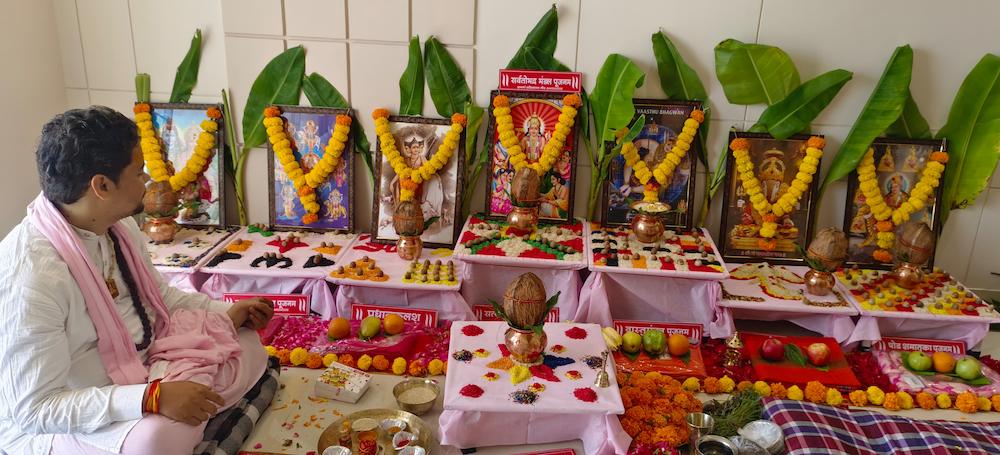
2 pandit ji, approximately 4 to 5 hours. This is the premium ceremony with 6 puja mandals drawn on the floor with coloured rice powder:
- Shodashmatrika Mandal — invoking the 16 divine mothers for protection
- Ganesh Pujan Mandal — Lord Ganesha for obstacle-free entry
- Navgrah Mandal — 9 planets for planetary harmony
- Vastu Mandal — Vastu Purush for energy alignment of the home
- Sarvatobhadra Mandal — auspicious blessings from all directions
- Kalash/Vishnu Mandal — Lord Vishnu for preservation of prosperity
Additionally includes Dwar Pujan, Kitchen Pujan, Vastu Shanti Havan, Maha Sankalp, and Maha Aarti.
This is the most chosen package by families in PCMC, and for good reason — when you invest ₹50 lakhs to ₹1.5 crores in a flat, spending ₹15,000 on a comprehensive Vastu Shanti with 6 mandals and 2 pandits is the right beginning.
You can directly book this package from our Vastu Shanti Puja booking page.
Package 3: Grand Puja with Satyanarayan Katha and Durga Saptshati Path — ₹21,000
3 pandit ji, approximately 4 to 5 hours. Everything in Package 2 plus Satyanarayan Katha and Durga Saptshati Path. The most elaborate Grihapravesh ceremony available.
All packages include pandit ji dakshina and puja samagri. No hidden charges.
Other Pujas Available in PCMC by North Indian Pandit
Beyond Grihapravesh, Pitradev’s North Indian pandits serve PCMC families for all major ceremonies:
Satyanarayan Katha — ₹4,500
The most commonly performed North Indian puja. 1 pandit ji, approximately 3 hours. Complete vidhi with 5 chapters of the Katha, Shanti Havan, Aarti, and Prasad Distribution. Pandit ji brings Shaligram, Satyanarayan Swami photo, and all samagri.
Rudrabhishek — ₹5,000
Lord Shiva puja with Abhishek, Rudra Path, and Shanti Havan. Especially popular during Sawan Somvar and Mahashivratri. Pandit Amitabh Mishra has specific expertise in this ceremony.
Gand Mool Nakshatra Shanti Puja — ₹11,000
For babies born under one of the 6 Gand Mool Nakshatras. 2 to 3 pandit ji, 4 to 5 hours, 27-element ritual with Shanti Havan. Ideally performed on the 27th day after birth.
Sunderkand Path — ₹3,500
Recitation of the Sunderkand chapter from Ramcharitmanas. Popular on Tuesdays and Saturdays, or during Navratri.
Navgraha Shanti Puja — ₹7,000
For families with planetary afflictions identified in the kundali. 1 to 2 pandit ji, approximately 3 hours, with Navagraha Havan.
Barsi / Varshik Shradh — ₹3,500
Annual death anniversary ceremony at home. Pandit Shashikant Gaud has extensive experience in Shradh ceremonies and handles them with the sensitivity these occasions require.
Mundan / Annaprashan — ₹4,500
First head shaving ceremony and first rice feeding ceremony for babies. Pandit ji coordinates with the family on muhurat and all arrangements.
Areas We Serve in Pimpri-Chinchwad
Our North Indian pandits cover every locality within the PCMC limits:
Chinchwad — Bijalinagar, Premlok Park, Shahunagar, Sambhajinagar, Empire Estate, Empire Square, Runwal The Central Park. The heart of PCMC with the oldest and most established North Indian community.
Pimpri — Mahindra Antheia, Mahindra Citadel, Sukhwani Castle, Kohinoor Shangrila, and surrounding societies. Major industrial hub with a large workforce from UP and Bihar.
Bhosari — Industrial area with one of the highest concentrations of North Indian families in PCMC. MIDC Bhosari workers and their families make up a significant portion of our bookings.
Nigdi and Akurdi — Well-connected residential areas along the Pune-Mumbai railway line. Popular with families who work in PCMC’s industrial corridor.
Moshi — Rapidly growing residential area with new apartment projects attracting young North Indian families buying their first homes.
Thergaon and Kalewadi — Between the PCMC core and the Wakad-Hinjewadi IT belt. Families here often work in both the industrial and IT sectors.
Ravet and Tathawade — On the PCMC-Pune border, with large societies like Pharande Puneville. Well connected to both PCMC and the Hinjewadi IT corridor.
Wakad (PCMC side) — Kolte Patil City Avenue and other societies that fall within PCMC limits rather than PMC.
No matter which PCMC locality you are in, a dedicated North Indian pandit ji can be arranged at your doorstep.
What Makes PCMC Different from Pune for Puja Booking
Families in PCMC face a few unique challenges that families in Baner or Kharadi do not:
Distance surcharge. Many pandit services based in Pune charge extra ₹500 to ₹1,000 for PCMC bookings because they consider it “outside Pune.” Pitradev does not charge any travel surcharge for PCMC — the price is the same whether your flat is in Chinchwad or in Baner.
Pandit availability. Because most pandit services focus on the IT corridor (Hinjewadi, Wakad, Baner), PCMC often gets the “leftover” pandit — whoever is free on that day. At Pitradev, Pandit Shashikant Gaud and Pandit Amitabh Mishra specifically serve the PCMC belt, so you get a dedicated pandit, not an afterthought.
Factory shift timings. Many families in PCMC work in manufacturing, with shift timings that differ from the standard 9-to-5 IT schedule. Our pandits accommodate early morning (6 AM start) and weekend pujas to fit around factory schedules.
Society types. PCMC has a mix of older residential colonies, mid-range apartments, and new premium societies. Our pandits are equally comfortable performing a puja in a 1 BHK in Bhosari and a 3 BHK in Mahindra Antheia — the vidhi is the same, the respect is the same, and the price is the same.
How to Book a North Indian Pandit in PCMC
- Contact Pitradev on WhatsApp or phone
- Pandit Shashikant Gaud: 7829965737
- Pandit Amitabh Mishra: 9686645737
- Share the puja you need, your preferred date, and your PCMC address
- Choose your package (for Grihapravesh: ₹7,500, ₹15,000, or ₹21,000)
- Pandit ji name, timing, and the list of household items you need to arrange are confirmed
- Pandit ji arrives at your home with all samagri on the confirmed date
Book at least 5 to 7 days in advance. During the November-December Grihapravesh season, book 2 to 3 weeks in advance.
Conclusion
Pimpri-Chinchwad has one of the largest North Indian communities in Maharashtra, and every family in this belt deserves a pandit who serves their area with the same dedication that the IT corridor receives. Whether you are performing a Grihapravesh in your new flat in Runwal The Central Park, a Satyanarayan Katha in your home in Bhosari, or a Rudrabhishek during Sawan in Nigdi, Pitradev’s North Indian pandits — Pandit Shashikant Gaud and Pandit Amitabh Mishra — are available across every PCMC locality with fixed pricing, all samagri included, and no travel surcharge.
For the complete list of all services and to explore pandit options across all of Pune, visit our Pandit in Pune page.
Your tradition did not change when you moved to PCMC. Your pandit should not either.
Frequently Asked Questions
1. Is a North Indian pandit available in Pimpri-Chinchwad for Grihapravesh?
Yes. Pitradev has dedicated North Indian pandits serving the entire PCMC belt, including Pandit Shashikant Gaud and Pandit Amitabh Mishra, both from Uttar Pradesh. They cover Chinchwad, Pimpri, Bhosari, Moshi, Nigdi, Akurdi, Thergaon, Ravet, and all PCMC areas.
2. What is the cost of Vastu Shanti Puja in Pimpri-Chinchwad?
Pitradev offers 3 packages: Basic Grihapravesh at ₹7,500 (1 pandit, 3 hours), Vastu Shanti Puja at ₹15,000 (2 pandits, 6 mandals, 4 to 5 hours), and Grand Puja at ₹21,000 (3 pandits, with Satyanarayan Katha and Durga Saptshati Path). All packages include pandit dakshina and samagri with no travel surcharge for PCMC.
3. Is there an extra charge for Pimpri-Chinchwad bookings?
No. Pitradev does not charge any travel surcharge for PCMC localities. The price is the same whether your flat is in Chinchwad, Bhosari, or Baner.
4. Which pujas do your North Indian pandits perform in PCMC?
Grihapravesh, Vastu Shanti Puja, Satyanarayan Katha, Rudrabhishek, Sunderkand Path, Navgraha Shanti, Gand Mool Nakshatra Shanti, Mundan, Annaprashan, Barsi, and all other North Indian ceremonies are available.
5. How far in advance should I book for Grihapravesh in PCMC?
Book at least 5 to 7 days in advance. During the November-December Grihapravesh season after Devuthani Ekadashi, booking 2 to 3 weeks in advance is strongly recommended.
6. Can I book a specific pandit by name?
Yes. You can request Pandit Shashikant Gaud (7829965737) or Pandit Amitabh Mishra (9686645737) by name at the time of booking. Subject to availability on your preferred date.
Shashank Mishra comes with over 15 years of experience in religious tourism and organising Vedic rituals and ancestral ceremonies. At Pitradev, he oversees the coordination of Asthi Visarjan, Pind Daan, Shraadh, Grihapravesh, Vastu Shanti Puja, Satyanarayan Katha, Rudrabhishek, and other sacred rites across Varanasi, Prayagraj, Gaya, Bangalore, Hyderabad, Pune, and Mumbai.
Latest Blog
- North Indian Pandit in Pimpri-Chinchwad
- Pind Daan in Gaya by Odia Pandit | Odia Shraddha Paddhati
- Vastu Shanti Puja in Pune | 6 Mandals, 2 Pandits | ₹15000
- Gaya Pind Daan vs Varanasi Pind Daan
- Satyanarayan Katha in Pune by North Indian Pandit
- Odia Pandit Prayagraj | Asthi Bisarjan & Pind Daan Same Day
- How to Book Asthi Visarjan in Kashi Online
- Book Pandit Services Online A Complete Step by Step Guide
- Book Verified Pandit Ji in Bangalore for Any Puja Easy Guide
- How to Book a Vastu Pujan Griha Pravesh Puja for Your New Home
- How to Book Pind Daan in Gaya Online Complete Guide
- Pind Daan in Varanasi After Pitru Paksha
- Pind Daan for Dogs in Varanasi: Complete Rituals at Kashi
- Things To Know Before Booking A Pandit for Satyanarayan Puja
- How To Choose Right Muhurat for Griha Pravesh for Your New Home
- 7 Key Rituals and Stages of Pind Daan in Gaya
- Gand Mool Nakshatra Shanti Puja: Complete Process
- Grihapravesh Muhurat in November and December 2026
- Asthi Visarjan in Varanasi for Pets: Dogs And Cats
- Pind Daan in Varanasi: Guide to Ritual, Process, Cost, Booking
- Mistakes to Avoid During Asthi Visarjan in Varanasi
- How to book satyanarayn puja
- Verified South Indian Purohits in Gaya
- Samvatsarikam in Varanasi: Cost and Vidhi
- Best South Indian Purohits in Kashi Varanasi
- Pind Daan in Varanasi by Telugu Purohit
- Telugu Purohit in Gaya: Pind Daan Packages
- Tripindi Shraadh in Gaya
- Pitradev- Hindi, Tamil, Telugu & Bengali Pandit in Bangalore
- Narayan Bali Puja in Gaya
- Can I Do Pind Daan Within One Year of Death?
- One Day Narayan Bali Puja at Trimbakeshwar
- Asthi Visarjan at Manikarnika Ghat in Kashi Varanasi
- Cost of Asthi Visarjan in Varanasi: Packages and Precautions
- Pandit for Tripindi Shradh in Varanasi: 2026 Dates & Cost
- Pind Daan in Gaya in Pitru Paksha 2026: Dates and Packages
- Vastu Shanti Puja Cost in Pune by North Indian Pandit
- Pitra Dosh: Causes, Symptoms and Remedies — A Complete Guide
- How to Find Genuine Tamil Vadhyars in Kashi Varanasi
- How to Carry Asthi in Flight in India?
- Pind Daan in Gaya by Tamil Iyer: Cost, Packages and Process
- Asthi Visarjan in Srirangapatna from Bangalore — Full Guide
- Send Ashes from Coimbatore to Kashi — Asthi Visarjan Service
- Cost of Asthi Visarjan in Prayagraj by Telugu Pandit
- Asthi Visarjan and Pind Daan in Prayagraj for Odia Families
- North Indian Pandit Bangalore for Annaprashan Puja
- Telugu Grihapravesham Bangalore: 4 Packages Cost & Inclusion
- Cost of Tripindi Shraadh in Varanasi -Pishachmochan Kund
- North Indian Pandit in Pune for Grihapravesh: Package Guide
- Pind Daan in Prayagraj: Cost, Vidhi & Booking Guide-2026
- Narayan Bali Puja in Varanasi — Complete Cost Breakdown for 2026
- Book a Verified North Indian Pandit in Pune: Cost & Packages
- How to Send Asthi to Kashi: A Step-by-Step Guide
- Book Tamil Iyer in Bangalore for Grihapravesham – Complete Guide
- How to Plan 10th 11th and 12th Day Rituals in Varanasi
- Pitru Paksha 2026 – Pind Daan in Prayagraj, Kashi and Gaya
- Pitru Paksha 2026 – Book Online Pind Daan in Varanasi
- Asthi Visarjan in Varanasi for Tamil Families – Complete Guide
- How to Send Asthi (Ashes) from USA to India – Complete Guide
- Narayan Bali Puja in Varanasi – Complete Guide 2026
- Pind Daan in Gaya from Malaysia – Complete Guide
- Pind Pradanam in Varanasi from Malaysia – Complete Guide
- Grihapravesh Puja in Bangalore by Kannada Purohit
- Online Pind Daan in Varanasi for NRIs
- Book Verified Telugu Purohits in Bangalore for Grihapravesham
- Best Ghat for Asthi Visarjan in Varanasi: A Practical Comparison
- Asthi Visarjan in Prayagraj – Complete Guide 2026
- Tripindi Shradh in Varanasi – Complete Guide
- Asthi Visarjan in Varanasi –Best Ghat & Package 2026
- Grihapravesh Puja in Prestige City Sarjapur
- Gaya Ji Pind Daan 2026 – Quick Guide for Planning Your Trip
- Online Puja Booking for Griha Pravesh, Shradh & Satyanarayan
- Pitru Paksha 2026 Dates, Rituals and Pind Daan Guide
- Akshaya Tritiya 2026 (19 April): Best Muhurat for Griha Pravesh
- How to Do Asthi Visarjan When You Cannot Travel: Complete Guide
- Asthi Visarjan in Kashi: Complete Guide with Cost & Time
- Griha Pravesh Muhurat 2026: Auspicious Dates & Timings
- Complete Guide to Gaya Pind Daan Ritual, Samagri & Best Time
- Asthi Visarjan By Post in Kashi Varanasi – Complete Guide
- How to Book a Bengali Pandit for Puja: Step-by-Step Process
- Book Verified Pandit for Puja in Bangalore
- Book Verified North Indian Pandit in Hyderabad Online
- Book North Indian Pandit in Bangalore for Satyanarayan Puja
- How to Book a Pandit in Bangalore Online for Puja:Complete Guide
- Find and Book Pandits in Hyderabad for Griha Pravesh Puja Online
- How to Find and Book Experienced Pandit Online for Puja?
- Exploring the History and Origins of Griha Pravesh Puja Rituals
- Top 5 Ancient Places for Gayaji Pind Daan - 2024 Guide
- Significance of Performing Griha Pravesh Puja in Hindu Culture
- How to Choose the Right Pandit for Pind Daan in Gaya
- Why is Pind Daan in Gaya so Famous?
- Where to Find Experienced Pandit for Griha Pravesh Puja Online?
- Cost of Pind Daan in Gaya: Packages, Procedure and How to Book
- Griha Pravesh Puja and Housewarming Ceremony 2024
- How Gaya Pind Daan Brings Closure and Peace to Your Ancestors
- Gayaji Pind Daan: Achieve Eternal Peace for Your Ancestors
- Online Pind daan: Importance, Cost, and Procedure
- Gaya Pind Daan Puja is Performed by an Experienced Pandit ji
- The Sacred Ritual of Brahma Kapal Pind Daan
- A Complete Guide About Pind Daan in India: Update 2023
- Unveiling the Significance of Pind Daan in Gaya
- The Ultimate Guide to Pind Daan Tour Packages
- Where to do Asthi Visarjan in Haridwar?
- Rudrabhishek Pooja Why Hindus Perform Rudrabhishek pooja At home
- Varanasi's Asthi Visarjan: Embracing Life's Eternal Journey
- Unveiling the Sacred Ritual:
- Significance of Asthi Visarjan in Haridwar
- Exploring the Profound Significance of Asthi Visarjan in Kashi
- The Science of Pind Daan:
- What are the rituals of Pind Daan?
- Varanasi Ayodhya Tour Package with Prayagraj
- Pind Daan Puja in Varanasi | Book Your Puja Online
- Prayagraj: The Enchanting Journey of Asthi Visarjan
- Pind Daan Gaya : When and Where to Do Pind Daan in Gayaji
- Exploring the Mystical Rituals of Asthi Visarjan Poojan
- Which are the Best Places to do Pind Daan in Gaya?
- Everything You Need to Know About Rudrabhishek Puja
- Why Is Pind Daan At Gaya Important To Hindus?
- Asthi Visarjan: When to Perform It, Where to Go, and Cost
- Rudra Abhishek Puja's Purpose:
- Ganga Pushkaralu 2023
- Pind daan for people having unnatural deaths
- Is doing pind daan beneficial without self presence of related?