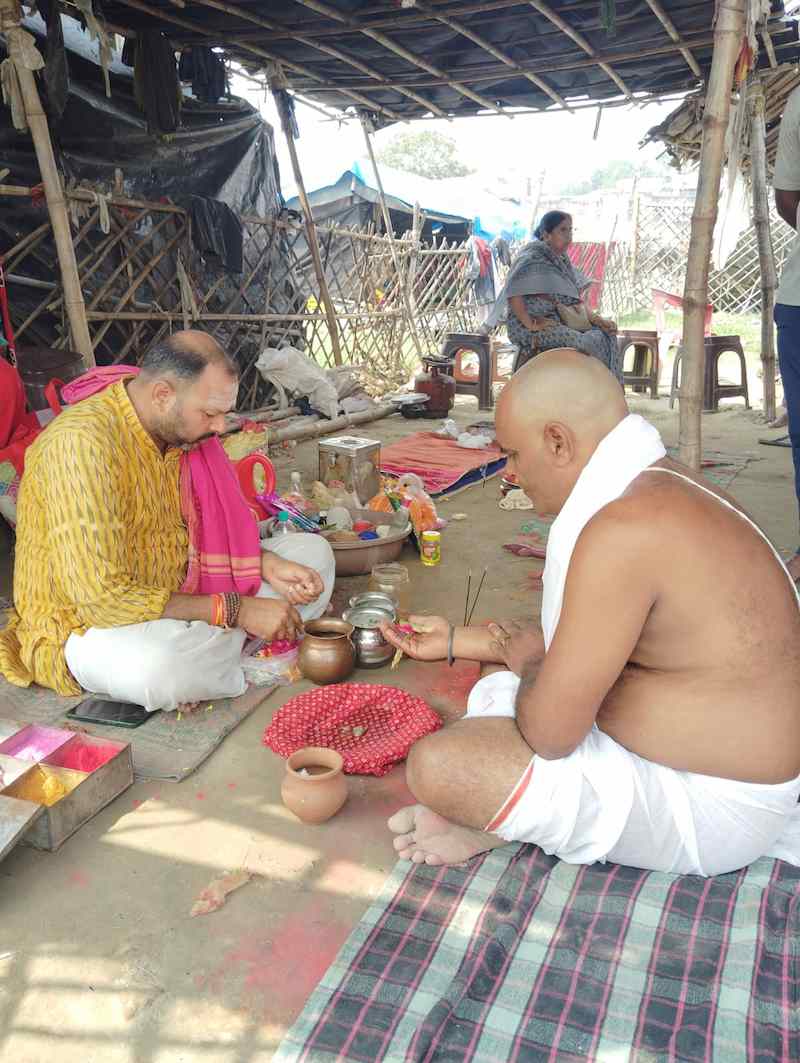
Odia Pandit Prayagraj | Asthi Bisarjan & Pind Daan Same Day
TL;DR: Odia families can perform both Asthi Bisarjan and Pind Daan at Triveni Sangam in Prayagraj on the same day. Asthi Bisarjan is performed first, followed by Pind Daan. If the departed passed away within one year, Asthi Sanchay Pind Daan with 3 pinds is performed for the deceased only. If the departed passed away more than a year ago, Tirth Shradh Pind Daan with 17 pinds is performed for all ancestors. The combined cost through Pitradev is ₹7,000, all-inclusive, with an Odia-speaking pandit, all puja material, and a private boat to the Sangam for 2 persons.
Why Odia Families Combine Both Rituals in One Trip
For Odia families living in Bhubaneswar, Cuttack, Rourkela, Sambalpur, or those settled in cities like Bangalore and Hyderabad for work, travelling to Prayagraj is not a casual trip. It requires planning, leave from work, travel arrangements, and often coordinating with family members across different cities.
This is why most Odia families prefer to complete both Asthi Bisarjan and Pind Daan on the same day at Triveni Sangam, rather than making two separate trips. The good news is that this is not just practical — it is scripturally appropriate. Both rituals are traditionally performed at the same sacred site, and performing them in sequence on the same day is the most common approach followed by families visiting Pitradev Prayagraj for ancestral rites.
The combined ceremony means you travel once, complete both sacred duties in a single morning, and return home with the peace of knowing that everything has been done correctly and completely.
Can Both Rituals Be Done on the Same Day?
Yes. Asthi Bisarjan and Pind Daan can absolutely be performed on the same day at Triveni Sangam. In fact, this is the most natural sequence — the ashes are immersed first, and then the Pind Daan is performed for the peace of the departed soul.
The two rituals serve different purposes:
Asthi Bisarjan is the immersion of the cremated remains (ashes) in the sacred river. It is the physical farewell — returning the mortal remains to the elements through the holiest waters.
Pind Daan is the spiritual offering — rice ball pinds are offered in the name of the departed, nourishing and supporting the soul on its onward journey.
When performed together, the family completes both the physical farewell and the spiritual offering in a single ceremony, giving the departed the most complete send-off at the holiest confluence.
Two Types of Pind Daan — Which One Applies to You
This is an important distinction that every family must understand before the ceremony, because the type of Pind Daan depends on how long ago the departed passed away.
If the Departed Passed Away Within One Year — Asthi Sanchay Pind Daan (3 Pinds)
When you are carrying the ashes of someone who passed away within one year and whose Barsi (first annual Shradh) has not been completed, the Pind Daan performed is called Asthi Sanchay Pind Daan. In this form:
- 3 rice ball pinds are made and offered
- The pinds are offered in the name of the deceased person only — not for all ancestors
- The sankalp is taken specifically for the recently departed soul
This is the only form of Pind Daan at a tirtha that is permitted within the first year. Tirth Shradh for all ancestors (the full ancestral Pind Daan) should not be done until the Barsi is completed.
If the Departed Passed Away More Than One Year Ago — Tirth Shradh Pind Daan (17 Pinds)
When you are carrying the ashes of someone who passed away more than one year ago and whose Barsi has already been completed, the Pind Daan performed is the full Tirth Shradh Pind Daan. In this form:
- 17 rice ball pinds are made and offered
- The pinds are offered for all departed ancestors in the family — not just the person whose ashes are being immersed
- The sankalp includes the names and gotra of all ancestors across generations
- This is the complete ancestral Pind Daan prescribed by the scriptures for tirtha kshetras
The Odia pandit will determine which type applies based on the date of death you share at the time of booking, and will guide you accordingly.
The Sequence — Asthi Bisarjan First, Then Pind Daan
The ceremony follows a specific order that the Odia pandit guides you through:
If the departed passed away more than one year ago — 17 rice ball pinds are offered in the names of all departed ancestors in the family (Tirth Shradh Pind Daan).
Each pind is offered with Vedic mantras, with the Odia pandit guiding you through every step.
Cost of Combined Asthi Bisarjan + Pind Daan — ₹7,000
Pitradev offers the combined Asthi Bisarjan and Pind Daan at Triveni Sangam for Odia families at a fixed, all-inclusive cost of ₹7,000.
What is included:
- Experienced Odia-speaking pandit who conducts the entire ceremony in Odia
- Asthi Bisarjan with complete asthi pujan and immersion at the Sangam
- Pind Daan (3 pinds or 17 pinds depending on the case — the pandit determines this)
- Tarpan
- Private boat to the Triveni Sangam confluence (for 2 persons)
- All puja samagri and ritual material
- Pandit dakshina
- No hidden charges
Additional charges (if applicable):
- For more than 2 persons on the boat — ₹300 per additional person
- Nai (barber) for head shaving before the ceremony — ₹100 to ₹150 per person (optional)
These are the only additional costs, and both are communicated before the ceremony.
For families who wish to perform only Asthi Bisarjan or only Pind Daan in Prayagraj, each ritual is available separately at ₹5,000.
How the Day Looks — A Practical Timeline for Odia Families
Here is a realistic timeline for families travelling from Odisha:
The entire ritual — from sankalp to concluding prayers — takes approximately 3 to 4 hours. A family that arrives the previous evening and starts the puja by 7:30 AM can comfortably finish by 11:00 AM and catch an afternoon train or evening flight back to Bhubaneswar.
The Odia Pandit Difference
For Odia families, having an Odia-speaking pandit is not a luxury — it is a necessity for the ceremony to feel correct and complete.
The sankalp must be taken with the correct pronunciation of the departed’s name, the family gotra, and the place of origin. An Odia pandit does this naturally because he understands the Odia naming conventions, the common gotras in Odisha, and the way Odia families traditionally observe ancestral rites.
The guidance through every step — which hand to use, how to hold the pind, when to pour the water, what to say at each moment — is given in Odia. This means every family member, including elderly parents who may not be comfortable in Hindi, can participate fully and with understanding.
Pitradev’s Odia pandit at Prayagraj is not a Hindi pandit who speaks basic Odia for communication. He conducts the entire vidhi as per the customs observed by Odia families, so the ceremony feels exactly as it would at a ghat in Cuttack or Puri.
What Odia Families Need to Carry
You need to carry very little:
- White dhoti and gamcha — 1 per person participating in the ritual
- Ashes of the departed in a container (for Asthi Bisarjan)
- Names and gotra of the departed written on a note
- If opting for Tirth Shradh Pind Daan (17 pinds), bring names and gotras of all departed ancestors in the family
All puja samagri, flowers, pind ingredients, sesame seeds, sacred thread, and every other ritual material is arranged by the pandit. Nothing needs to be sourced or carried from Odisha.
How to Plan the Trip from Odisha
Tip: Arrive the previous evening, perform the ceremony the next morning, and you can return the same day if you have an afternoon or evening train or flight. This makes it a 1 night, 2 day trip — the minimum time needed to complete both rituals comfortably.
For Odia Families Who Cannot Travel
If travelling to Prayagraj is not possible — due to age, health, distance, or work commitments — Pitradev arranges the complete Asthi Bisarjan and Pind Daan on your behalf at Triveni Sangam.
You send the ashes by Speed Post or courier to our Prayagraj address. The Odia pandit performs the complete ceremony at the Sangam — the sankalp in the departed’s name, the asthi pujan, the boat ride, the immersion, the Pind Daan, and the tarpan. Photos and videos of the entire ceremony are shared with you after completion.
For families who wish to watch the ceremony live, a WhatsApp video call can also be arranged at the ghat during the puja.
The charges for the online combined ceremony are the same — ₹7,000.
Conclusion
For Odia families, performing both Asthi Bisarjan and Pind Daan at Triveni Sangam in a single day is the most practical, complete, and scripturally correct way to honour the departed. Whether the departed passed away within one year (3 pinds for the deceased only) or more than one year ago (17 pinds for all ancestors), the Odia pandit determines the correct vidhi and guides you through every step.
The journey to Prayagraj need not be long or complicated — arrive the previous evening, complete the ceremony the next morning, and return with the peace of knowing that everything was done correctly, in Odia, by a genuine Odia pandit, at the holiest confluence in the country.
The combined ceremony costs ₹7,000 with Pitradev — all inclusive, no hidden charges. For families who also wish to perform rites at Varanasi, Asthi Visarjan in Varanasi by Tamil, Telugu, Odia, and Hindi pandits is available with the same trusted arrangements.
Book your date and give your loved one the farewell they deserve.
Frequently Asked Questions
Shashank Mishra
Manager, Pitradev.com
Shashank Mishra comes with over 15 years of experience in religious tourism and organising Vedic rituals and ancestral ceremonies. At Pitradev, he oversees the coordination of Asthi Visarjan, Pind Daan, Shraadh, Grihapravesh, Vastu Shanti Puja, Satyanarayan Katha, Rudrabhishek, and other sacred rites across Varanasi, Prayagraj, Gaya, Bangalore, Hyderabad, Pune, and Mumbai.
Latest Blog
- Odia Pandit Prayagraj | Asthi Bisarjan & Pind Daan Same Day
- How to Book Asthi Visarjan in Kashi Online
- Book Pandit Services Online A Complete Step by Step Guide
- Book Verified Pandit Ji in Bangalore for Any Puja Easy Guide
- How to Book a Vastu Pujan Griha Pravesh Puja for Your New Home
- How to Book Pind Daan in Gaya Online Complete Guide
- Pind Daan in Varanasi After Pitru Paksha
- Pind Daan for Dogs in Varanasi: Complete Rituals at Kashi
- Things To Know Before Booking A Pandit for Satyanarayan Puja
- How To Choose Right Muhurat for Griha Pravesh for Your New Home
- 7 Key Rituals and Stages of Pind Daan in Gaya
- Gand Mool Nakshatra Shanti Puja: Complete Process
- Grihapravesh Muhurat in November and December 2026
- Asthi Visarjan in Varanasi for Pets: Dogs And Cats
- Pind Daan in Varanasi: Guide to Ritual, Process, Cost, Booking
- Mistakes to Avoid During Asthi Visarjan in Varanasi
- How to book satyanarayn puja
- Verified South Indian Purohits in Gaya
- Samvatsarikam in Varanasi: Cost and Vidhi
- Best South Indian Purohits in Kashi Varanasi
- Pind Daan in Varanasi by Telugu Purohit
- Telugu Purohit in Gaya: Pind Daan Packages
- Tripindi Shraadh in Gaya
- Pitradev- Hindi, Tamil, Telugu & Bengali Pandit in Bangalore
- Narayan Bali Puja in Gaya
- Can I Do Pind Daan Within One Year of Death?
- One Day Narayan Bali Puja at Trimbakeshwar
- Asthi Visarjan at Manikarnika Ghat in Kashi Varanasi
- Cost of Asthi Visarjan in Varanasi: Packages and Precautions
- Pandit for Tripindi Shradh in Varanasi: 2026 Dates & Cost
- Pind Daan in Gaya in Pitru Paksha 2026: Dates and Packages
- Vastu Shanti Puja Cost in Pune by North Indian Pandit
- Pitra Dosh: Causes, Symptoms and Remedies — A Complete Guide
- How to Find Genuine Tamil Vadhyars in Kashi Varanasi
- How to Carry Asthi in Flight in India?
- Pind Daan in Gaya by Tamil Iyer: Cost, Packages and Process
- Asthi Visarjan in Srirangapatna from Bangalore — Full Guide
- Send Ashes from Coimbatore to Kashi — Asthi Visarjan Service
- Cost of Asthi Visarjan in Prayagraj by Telugu Pandit
- Asthi Visarjan and Pind Daan in Prayagraj for Odia Families
- North Indian Pandit Bangalore for Annaprashan Puja
- Telugu Grihapravesham Bangalore: 4 Packages Cost & Inclusion
- Cost of Tripindi Shraadh in Varanasi -Pishachmochan Kund
- North Indian Pandit in Pune for Grihapravesh: Package Guide
- Pind Daan in Prayagraj: Cost, Vidhi & Booking Guide-2026
- Narayan Bali Puja in Varanasi — Complete Cost Breakdown for 2026
- Book a Verified North Indian Pandit in Pune: Cost & Packages
- How to Send Asthi to Kashi: A Step-by-Step Guide
- Book Tamil Iyer in Bangalore for Grihapravesham – Complete Guide
- How to Plan 10th 11th and 12th Day Rituals in Varanasi
- Pitru Paksha 2026 – Pind Daan in Prayagraj, Kashi and Gaya
- Pitru Paksha 2026 – Book Online Pind Daan in Varanasi
- Asthi Visarjan in Varanasi for Tamil Families – Complete Guide
- How to Send Asthi (Ashes) from USA to India – Complete Guide
- Narayan Bali Puja in Varanasi – Complete Guide 2026
- Pind Daan in Gaya from Malaysia – Complete Guide
- Pind Pradanam in Varanasi from Malaysia – Complete Guide
- Grihapravesh Puja in Bangalore by Kannada Purohit
- Online Pind Daan in Varanasi for NRIs
- Book Verified Telugu Purohits in Bangalore for Grihapravesham
- Best Ghat for Asthi Visarjan in Varanasi: A Practical Comparison
- Asthi Visarjan in Prayagraj – Complete Guide 2026
- Tripindi Shradh in Varanasi – Complete Guide
- Asthi Visarjan in Varanasi –Best Ghat & Package 2026
- Grihapravesh Puja in Prestige City Sarjapur
- Gaya Ji Pind Daan 2026 – Quick Guide for Planning Your Trip
- Online Puja Booking for Griha Pravesh, Shradh & Satyanarayan
- Pitru Paksha 2026 Dates, Rituals and Pind Daan Guide
- Akshaya Tritiya 2026 (19 April): Best Muhurat for Griha Pravesh
- North Indian Pandit in Bangalore for All Hindu Pujas
- How to Do Asthi Visarjan When You Cannot Travel: Complete Guide
- Asthi Visarjan in Kashi: Complete Guide with Cost & Time
- Griha Pravesh Muhurat 2026: Auspicious Dates & Timings
- Complete Guide to Gaya Pind Daan Ritual, Samagri & Best Time
- Asthi Visarjan By Post in Kashi Varanasi – Complete Guide
- How to Book a Bengali Pandit for Puja: Step-by-Step Process
- Book Verified Pandit for Puja in Bangalore
- Book Verified North Indian Pandit in Hyderabad Online
- Book North Indian Pandit in Bangalore for Satyanarayan Puja
- How to Book a Pandit in Bangalore Online for Puja:Complete Guide
- Find and Book Pandits in Hyderabad for Griha Pravesh Puja Online
- How to Find and Book Experienced Pandit Online for Puja?
- Exploring the History and Origins of Griha Pravesh Puja Rituals
- Top 5 Ancient Places for Gayaji Pind Daan - 2024 Guide
- Significance of Performing Griha Pravesh Puja in Hindu Culture
- How to Choose the Right Pandit for Pind Daan in Gaya
- Why is Pind Daan in Gaya so Famous?
- Where to Find Experienced Pandit for Griha Pravesh Puja Online?
- Cost of Pind Daan in Gaya: Packages, Procedure and How to Book
- Griha Pravesh Puja and Housewarming Ceremony 2024
- How Gaya Pind Daan Brings Closure and Peace to Your Ancestors
- Gayaji Pind Daan: Achieve Eternal Peace for Your Ancestors
- Online Pind daan: Importance, Cost, and Procedure
- Gaya Pind Daan Puja is Performed by an Experienced Pandit ji
- The Sacred Ritual of Brahma Kapal Pind Daan
- A Complete Guide About Pind Daan in India: Update 2023
- Unveiling the Significance of Pind Daan in Gaya
- The Ultimate Guide to Pind Daan Tour Packages
- Where to do Asthi Visarjan in Haridwar?
- Rudrabhishek Pooja Why Hindus Perform Rudrabhishek pooja At home
- Varanasi's Asthi Visarjan: Embracing Life's Eternal Journey
- Unveiling the Sacred Ritual:
- Significance of Asthi Visarjan in Haridwar
- Exploring the Profound Significance of Asthi Visarjan in Kashi
- The Science of Pind Daan:
- What are the rituals of Pind Daan?
- Varanasi Ayodhya Tour Package with Prayagraj
- Pind Daan Puja in Varanasi | Book Your Puja Online
- Prayagraj: The Enchanting Journey of Asthi Visarjan
- Pind Daan Gaya : When and Where to Do Pind Daan in Gayaji
- Exploring the Mystical Rituals of Asthi Visarjan Poojan
- Which are the Best Places to do Pind Daan in Gaya?
- Everything You Need to Know About Rudrabhishek Puja
- Why Is Pind Daan At Gaya Important To Hindus?
- Asthi Visarjan: When to Perform It, Where to Go, and Cost
- Rudra Abhishek Puja's Purpose:
- Ganga Pushkaralu 2023
- Pind daan for people having unnatural deaths
- Is doing pind daan beneficial without self presence of related?