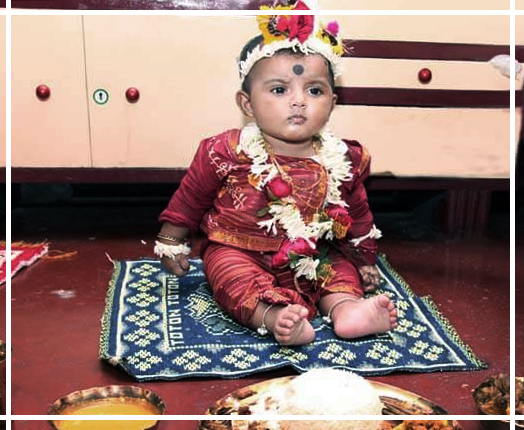
Annaprashan in Pune | First Rice Feeding Ceremony ₹4500
TL;DR: Pitradev arranges Annaprashan (first rice feeding ceremony) at your home in Pune at a fixed cost of ₹4,500. 1 pandit ji performs the complete vidhi including Gauri Ganesh Pujan, Navgrah Shanti Pujan, Kalash Pujan, Bal Gopal Pujan, Annaprashan, Sankalp, and Mangal Aarti. All puja samagri brought by pandit ji. Both Marathi Guruji and North Indian pandit available. The ceremony takes approximately 1.5 to 2 hours.
Your Baby’s First Taste of Food — A Milestone That Deserves a Ceremony
Annaprashan is one of the most joyful ceremonies in a baby’s first year. The word comes from Sanskrit — “Anna” means food and “Prashan” means feeding or consuming. Together, Annaprashan literally means “feeding with food.”
This ceremony marks the moment your baby transitions from a diet of only milk to solid food for the first time. It is not just a family celebration — it is one of the 16 Samskaras prescribed in the Vedic texts, recognising that the introduction of solid food is a significant milestone in the baby’s physical and spiritual development. The feeding of the first morsel — traditionally sweetened rice or kheer — symbolises the prayer that the child will always have abundance, nourishment, and good health throughout life.
For North Indian families in Pune, the Annaprashan must be performed with the correct vidhi — the Sankalp, the puja, the mantras, and the feeding, all done in the tradition the family knows. Pitradev arranges experienced North Indian pandits in Pune who perform the complete Annaprashan at your home with all samagri included.
When Is Annaprashan Performed
For boys: The ceremony is traditionally performed in the 6th month after birth (even months are preferred for boys).
For girls: The ceremony is traditionally performed in the 5th or 7th month (odd months are preferred for girls).
These are the ideal timings, but if the exact month is missed due to the baby’s health, teething, or any other reason, the Annaprashan can be performed any time between the 5th and 12th month. The baby should have started showing interest in food — watching family members eat, reaching for food, or making chewing motions — which are natural signs that the baby is ready for solid food.
Preferred tithis: Shukla Paksha tithis (waxing moon phase) are considered more auspicious. Dwitiya, Tritiya, Panchami, Saptami, Dashami, Ekadashi, and Trayodashi are traditionally favourable.
Preferred days: Monday, Wednesday, Thursday, and Friday are considered auspicious for Annaprashan.
If you are unsure about the best date, our pandit ji can calculate the correct muhurat based on the baby’s date and time of birth.
The Complete Annaprashan Vidhi — Step by Step
The ceremony is performed by 1 pandit ji at your home and takes approximately 1.5 to 2 hours. Here is the complete sequence:
Sankalp
The ceremony opens with the Sankalp, in which the father formally declares the intention of the Annaprashan — the baby’s name, date of birth, gotra, and the purpose of the ceremony. Coins are held in the hand during the Sankalp as per tradition.
Gauri Ganesh Pujan
Lord Ganesha and Goddess Gauri are invoked and worshipped first, seeking their blessings for the successful completion of the ceremony and for the obstacle-free growth of the child.
Kalash Pujan
The sacred Kalash is established with water, mango leaves, and coconut, representing the divine presence during the ceremony.
Navgrah Shanti Pujan
All 9 planets are worshipped to harmonise their influence on the baby’s horoscope. This is particularly important during the first year, as the planetary positions at the time of the baby’s first solid food intake are believed to influence the child’s digestion, appetite, and overall health.
Bal Gopal Pujan
This is a beautiful and unique element of the Annaprashan ceremony. Bal Gopal — the infant form of Lord Krishna — is worshipped, seeking his blessings for the baby. Lord Krishna as Bal Gopal represents the divine child, and worshipping him during the Annaprashan is a prayer that the baby grows with the same joy, mischief, wisdom, and divine grace as Krishna did. The baby is symbolically placed under Bal Gopal’s protection.
Annaprashan — The Main Ceremony
This is the heart of the event. The pandit ji recites the Vedic mantras while the baby is fed the first morsel of solid food. Traditionally, sweetened rice or kheer is used — rice cooked with milk and sweetened with sugar or honey.
The first morsel is given by the father, followed by the mother, and then by the grandparents and other elders in the family. Each person who feeds the baby offers their blessings along with the food. The pandit ji guides the family on the correct sequence and the mantras to be recited at each step.
In many North Indian families, a playful tradition follows the formal feeding — several objects are placed in front of the baby (a book, a pen, a coin, a piece of jewellery, a clay pot), and whichever object the baby reaches for first is said to predict their future inclination. A book suggests scholarship, a coin suggests wealth, jewellery suggests beauty, and so on. This is not part of the Vedic vidhi but is a popular family tradition that the pandit ji happily accommodates.
Mangal Aarti
The family performs the concluding Aarti together, offering light to the deities and seeking their continued blessings for the baby’s health and growth.
Prasad Distribution
The sanctified prasad — including the kheer that was offered during the ceremony — is distributed to all family members and guests.
Annaprashan Package — ₹4,500
Pitradev offers the complete Annaprashan at your home in Pune at a fixed, all-inclusive cost of ₹4,500.
What is included:
- 1 experienced pandit ji (Marathi Guruji or North Indian pandit — your choice)
- All puja samagri brought by pandit ji including Kalash, flowers, banana leaves, incense, sacred thread, and all other ritual items
- Pandit dakshina
- No hidden charges
What you need to arrange:
- Fruits — 5 types
- Sweets — 1 kg
- Milk — 500 ml
- Curd — 250 grams
- A new bowl and spoon (for feeding the baby — this becomes the baby’s first feeding set)
- Kheer — prepared at home (rice cooked with milk and sugar/honey — this is the food that will be fed to the baby during the ceremony)
- Coins (change) for Sankalp — ₹1, ₹2, ₹5, or ₹10 coins, 10 to 15 numbers
The complete item list is shared after booking so there is no confusion on the day.
Duration: Approximately 1.5 to 2 hours
Why the First Feeding Matters — Beyond Tradition
Modern paediatrics agrees with what the Vedic tradition recognised thousands of years ago — the introduction of solid food is a critical milestone. At around 6 months, the baby’s digestive system matures enough to handle foods beyond breast milk. The iron stores that the baby was born with begin to deplete, and solid food becomes necessary for continued healthy development.
The Annaprashan ceremony acknowledges this transition not just physically but spiritually. The mantras recited during the feeding are prayers for strong digestion (Agni — the digestive fire), abundant nourishment (Anna — food), and long life (Ayu — longevity). The ceremony is essentially a blessing for the baby’s body to receive, process, and thrive on the food that will sustain it for the rest of its life.
For North Indian families who have moved to Pune, performing the Annaprashan with the correct vidhi connects the baby to the family’s cultural roots — even if those roots are in UP, Bihar, Delhi, or Rajasthan and the baby is being raised in Hinjewadi or Wakad.
Preparing the Kheer — A Simple Guide
The kheer for the Annaprashan should be prepared fresh on the morning of the ceremony. Here is a simple recipe:
- Wash and soak 2 tablespoons of rice for 30 minutes
- Boil 500 ml of full-fat milk
- Add the soaked rice and cook on low flame, stirring frequently
- Add 2 tablespoons of sugar when the rice is fully cooked and soft
- A pinch of cardamom powder for flavour (optional)
- Let it cool to a safe temperature before the ceremony
The kheer should be smooth, soft, and slightly sweet — easy for the baby to swallow. The pandit ji will guide you on the exact moment during the ceremony when the feeding begins.
Note: for babies younger than 12 months, honey should be avoided as per paediatric guidelines. Use sugar instead.
Both Marathi Guruji and North Indian Pandit Available
For Marathi families: A Marathi Guruji performs the Annaprashan as per Maharashtrian tradition — known locally as “Mukhe Bhaat” in many Marathi households.
For North Indian families: A North Indian pandit performs the ceremony as per the UP-Bihar-Delhi tradition with the familiar mantras, the Bal Gopal Pujan, and the complete sequence that North Indian families follow.
The language and tradition preference is confirmed at the time of booking.
Annaprashan in Pune Apartments — Practical Tips
Space. The puja setup requires approximately 4 by 4 feet of clear floor space. Any living room can accommodate this.
Baby’s comfort. The baby needs to be present for the main Annaprashan portion only (approximately 20 to 30 minutes). If the baby is sleeping or cranky during the earlier pujas, the mother can keep the baby in another room and bring the baby out for the feeding. The pandit ji will signal when the baby needs to be present.
Timing. Late morning (10 to 11 AM) is ideal — the baby is usually well-rested and alert after the morning nap, and the ceremony finishes before the afternoon nap time.
Guests and family. Many families invite grandparents, aunts, uncles, and close friends for the Annaprashan. The ceremony is joyful and celebratory — unlike solemn pujas, this one is filled with laughter, photographs, and the baby’s expressions while tasting food for the first time.
Photography tip. The moment the baby tastes the kheer for the first time is the most memorable moment. Have your photographer ready — the baby’s expression (confusion, delight, or sometimes outright rejection) is the photograph that every family treasures.
What to Do After Annaprashan
After the ceremony, the baby can gradually be introduced to different solid foods:
Week 1-2: Rice cereal or mashed rice with dal water
Week 3-4: Mashed banana, apple puree, or boiled and mashed potato
Month 2: Moong dal khichdi, mashed carrots, sweet potato
Month 3 onwards: Gradually introduce roti, curd rice, and other family foods
The Annaprashan marks the beginning of this journey. The pandit ji’s blessing and the Vedic mantras recited during the ceremony are believed to strengthen the baby’s digestive fire (Agni) so that the transition to solid food is smooth and healthy.
Areas We Serve in Pune
Pitradev arranges pandit for Annaprashan across every area of Pune:
Hinjewadi, Wakad, Baner, Balewadi, Kharadi, Viman Nagar, Pimpri-Chinchwad, Hadapsar, Magarpatta, Aundh, Pimple Saudagar, Wagholi, Kalyani Nagar, NIBM Road, Kondhwa, Bavdhan, Pashan, Koregaon Park, Deccan, and all surrounding localities.
For all pandit services across Pune, visit our Pandit in Pune page.
How to Book
- Contact Pitradev on WhatsApp or phone
- Share the baby’s date of birth and your preferred date for the Annaprashan
- Specify your tradition — Marathi or North Indian
- Pandit ji will confirm the muhurat and share the complete item list
- Pandit ji arrives at your home with all samagri on the confirmed date
Book at least 3 to 5 days in advance. For weekend ceremonies, book 1 week in advance.
Conclusion
The Annaprashan is a celebration — of growth, of nourishment, of the baby’s first step towards the world beyond milk. It is the ceremony where your baby tastes food for the first time, blessed by Vedic mantras and surrounded by the love of the family.
With Pitradev, the Annaprashan in Pune is arranged at your home for ₹4,500 — with 1 pandit ji, all samagri included, the complete 1.5 to 2 hour vidhi including Bal Gopal Pujan and Navgrah Shanti, and a tradition that matches your family’s own. Both Marathi Guruji and North Indian pandit available.
Give your baby’s first bite the blessings it deserves.
Frequently Asked Questions
1. What is the cost of Annaprashan in Pune?
The complete Annaprashan in Pune with Pitradev costs ₹4,500, all-inclusive. This covers 1 pandit ji, all puja samagri, and pandit dakshina. No hidden charges.
2. When should Annaprashan be performed?
For boys, in the 6th month after birth. For girls, in the 5th or 7th month. It can also be done any time between the 5th and 12th month if the traditional date is missed. The pandit ji can calculate the best muhurat from the baby’s birth details.
3. How long does the ceremony take?
The complete Annaprashan takes approximately 1.5 to 2 hours, covering Sankalp, Gauri Ganesh Pujan, Kalash Pujan, Navgrah Shanti Pujan, Bal Gopal Pujan, Annaprashan, Mangal Aarti, and Prasad Distribution.
4. What food is fed to the baby during the ceremony?
Traditionally, kheer (rice cooked with milk and sweetened with sugar) is fed to the baby. The kheer should be prepared fresh at home on the morning of the ceremony. The pandit ji guides the family on the exact moment of the feeding.
5. Is a Marathi Guruji available for Annaprashan in Pune?
Yes. Pitradev provides both Marathi Guruji and North Indian pandit for Annaprashan in Pune. The ceremony is performed as per your community’s tradition.
6. What items do I need to arrange at home?
You need to arrange 5 types of fruits, 1 kg sweets, 500 ml milk, 250 grams curd, a new bowl and spoon for the baby, kheer prepared at home, and coins for Sankalp. The pandit ji brings all other puja materials.
Shashank Mishra
Manager, Pitradev.com
Shashank Mishra comes with over 15 years of experience in religious tourism and organising Vedic rituals and ancestral ceremonies. At Pitradev, he oversees the coordination of Asthi Visarjan, Pind Daan, Shraadh, Grihapravesh, Vastu Shanti Puja, Satyanarayan Katha, Rudrabhishek, and other sacred rites across Varanasi, Prayagraj, Gaya, Bangalore, Hyderabad, Pune, and Mumbai.
Latest Blog
- Annaprashan in Pune | First Rice Feeding Ceremony ₹4500
- Namkaran Sanskar in Pune | Baby Naming Ceremony ₹5100
- North Indian Pandit in Hinjewadi for All Pujas
- North Indian Pandit in Pimpri-Chinchwad
- Pind Daan in Gaya by Odia Pandit | Odia Shraddha Paddhati
- Vastu Shanti Puja in Pune | 6 Mandals, 2 Pandits | ₹15000
- Gaya Pind Daan vs Varanasi Pind Daan
- Satyanarayan Katha in Pune by North Indian Pandit
- Odia Pandit Prayagraj | Asthi Bisarjan & Pind Daan Same Day
- How to Book Asthi Visarjan in Kashi Online
- Book Pandit Services Online A Complete Step by Step Guide
- Book Verified Pandit Ji in Bangalore for Any Puja Easy Guide
- How to Book a Vastu Pujan Griha Pravesh Puja for Your New Home
- How to Book Pind Daan in Gaya Online Complete Guide
- Pind Daan in Varanasi After Pitru Paksha
- Pind Daan for Dogs in Varanasi: Complete Rituals at Kashi
- Things To Know Before Booking A Pandit for Satyanarayan Puja
- How To Choose Right Muhurat for Griha Pravesh for Your New Home
- 7 Key Rituals and Stages of Pind Daan in Gaya
- Gand Mool Nakshatra Shanti Puja: Complete Process
- Grihapravesh Muhurat in November and December 2026
- Asthi Visarjan in Varanasi for Pets: Dogs And Cats
- Pind Daan in Varanasi: Guide to Ritual, Process, Cost, Booking
- Mistakes to Avoid During Asthi Visarjan in Varanasi
- How to book satyanarayn puja
- Verified South Indian Purohits in Gaya
- Samvatsarikam in Varanasi: Cost and Vidhi
- Best South Indian Purohits in Kashi Varanasi
- Pind Daan in Varanasi by Telugu Purohit
- Telugu Purohit in Gaya: Pind Daan Packages
- Tripindi Shraadh in Gaya
- Pitradev- Hindi, Tamil, Telugu & Bengali Pandit in Bangalore
- Narayan Bali Puja in Gaya
- Can I Do Pind Daan Within One Year of Death?
- One Day Narayan Bali Puja at Trimbakeshwar
- Asthi Visarjan at Manikarnika Ghat in Kashi Varanasi
- Cost of Asthi Visarjan in Varanasi: Packages and Precautions
- Pandit for Tripindi Shradh in Varanasi: 2026 Dates & Cost
- Pind Daan in Gaya in Pitru Paksha 2026: Dates and Packages
- Vastu Shanti Puja Cost in Pune by North Indian Pandit
- Pitra Dosh: Causes, Symptoms and Remedies — A Complete Guide
- How to Find Genuine Tamil Vadhyars in Kashi Varanasi
- How to Carry Asthi in Flight in India?
- Pind Daan in Gaya by Tamil Iyer: Cost, Packages and Process
- Asthi Visarjan in Srirangapatna from Bangalore — Full Guide
- Send Ashes from Coimbatore to Kashi — Asthi Visarjan Service
- Cost of Asthi Visarjan in Prayagraj by Telugu Pandit
- Asthi Visarjan and Pind Daan in Prayagraj for Odia Families
- North Indian Pandit Bangalore for Annaprashan Puja
- Telugu Grihapravesham Bangalore: 4 Packages Cost & Inclusion
- Cost of Tripindi Shraadh in Varanasi -Pishachmochan Kund
- North Indian Pandit in Pune for Grihapravesh: Package Guide
- Pind Daan in Prayagraj: Cost, Vidhi & Booking Guide-2026
- Narayan Bali Puja in Varanasi — Complete Cost Breakdown for 2026
- Book a Verified North Indian Pandit in Pune: Cost & Packages
- How to Send Asthi to Kashi: A Step-by-Step Guide
- Book Tamil Iyer in Bangalore for Grihapravesham – Complete Guide
- How to Plan 10th 11th and 12th Day Rituals in Varanasi
- Pitru Paksha 2026 – Pind Daan in Prayagraj, Kashi and Gaya
- Pitru Paksha 2026 – Book Online Pind Daan in Varanasi
- Asthi Visarjan in Varanasi for Tamil Families – Complete Guide
- How to Send Asthi (Ashes) from USA to India – Complete Guide
- Narayan Bali Puja in Varanasi – Complete Guide 2026
- Pind Daan in Gaya from Malaysia – Complete Guide
- Pind Pradanam in Varanasi from Malaysia – Complete Guide
- Grihapravesh Puja in Bangalore by Kannada Purohit
- Online Pind Daan in Varanasi for NRIs
- Book Verified Telugu Purohits in Bangalore for Grihapravesham
- Best Ghat for Asthi Visarjan in Varanasi: A Practical Comparison
- Asthi Visarjan in Prayagraj – Complete Guide 2026
- Tripindi Shradh in Varanasi – Complete Guide
- Asthi Visarjan in Varanasi –Best Ghat & Package 2026
- Grihapravesh Puja in Prestige City Sarjapur
- Gaya Ji Pind Daan 2026 – Quick Guide for Planning Your Trip
- Online Puja Booking for Griha Pravesh, Shradh & Satyanarayan
- Pitru Paksha 2026 Dates, Rituals and Pind Daan Guide
- Akshaya Tritiya 2026 (19 April): Best Muhurat for Griha Pravesh
- How to Do Asthi Visarjan When You Cannot Travel: Complete Guide
- Asthi Visarjan in Kashi: Complete Guide with Cost & Time
- Griha Pravesh Muhurat 2026: Auspicious Dates & Timings
- Complete Guide to Gaya Pind Daan Ritual, Samagri & Best Time
- Asthi Visarjan By Post in Kashi Varanasi – Complete Guide
- How to Book a Bengali Pandit for Puja: Step-by-Step Process
- Book Verified Pandit for Puja in Bangalore
- Book Verified North Indian Pandit in Hyderabad Online
- Book North Indian Pandit in Bangalore for Satyanarayan Puja
- How to Book a Pandit in Bangalore Online for Puja:Complete Guide
- Find and Book Pandits in Hyderabad for Griha Pravesh Puja Online
- How to Find and Book Experienced Pandit Online for Puja?
- Exploring the History and Origins of Griha Pravesh Puja Rituals
- Top 5 Ancient Places for Gayaji Pind Daan - 2024 Guide
- Significance of Performing Griha Pravesh Puja in Hindu Culture
- How to Choose the Right Pandit for Pind Daan in Gaya
- Why is Pind Daan in Gaya so Famous?
- Where to Find Experienced Pandit for Griha Pravesh Puja Online?
- Cost of Pind Daan in Gaya: Packages, Procedure and How to Book
- Griha Pravesh Puja and Housewarming Ceremony 2024
- How Gaya Pind Daan Brings Closure and Peace to Your Ancestors
- Gayaji Pind Daan: Achieve Eternal Peace for Your Ancestors
- Online Pind daan: Importance, Cost, and Procedure
- Gaya Pind Daan Puja is Performed by an Experienced Pandit ji
- The Sacred Ritual of Brahma Kapal Pind Daan
- A Complete Guide About Pind Daan in India: Update 2023
- Unveiling the Significance of Pind Daan in Gaya
- The Ultimate Guide to Pind Daan Tour Packages
- Where to do Asthi Visarjan in Haridwar?
- Rudrabhishek Pooja Why Hindus Perform Rudrabhishek pooja At home
- Varanasi's Asthi Visarjan: Embracing Life's Eternal Journey
- Unveiling the Sacred Ritual:
- Significance of Asthi Visarjan in Haridwar
- Exploring the Profound Significance of Asthi Visarjan in Kashi
- The Science of Pind Daan:
- What are the rituals of Pind Daan?
- Varanasi Ayodhya Tour Package with Prayagraj
- Pind Daan Puja in Varanasi | Book Your Puja Online
- Prayagraj: The Enchanting Journey of Asthi Visarjan
- Pind Daan Gaya : When and Where to Do Pind Daan in Gayaji
- Exploring the Mystical Rituals of Asthi Visarjan Poojan
- Which are the Best Places to do Pind Daan in Gaya?
- Everything You Need to Know About Rudrabhishek Puja
- Why Is Pind Daan At Gaya Important To Hindus?
- Asthi Visarjan: When to Perform It, Where to Go, and Cost
- Rudra Abhishek Puja's Purpose:
- Ganga Pushkaralu 2023
- Pind daan for people having unnatural deaths
- Is doing pind daan beneficial without self presence of related?