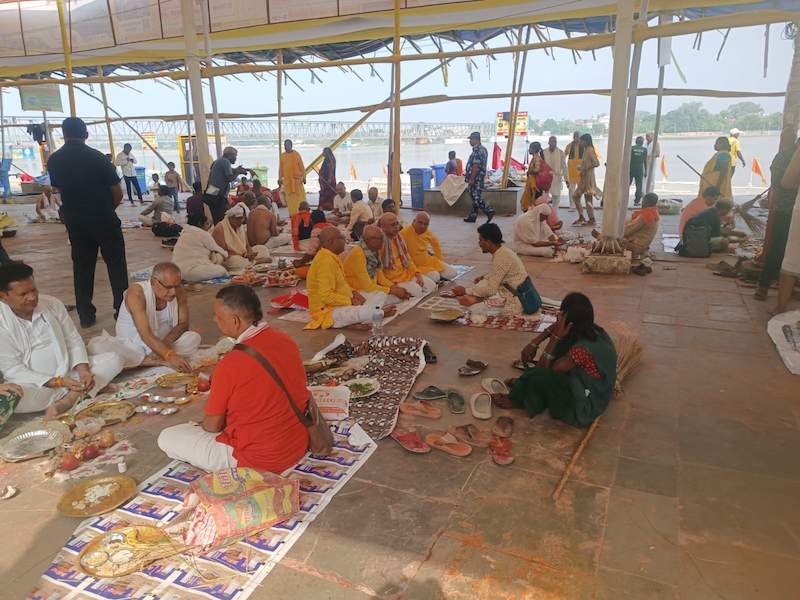
3-Day Pind Daan in Gaya 2027 — All 45 Vedis | ₹25,000
TL;DR: Pitradev arranges the complete 3-Day Gaya Shradh covering all 45 sacred vedis at ₹25,000 per family. This is the most comprehensive Pind Daan available at Gaya — the full Vayu Purana sequence starting at the Falgu River and concluding at Akshayavat (the Immortal Banyan). Day 1 covers the Falgu River circuit, Day 2 covers Pretshila, Ramshila, and the hill vedis, Day 3 covers Vishnupad Temple, Akshayavat, and the concluding vedis. All inclusive — Gayawal Pandit, samagri, dakshina, temple fees, and auto/tempo for travel between vedis. Telugu, Tamil, Hindi, and Odia pandits available.
Why 3 Days — When 1-Day Pind Daan Is Also Available
Pitradev offers 1-day Pind Daan in Gaya from ₹5,000 covering the 3 principal vedis — Falgu River, Vishnupad Temple, and Akshayavat. This is a complete and valid Pind Daan by all traditional standards, and most families who visit Gaya perform this 1-day ceremony.
So why would a family choose the 3-day, ₹25,000 package?
Because the scriptures describe Gaya Shradh as a pilgrimage across the entire Gaya Kshetra — not just the 3 principal sites. The Vayu Purana, the Garuda Purana, and the Agni Purana prescribe 45 sacred vedis (ritual offering points) spread across the Gaya region. Each vedi has a specific deity, a specific mantra, and a specific purpose in the sequence of ancestral liberation. The 1-day ceremony covers the 3 most important vedis. The 3-day ceremony covers all 45.
The difference is not in validity — both are valid. The difference is in completeness. The 3-day Gaya Shradh is the full scriptural circuit. It is what the texts mean when they say “Gaya Shradh liberates seven generations.” It is the ceremony that kings and sages performed when they came to Gaya. And it is the ceremony that gives the family the assurance that nothing was left undone — that every prescribed offering was made, at every prescribed location, in the correct sequence.
Families who choose the 3-day package typically fall into one of these categories:
- The departed had a particularly difficult life or a troubled death, and the family wants the most comprehensive rite available
- The family has not performed Pind Daan for multiple generations, and wants to cover all ancestors thoroughly
- Pitra Dosh has been identified in the family’s kundali, and the pandit or astrologer has recommended the full Gaya Shradh
- The family wants to fulfil the obligation once and completely, rather than returning to Gaya multiple times
The 45 Vedis — What They Are and Why They Matter
A “vedi” is a sanctified ritual point — a specific location in the Gaya Kshetra where the offering of pinds to the ancestors carries scriptural authority. Each vedi is associated with a particular deity (Vishnu, Brahma, Surya, Chandra, the Navagrahas, various forms of Shiva) and a particular step in the sequence of ancestral liberation.
The 45 vedis are not 45 temples. Some are ghats on the Falgu River, some are sacred kunds (ponds), some are hilltop shrines (Pretshila, Ramshila), some are temple courtyards (Vishnupad), and some are sacred trees (Akshayavat). They are spread across the Gaya Kshetra — a geographic area of approximately 5 to 8 kilometres — and covering all of them requires systematic travel over 3 days.
The principal vedis that every family recognises are:
- Falgu River (Devghat) — The sacred river where Mata Sita performed Pind Daan for King Dasharatha. The starting point of the Gaya Shradh circuit. Tarpan and pind offering on the river bank.
- Vishnupad Temple — The temple housing the sacred footprint of Lord Vishnu. The most revered single location in Gaya for Pind Daan.
- Akshayavat (Immortal Banyan) — The eternal tree under which offerings are considered imperishable (“akshaya” = indestructible). The concluding point of the Gaya Shradh.
- Pretshila Hill — The hill shrine specifically prescribed for souls who died an unnatural death (accident, suicide, sudden illness) or who are believed to be in a disturbed state.
- Ramshila Hill — Contains sacred footprints associated with Lord Rama. Pind Daan here is prescribed for specific ancestral afflictions.
- Brahma Kund — The sacred pond near Pretshila, associated with Lord Brahma.
- Sita Kund — The location where Mata Sita is believed to have offered Pind Daan, on the eastern bank of the Falgu River.
- Ram Kund, Uttarmanas, Dakhinmanas — Vedis in the Vishnupad Temple circuit, each with specific planetary and deity associations.
- Gayasir, Gayakup, Mundpristha — The concluding vedis that complete the circuit.
Beyond these, the remaining vedis include deity-specific offering points — Suryapada, Chandrapada, Ganeshpada, Kartikpada, Rudrapada, Vishnupada, Brahmapada — that address the planetary and divine influences on the departed soul.
Covering all 45 vedis in the correct sequence is what distinguishes the 3-day Gaya Shradh from a regular Pind Daan.
Day-by-Day Itinerary — The Complete 3-Day Gaya Shradh
Day 1: Falgu River Circuit
The first day begins at the Falgu River, the foundational vedi of the Gaya Shradh.
Morning: The family arrives at the Falgu River bank (Devghat) with the Gayawal Pandit. The sankalp is taken — the pandit recites the names, gotra, and details of all departed ancestors for whom the Shradh is being performed (up to 3 generations, both father’s side and mother’s side). This sankalp establishes the intention for the entire 3-day ceremony.
Tarpan is performed first — water mixed with black sesame seeds is offered to the ancestors on the river bank.
Pind preparation and offering — Rice ball pinds are prepared and offered with Vedic mantras. Each pind is dedicated to a specific ancestor by name.
Falgu River vedis — The pandit takes the family through the vedis along the Falgu River bank: Devghat, Sita Kund (eastern bank), and the river-adjacent offering points. Pinds are offered at each vedi with specific mantras.
Auto/tempo takes the family to the vedis that are away from the river bank but part of the Day 1 circuit.
Duration: Approximately 4 to 5 hours.
After completing the Day 1 vedis, the family returns to their accommodation and rests. The pandit confirms the schedule for Day 2.
Day 2: Pretshila, Ramshila, and the Hill Vedis
The second day covers the hill vedis — locations that require travel away from the Falgu River bank and Vishnupad area.
Pretshila Hill — Approximately 8 kilometres from Vishnupad Temple. The climb to the Pretshila shrine takes about 20 to 30 minutes. Pind Daan at Pretshila is specifically prescribed for ancestors who died an unnatural death, or whose souls are believed to be in distress. Even for families where the death was natural, the Pretshila offering is part of the complete 45-vedi circuit.
Brahma Kund — At the base of Pretshila Hill. Offerings are made at this sacred pond associated with Lord Brahma.
Ramshila Hill — Contains the sacred footprints of Lord Rama. The Ramshila vedis are covered after Pretshila.
Kagbali, Uttarmanas, Udichi, Kankhal — Additional vedis in this circuit. Each has a specific deity association and mantra.
Auto/tempo is used for travel between the hill vedis, which are spread across the Gaya outskirts.
Duration: Approximately 4 to 5 hours.
Day 3: Vishnupad Temple, Akshayavat, and Concluding Vedis
The third and final day is the culmination of the Gaya Shradh — the offerings at the most sacred vedis and the formal conclusion of the ceremony.
Vishnupad Temple — The family enters the temple and performs Pind Daan at the sacred footprint of Lord Vishnu. This is the most important single offering in the entire 3-day sequence. The pandit guides the family through the Vishnupad-specific mantras and the offering at the footprint.
Temple circuit vedis — Inside and around the Vishnupad Temple complex, the family covers the remaining vedis: Dakhinmanas, Suryapada, Chandrapada, Ganeshpada, Kartikpada, Rudrapada, Brahmapada, Kasyappada, Gajakarna, Gayasir, Gayakup, and others. Each receives a pind offering with specific mantras.
Akshayavat (Immortal Banyan) — The concluding vedi. The final pinds are offered under the eternal banyan tree, where offerings are considered imperishable. The pandit recites the concluding prayers that formally complete the 45-vedi Gaya Shradh.
Sufal Puja — The completion ceremony. The pandit declares that the Gaya Shradh has been completed in full as prescribed in the scriptures. The family receives the ashirvaad (blessing) of the pandit and the assurance that the ancestral debt (Pitra Rin) has been discharged.
Vastra Daan, Patra Daan, and Brahmin Bhojan — The concluding daans are performed. Cloth and utensils are donated, and a Brahmin is fed, completing the Shradh in its fullest form.
Duration: Approximately 4 to 5 hours.
What Is Included in the ₹25,000 Package
The 3-Day Gaya Shradh at ₹25,000 is an all-inclusive package:
- Experienced Gayawal Pandit for all 3 days (dakshina included)
- All puja samagri for all 3 days — rice, sesame, barley flour, flowers, sacred thread, Ganga jal, and all ritual items for every vedi
- Auto/tempo for travel between vedis across all 3 days
- Temple entry fees at Vishnupad Temple and other locations
- Vastra Daan and Patra Daan (Day 3)
- Brahmin Bhojan (Day 3)
- No hidden charges — no additional dakshina requests, no “special fees” at any vedi, no surprise costs at the temple
What is not included:
- Your travel to and from Gaya (train, flight, or bus)
- Your accommodation in Gaya (hotels are available from ₹800 to ₹3,000 per night depending on the type — we can recommend options)
- Your meals during the 3 days
Telugu Shashtri, Tamil Vadhyar, Hindi, and Odia pandits are available. The ceremony is performed in your language and tradition across all 3 days.
Comparing All Gaya Packages — When Each One Fits
Package | Vedis Covered | Duration | Cost | Best For |
1 Place | Falgu River only | 1 to 1.5 hours | ₹5,000 | Families with limited time |
3 Places | Falgu + Vishnupad + Akshayavat | 3 to 4 hours | ₹7,500 | Standard Pind Daan for most families |
4 Places | Falgu + Vishnupad + Akshayavat + Pretshila | Full day | ₹11,000 | Families with unnatural death case |
All 45 Vedis | Complete Gaya Kshetra circuit | 3 days | ₹25,000 | Full scriptural Gaya Shradh |
All packages include pandit charges, samagri, and dakshina. The 3-day package additionally includes auto/tempo, temple fees, Vastra Daan, Patra Daan, and Brahmin Bhojan.
For families who cannot travel to Gaya at all, Online Pind Daan in Gaya is available at ₹11,000 as a private ceremony at the Falgu River with live video call.
How to Reach Gaya
By Train: Gaya Junction is a major railway station connected to Delhi (12 to 15 hours), Kolkata (6 to 8 hours), Varanasi (4 to 5 hours), Patna (2 to 3 hours), and most North Indian cities. The Mahabodhi Express from Delhi and the Rajdhani Express via Gaya are the most common trains families use.
By Flight: Gaya Airport (Bodhgaya Airport) has limited but growing connectivity. Flights from Delhi, Kolkata, and a few other cities are available. The airport is approximately 10 kilometres from Vishnupad Temple.
By Road from Varanasi: Many families combine Varanasi rites with Gaya. The drive from Varanasi to Gaya takes approximately 5 to 6 hours via NH2. Pitradev can arrange the vehicle.
By Road from Patna: Approximately 3 hours by road. Patna has better flight connectivity, and many families fly into Patna and drive to Gaya.
Planning Your 3 Days in Gaya — Practical Advice
Arrive the evening before Day 1. The pandit begins the ceremony on Day 1 morning. Arriving the previous evening gives you time to check into your hotel, rest, and meet the pandit for a briefing on the 3-day schedule.
Carry comfortable footwear. Day 2 involves walking and climbing at Pretshila and Ramshila hills. Sturdy sandals or walking shoes are recommended. The hill climbs are moderate — 20 to 30 minutes — but can be tiring for elderly family members.
White clothing for all 3 days. Men should carry 3 white dhotis and gamchas. Women can wear any traditional Indian attire — white or light-coloured sarees or salwar suits.
Carry names and gotra written on paper. Three generations — father’s side and mother’s side. The pandit will reference this list during the sankalp.
Weather in Gaya. October to February is the most comfortable period. March to May is hot. July to September can have rain, which affects the hill vedis. The ceremony is performed in all seasons — only the comfort level differs.
Combining Varanasi and Gaya
Many families perform Asthi Visarjan and Pind Daan in Varanasi first and then travel to Gaya for the 3-day Shradh. This is the traditional sequence — Kashi for the Ganga immersion and initial rites, Gaya for the comprehensive ancestral liberation.
A suggested combined itinerary:
- Day 1: Arrive Varanasi, Asthi Visarjan and Pind Daan at the Ganga ghat
- Day 2: Travel Varanasi to Gaya (5 to 6 hours by road, or train)
- Day 3 to 5: 3-Day Gaya Shradh at all 45 vedis
- Day 6: Return home from Gaya
Pitradev coordinates the entire Varanasi + Gaya itinerary — the pandit in Varanasi, the travel, and the Gayawal Pandit in Gaya — as a single arrangement. Contact us for the combined cost and schedule.
How to Book the 3-Day Gaya Shradh
- Contact Pitradev on WhatsApp or phone — 7829965737
- Share the names and gotra of the departed ancestors (3 generations, both sides)
- Share your planned travel dates to Gaya
- Confirm the 3-Day package at ₹25,000
- Specify your language preference — Hindi, Telugu, Tamil, or Odia
- Gayawal Pandit name, daily schedule, and hotel recommendations are confirmed
- Arrive Gaya the evening before Day 1. The pandit meets you at the hotel for a briefing.
Book at least 2 to 3 weeks in advance so the pandit’s 3-day schedule can be confirmed for your dates. During Pitru Paksha, book at least 4 to 6 weeks in advance.
Conclusion
The 3-Day Gaya Shradh at all 45 vedis is not the most common Pind Daan — most families perform the 1-day ceremony at 3 vedis, and it is fully valid. But for families who want to discharge the ancestral obligation in its fullest scriptural form — covering every prescribed vedi, every mantra, every offering — the 3-day circuit is what the Vayu Purana describes as the complete Gaya Shradh.
At ₹25,000 with Pitradev, the 3-day package includes the Gayawal Pandit for all 3 days, all puja samagri, auto/tempo for travel between vedis, temple fees, Vastra Daan, Patra Daan, and Brahmin Bhojan. No hidden charges. No additional dakshina requests. No surprises at any vedi.
For families who wish to perform Pind Daan in Gaya in 1 day, packages from ₹5,000 are available. For families who cannot travel, Online Pind Daan in Varanasi is available from ₹3,000.
The scriptures say that after completing the Gaya Shradh at all vedis, no further Pind Daan obligation remains. The ancestors are liberated. The Pitra Rin is discharged. The family is at peace.
May your ancestors find that liberation at Gaya.
Frequently Asked Questions
Shashank Mishra comes with over 15 years of experience in religious tourism and organising Vedic rituals and ancestral ceremonies. At Pitradev, he oversees the coordination of Asthi Visarjan, Pind Daan, Shraadh, Grihapravesh, Vastu Shanti Puja, Satyanarayan Katha, Rudrabhishek, and other sacred rites across Varanasi, Prayagraj, Gaya, Bangalore, Hyderabad, Pune, and Mumbai.
Latest Blog
- 3-Day Pind Daan in Gaya 2027 — All 45 Vedis | ₹25,000
- Same Day Asthi Visarjan in Varanasi 2027 | ₹2,000
- North Indian Pandit in Wakad for All Pujas | ₹3500
- Online Pind Daan in Gaya | Private Puja ₹11,000
- Online Pind Daan in Varanasi | From ₹3,000 – Pitradev
- Can Women Perform Pind Daan in Varanasi?
- Tamil Vadhyar in Bangalore | Book Tamil Iyer Purohit
- Satyanarayana Vratam in Bangalore | Telugu Purohit ₹5100
- Satyanarayana Pooja in Bangalore | Kannada Purohit ₹5100
- Annaprashan in Pune | First Rice Feeding Ceremony ₹4500
- Namkaran Sanskar in Pune | Baby Naming Ceremony ₹5100
- North Indian Pandit in Hinjewadi for All Pujas
- North Indian Pandit in Pimpri-Chinchwad
- Pind Daan in Gaya by Odia Pandit | Odia Shraddha Paddhati
- Vastu Shanti Puja in Pune | 6 Mandals, 2 Pandits | ₹15000
- Gaya Pind Daan vs Varanasi Pind Daan
- Satyanarayan Katha in Pune by North Indian Pandit
- Odia Pandit Prayagraj | Asthi Bisarjan & Pind Daan Same Day
- How to Book Asthi Visarjan in Kashi Online
- Book Pandit Services Online A Complete Step by Step Guide
- Book Verified Pandit Ji in Bangalore for Any Puja Easy Guide
- How to Book a Vastu Pujan Griha Pravesh Puja for Your New Home
- How to Book Pind Daan in Gaya Online Complete Guide
- Pind Daan in Varanasi After Pitru Paksha
- Pind Daan for Dogs in Varanasi: Complete Rituals at Kashi
- Things To Know Before Booking A Pandit for Satyanarayan Puja
- How To Choose Right Muhurat for Griha Pravesh for Your New Home
- 7 Key Rituals and Stages of Pind Daan in Gaya
- Gand Mool Nakshatra Shanti Puja: Complete Process
- Grihapravesh Muhurat in November and December 2026
- Asthi Visarjan in Varanasi for Pets: Dogs And Cats
- Pind Daan in Varanasi: Guide to Ritual, Process, Cost, Booking
- Mistakes to Avoid During Asthi Visarjan in Varanasi
- How to book satyanarayn puja
- Verified South Indian Purohits in Gaya
- Samvatsarikam in Varanasi: Cost and Vidhi
- Best South Indian Purohits in Kashi Varanasi
- Pind Daan in Varanasi by Telugu Purohit
- Telugu Purohit in Gaya: Pind Daan Packages
- Tripindi Shraadh in Gaya
- Pitradev- Hindi, Tamil, Telugu & Bengali Pandit in Bangalore
- Narayan Bali Puja in Gaya
- Can I Do Pind Daan Within One Year of Death?
- One Day Narayan Bali Puja at Trimbakeshwar
- Asthi Visarjan at Manikarnika Ghat in Kashi Varanasi
- Cost of Asthi Visarjan in Varanasi: Packages and Precautions
- Pandit for Tripindi Shradh in Varanasi: 2026 Dates & Cost
- Pind Daan in Gaya in Pitru Paksha 2026: Dates and Packages
- Vastu Shanti Puja Cost in Pune by North Indian Pandit
- Pitra Dosh: Causes, Symptoms and Remedies — A Complete Guide
- How to Find Genuine Tamil Vadhyars in Kashi Varanasi
- How to Carry Asthi in Flight in India?
- Pind Daan in Gaya by Tamil Iyer: Cost, Packages and Process
- Asthi Visarjan in Srirangapatna from Bangalore — Full Guide
- Send Ashes from Coimbatore to Kashi — Asthi Visarjan Service
- Cost of Asthi Visarjan in Prayagraj by Telugu Pandit
- Asthi Visarjan and Pind Daan in Prayagraj for Odia Families
- North Indian Pandit Bangalore for Annaprashan Puja
- Telugu Grihapravesham Bangalore: 4 Packages Cost & Inclusion
- Cost of Tripindi Shraadh in Varanasi -Pishachmochan Kund
- North Indian Pandit in Pune for Grihapravesh: Package Guide
- Pind Daan in Prayagraj: Cost, Vidhi & Booking Guide-2026
- Narayan Bali Puja in Varanasi — Complete Cost Breakdown for 2026
- Book a Verified North Indian Pandit in Pune: Cost & Packages
- How to Send Asthi to Kashi: A Step-by-Step Guide
- Book Tamil Iyer in Bangalore for Grihapravesham – Complete Guide
- How to Plan 10th 11th and 12th Day Rituals in Varanasi
- Pitru Paksha 2026 – Pind Daan in Prayagraj, Kashi and Gaya
- Pitru Paksha 2026 – Book Online Pind Daan in Varanasi
- Asthi Visarjan in Varanasi for Tamil Families – Complete Guide
- How to Send Asthi (Ashes) from USA to India – Complete Guide
- Narayan Bali Puja in Varanasi – Complete Guide 2026
- Pind Daan in Gaya from Malaysia – Complete Guide
- Pind Pradanam in Varanasi from Malaysia – Complete Guide
- Grihapravesh Puja in Bangalore by Kannada Purohit
- Online Pind Daan in Varanasi for NRIs
- Book Verified Telugu Purohits in Bangalore for Grihapravesham
- Best Ghat for Asthi Visarjan in Varanasi: A Practical Comparison
- Asthi Visarjan in Prayagraj – Complete Guide 2026
- Tripindi Shradh in Varanasi – Complete Guide
- Asthi Visarjan in Varanasi –Best Ghat & Package 2026
- Grihapravesh Puja in Prestige City Sarjapur
- Gaya Ji Pind Daan 2026 – Quick Guide for Planning Your Trip
- Online Puja Booking for Griha Pravesh, Shradh & Satyanarayan
- Pitru Paksha 2026 Dates, Rituals and Pind Daan Guide
- Akshaya Tritiya 2026 (19 April): Best Muhurat for Griha Pravesh
- How to Do Asthi Visarjan When You Cannot Travel: Complete Guide
- Asthi Visarjan in Kashi: Complete Guide with Cost & Time
- Griha Pravesh Muhurat 2026: Auspicious Dates & Timings
- Complete Guide to Gaya Pind Daan Ritual, Samagri & Best Time
- Asthi Visarjan By Post in Kashi Varanasi – Complete Guide
- How to Book a Bengali Pandit for Puja: Step-by-Step Process
- Book Verified Pandit for Puja in Bangalore
- Book Verified North Indian Pandit in Hyderabad Online
- Book North Indian Pandit in Bangalore for Satyanarayan Puja
- How to Book a Pandit in Bangalore Online for Puja:Complete Guide
- Find and Book Pandits in Hyderabad for Griha Pravesh Puja Online
- How to Find and Book Experienced Pandit Online for Puja?
- Exploring the History and Origins of Griha Pravesh Puja Rituals
- Top 5 Ancient Places for Gayaji Pind Daan - 2024 Guide
- Significance of Performing Griha Pravesh Puja in Hindu Culture
- How to Choose the Right Pandit for Pind Daan in Gaya
- Why is Pind Daan in Gaya so Famous?
- Where to Find Experienced Pandit for Griha Pravesh Puja Online?
- Cost of Pind Daan in Gaya: Packages, Procedure and How to Book
- Griha Pravesh Puja and Housewarming Ceremony 2024
- How Gaya Pind Daan Brings Closure and Peace to Your Ancestors
- Gayaji Pind Daan: Achieve Eternal Peace for Your Ancestors
- Online Pind daan: Importance, Cost, and Procedure
- Gaya Pind Daan Puja is Performed by an Experienced Pandit ji
- The Sacred Ritual of Brahma Kapal Pind Daan
- A Complete Guide About Pind Daan in India: Update 2023
- Unveiling the Significance of Pind Daan in Gaya
- The Ultimate Guide to Pind Daan Tour Packages
- Where to do Asthi Visarjan in Haridwar?
- Rudrabhishek Pooja Why Hindus Perform Rudrabhishek pooja At home
- Varanasi's Asthi Visarjan: Embracing Life's Eternal Journey
- Unveiling the Sacred Ritual:
- Significance of Asthi Visarjan in Haridwar
- Exploring the Profound Significance of Asthi Visarjan in Kashi
- The Science of Pind Daan:
- What are the rituals of Pind Daan?
- Varanasi Ayodhya Tour Package with Prayagraj
- Pind Daan Puja in Varanasi | Book Your Puja Online
- Prayagraj: The Enchanting Journey of Asthi Visarjan
- Pind Daan Gaya : When and Where to Do Pind Daan in Gayaji
- Exploring the Mystical Rituals of Asthi Visarjan Poojan
- Which are the Best Places to do Pind Daan in Gaya?
- Everything You Need to Know About Rudrabhishek Puja
- Why Is Pind Daan At Gaya Important To Hindus?
- Asthi Visarjan: When to Perform It, Where to Go, and Cost
- Rudra Abhishek Puja's Purpose:
- Ganga Pushkaralu 2023
- Pind daan for people having unnatural deaths
- Is doing pind daan beneficial without self presence of related?